Unwinding in Sikkim
Text by daffydil, pictures by heng
Copyright © Daffydil Tan.
All rights reserved.
Home /
Album/
Blog /
Collections /
Flickr/
Haiku /
Heritage /
Jade /
Reflections/
Sale/
Travel
|
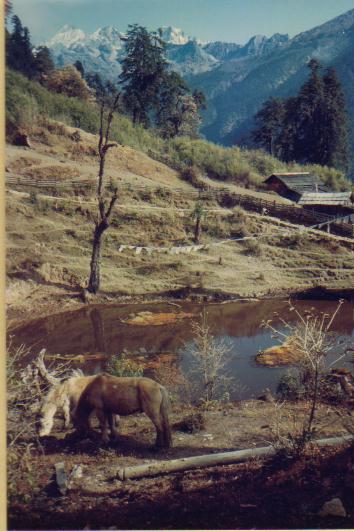
Prayer flags flutter from homesteads
in spiritual Sikkim |
"fish say they have their stream and pond but is there any life beyond?"
With this quote from Rupert Brooke in mind we shed our inhibitions and our natural habitat of urban Singapore for Sikkim's narrow serpentime roads, sheer cliffs, serrated mountains and turbulent rivers. Our 2 week tour cum trek was organised by a Sikkimese tour company, Foothills Adventure with whom we had corresponded for over a year. The company based in the capital Gangtok conducted business with the simple faith of innocent folks such is life like in Sikkim. Though small and obscure they were no fly-by-night operators and we found to our delight that we were not expected to pay a single cent until the last day of our trip. Our holiday started with a trek at the hamlet of Yuksam,which is the base of all treks in West Sikkim. Yuksam meaning three lamas derives its name from the historical meeting of the three Learned Lamas who came togeter for the coronation of Sikkim's first king in 1641. A stupa and monastery has beern erected to mark this consecrated spot and the stone throne from the first coronation is still intact. |
|
THE TREK
Yuksam-Dzongri
|
Most tracks from Yuksam are bound for Dzongri, a two-day march away. The trail winds steeply though pure wilderness of pine, rhododendron, fir and oak forests,of waterfalls and streams. Not surprisingly, rare creatures like the red panda, blue sheep and snow pigeon make their home here.
Unlike Nepalese tracks this was no Kleenex trail! According to the park warden,the routes are kept in pristine condition by constant cleaning and maintenance, not forgetting the relatively smaller number of trekkers.Sunlight hours are short in late Autumn and each day we had to reach our destination before 5pm or face the ordeal of groping round cliffs and ravines in total darkness. At 4030m Dzongri is the place for closeup views of Mt. Kanchenjunga, the third highest Himalayan mountain, where we were headed. But we never arrived there, as at various points of time, members of our group of six fractious individuals, ages 12-50 succumbed to illness, fatigue as well as a broken toe. |
|
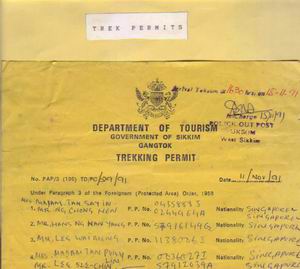
Trek permits.
|
The Tibetan Villlage of
Tshoka
However we made a refreshing two-day stop at the tiny Tibetan village of Tshoka,the last inhabited settlement on the route. There our accommodation was a simple trekkers' lodge, a short distance from the village.It was spartan lodging, but we weren't complaining because behind the lodge were the snowy peaks of Kanchenjungaand Pandim Whenever the clouds parted - unfortunately not often it was like the God's smiling down on us. In fact in Sikkim, Kanchenhunga is worshipped as a God and considered the Abode of Gods. That's why foreign expeditions attempting to scale this mountain are obliged to stop short of the summit in deference to local beliefs.Tshokavillage stands at 3200m and consists of ten tibetan homesteads and one monastery, clustered on a slope.Wooden hedges fence in a rural scene of vegetable and potato plots, grazing horses and women hoeing the land.
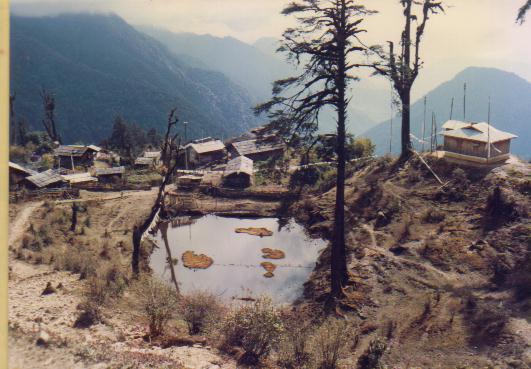
Time stands still in the village of Tshoka |
Over all this ascetic Buddhist prayer flags flutter in the wind, mutely beseeching the heavens.There's no electricity and running water and the temperature is a numbing -2 degree.Life is surely not easy so it must be our urban minds that paint utopic pictures of rustic living. But for our group who did not have to get up early to tend to animals or the land, the mornings were quite sublime - with frost on the ground and the whole world locked in a quietness so deep, one could break one's heart just listening to the sounds of silence.
|
|
Walking with Devotees to
Kechoepalri Lake
After the Holy Mountain, our next stop was the sacred Kechoepalri Lake also known as the 'Wish-Fulfilling Lake. Although its set in the middle of a wood and surrounded by dense foliage, not a single leaf disturbs its clear, blue-green waters. The birds inhabiting the nearby forests are said to act as 'guardians' by removing any waste which falls into the lake.
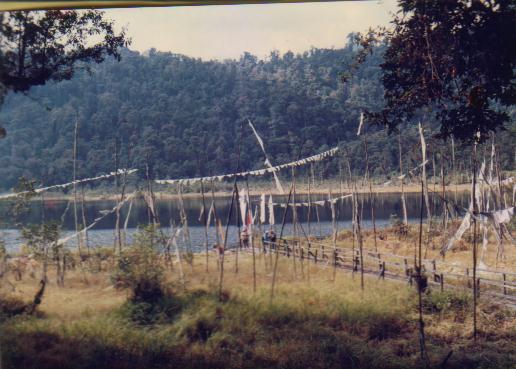 Wishes will come true at Kechoepalri the Wish Fullfilling Lake
Prayer flags strung from trees formed a hallowed canopy overhead,while below holy stupas lined the path leading to the lakeside.Together they created a spiritual mood.This caused devout pilgrims to tread quietly, as they came bearing unworldly gifts - fistful of wild blossoms,incense sticks,butter lamps and prayer flags.
The pervasive religious mood was enchanting and we soonfound ourselves shedding our cynicism and citylife complexities, and joinedinwith the devotees to cast our wishes - actually believing all our dreams would come true.
The Wheels and Road Journey
Pemayangtse
A two hour drive led us to Pemayangtse,the old Sikkimese capital, another ideal spot for mountain reflection and where on a clear day you can see the mountains forever.
Perched just above the town the Pemayangtse Monastery is Sikkim's second oldest monastery. It features beautiful wall frescoes and shelves lined with holy sutras. Especially is the Santhokpelri, a huge wooden structure depicting a vision of Paradise, which occupies one roomon the topmost storey. The holy man, Dunzin Ringpoche,was the inspiration behind this feat of art which was entirely handcarved and took five years to complete.
Gangtok
Our last stop was Gangtok, the Sikkimese capital. With a population of 45,000, this is the only place in Sikkim that actually bustles and looks crowded.
Standing 1,520m high, the town is built on a slope, with modern houses tumbling down in haphazard fashion. In contrast, are the bazaars teeming with local color - and they are the nucleus of life in Gangtok. Our group picked up some good bargains - woollen goods, Sikkimese tea, Tibetan handicrafts and religious objects.
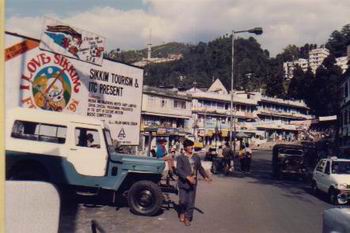
Street Scene, Gangtok |
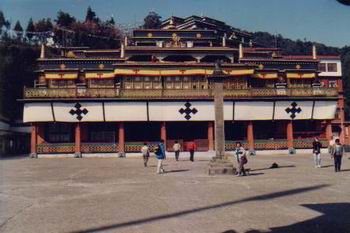
Rumtek, Center of Spiritual Energy |
Sikkim's largest and most active monastery - Rumtek Monastery is 24km away fromGangtok. The buildings are modelled on its original headquarters in Tibet and are a good example of Tibetan architecture shimmering in resplendent colours of red, gold and turquoise.
Such is the religious lure of Rumtekthat it has drawn a Singaporean withinits monastic walls. This lama whom we had the affinity to meet has overcome the cultural differences and language problems and adapted to the meditative life in Rumtek
ABOUT SIKKIM
Today Sikkim tends to be overshadowed by its more famous and bigger Himalayan neighbours, Tibet, Nepal and Bhutan,but back in the 1960s, before it became the 22nd State of India(in 1975), Sikkim was a monarchy which made news inthe western world's media because its King was married to a beautiful American socialite called Hope.
What's nice about Sikkim is that it is a well balanced state, unspoilt and wooing tourists in manageable proportion, unlike Bhutan which does not actively promote tourism and Nepal with its overheated tourist industry.
Accommodation is provided in comfortable and modest three star hotels or well-maintained government resthouses.Its people still keep the traditional ways and practice gentle hospitality. Buddhism - Tibetan style dominates Sikkim life and it's not surprising to find about 200 monasteries scattered throughout the land.
Sikkim has scarcely a km of flat land. But most towns and villages are accessible,thanks to a wide network of highways and roads.
Not all parts of Sikkim are open to foreigners. Our 15 day permit allowed us to visit West, East and parts of South Sikkim.
Most major international airlines fly to Calcutta or New Delhi where domestic flights take you to Bagdogra, the airport nearest to Sikkim.
Home /
Album/
Blog /
Collections /
Flickr/
Haiku /
Heritage /
Jade /
Reflections/
Sale/
Travel