Heating Tropical Tanks
Why a heater
You might be wondering what it is about heating in a tropical fish tank.
Tropical as the name suggests is a warm water species tank. Suppose you are living in a
tropical region, you do not need to heat the water as the ambient
temperature is high enough to keep the water warm and seasonal changes do not vary much. But
if you are living in a place that has cold climate or has winter season when the ambient can
really become cold, then you will need heaters to keep the water temperature
high and prevent freezing of water. Tropical fish species cannot live in cold waters. The
normal temperature you have to maintain in a tropical tank will be 75F to 80F. Fluctuating water
temperatures will cause stress on the fish, which will lead to a number of infections, and even death.
Type of heater

Tank Heter
-Ebo Jager
| 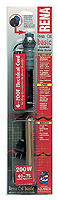
Tank Heater
-Rena Cal basic
| 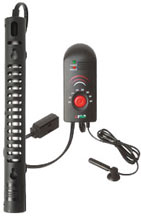
Silica Glass power heater & Controller
|
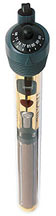
Electric submersible heaters are the best for this purpose. They come in sealed glass tubes
with thermostat and temperature setting knob, which can be immersed in the water and attached to the side of a
tank . The heater tube should always be placed inclined at 45 deg angle or buried in the
sand horizontally for uniform heat distribution in water. They should not be placed
vertically. For larger tanks two heaters may be necessary. Wattage will depend on how
low your ambient can go. Typical wattage requirement will be 5 watts per Gallon of water.
Typically, one heater is sufficient for an aquarium. However, for better heat distribution
in larger aquariums, especially tanks more than 36 inches in length, it's best to have two heaters.
The heaters should be placed at opposite ends of the tank and each should be about half the total
required wattage. For example, if you have a 30 gallon aquarium, you will have the best heat
distribution is you put a 75-watt heater at each end of your aquarium. If you have a 10-gallon
aquarium, one 50-watt heater placed in the center of the aquarium will be enough.
If you use a power filter or a canister filter with only one heater, place the heater
at the opposite end of the tank from the filter. This will help ensure good distribution
of the heated water.
Aquarium heaters come in different tube lengths to accommodate different height tanks.
Because heat rises it is important that you pick the right length heater so that all the
water is evenly heated.
When selecting a heater for your setup, do not buy more power than you need. If the heater
is too powerful for the size of the aquarium, the heater will cycle more often and will wear
out sooner. It is possible, if unlikely, for the heater to fail where it is on continuously.
The better heaters have a safety feature that will prevent overheating should the main
thermostat fail. You should look for this feature in any heater that you buy. Some heaters come
with a protective gaurd, as shown above, so that damage by accident is avoided.
The heating capacity is dependant on various factors. The following factors hereby have to be taken into account.
- Room temperature :
The heating capacity needed is the difference between the surrounding temperature and the desired water temperature.
- Closed or open aquarium :
The heat loss from an open aquarium (thermal discharge, drafts, evaporation) has to be constantly replaced by the heater.
- Lighting :
Fluorescent tubes give off up to 60 % of their power rating as warmth to the water. Similar heating effects
apply to other types of illumination.
- Additional sources of heat :
Internal filters and submersile pumps directly give off motor heat to the water. Similar heating
capacity required is therefore correspondingly less.
- Aquarium size :
The temperature increase in relation to the heating capacity cannot be proportionately equated to
the water quantity. For example, if one applies the rule of thumb of '5W per Gallon' a small aquarium
will be inadequately heated, while a larger tank can be overheated. An aquarium which is twice as big by
no means requires double amount of heating.
Temperature control-it is definitely recommendable to use a thermostat-controlled heating
source which ensures a constant water temperature: for instance thermo filters, regulated bar heaters
or floor heating.
CAUTION
Beware that a Glass tube heater could be very dangerous, if it is exposed without water and power on, it might
break the glass and could cause electrocution. While changing water, it is advisable to turn off the
power to the heater before you open the tank hood and start putting your hand inside. The power should
be turned on only after the re-filling is completed and all re-arrangement inside is over.
Heater Selection guide
Heater- Tronic
|
| Tank Size(G)
| Heater Wattage(W)
| Heater Length
|
| 10-15
| 50
| 9"
|
| 15-20
| 75
| 10"
|
| 20-30
| 100
| 12"
|
| 30-45
| 125
| 12"
|
| 40-60
| 150
| 13"
|
| 60-90
| 200
| 15"
|
| 90+
| 250
| 17"
|
You can plug the heater chord to the socket outlet in the tank
cover. This is a must for those who want to keep tropical fishes in cold regions.
But remember you cannot have long power blackouts, for this will cause your tank
temperature to drop below the level necessary for tropical fish to survive. Purchase a
good quality heater as any failure can cause the temperature to drop and cause the death
of the fishes or can cause electrical shock if you put your hand inside for maintenance. See
the great article from 2Many on heaters, under articles section.
Heater and thermostat can also aid in increasing the tank temperature to
get rid of certain parasites or to give relief to fishes from some internal bacterial
problems.
Integrated filter and Heater
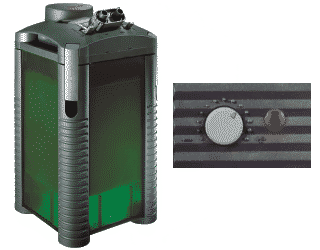
Filter cum Heater
-EHEIM Professional
| 
Filter cum Heater
Internals
|
Now new model filters are available with integral heater facility. This takes
care of heating the filtered water. EHEIM filer provides this facility, may be a few others
are also providing this. I do not know if this has any special advantage over immersion type
filters
Thermometer
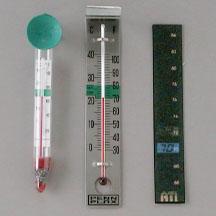
Thermometer
-Glass, Stick on Film
| 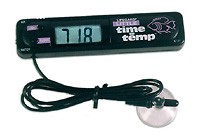
Thermometer
-Digital
|
An essential item for heated tanks in cold countries, but only an added
feature in a real tropical tank in a tropical country. Thermometers are available for
aquarium use and usually are made of glass with a liquid filled inside. There are also
stripes of heat sensitive films which can be stick to the outside glass surface. There are also
digital thermometers with the liquid filled bulb placed inside water. The liquid
in glass thermometer can break if the fish bump them against the glass or rocks. But they are
very accurate and work for many years. The heat sensitive film based thermometers are safe
but often are less accurate and never work after a few months. Never place a thermometer
near the heater as it can show false readings.
------------------ END -------------------