|
|
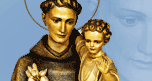
THE MIRACLES OF ST ANTHONY OF PADUA
St. Anthony was born in Portugal in 1195; on 15th August according to Baroque tradition. He was the son of the nobleman, Martino de Buglioni and Donna Maria Taveira, who lived a few metres away from the cathedral. He was christened with the name Fernando.
He spent his formative years under the cultured guidance of the canons of the cathedral. Many of his school companions were boys who were considering the priesthood as a career. It is likely that young Fernando's commitment to join the priesthood was born among his close friends.
In fact, the moral mediocrity and corruption of the society around him convinced Anthony to choose this path.
He entered the Augustinian monastery of St. Vincent, outside the walls of Lisbon, where he lived uncompromisingly according to his evangelical ideal.
Among the Augustinians
He stayed at St. Vincent for approximately two years. But, distracted by continuous visits from friends, he asked to be transferred elsewhere. He thus undertook his first great journey to Coimbra, then the capital of Portugal. The new monastery of Santa Cruz was about 230 km from Lisbon.
He was seventeen years old and was to live in this monastery of nearly 70 members for eight years from 1212 to 1220.
These were very important years in the young saint's humanistic and intellectual development. He was surrounded with good teachers and a vast, up-to-date library.
Fernando completely dedicated himself to the study of human and theological sciences in an attempt to remove himself from the tensions in the community. The years in Coimbra left a deep mark on the future apostle's personality and existential development.
Moreover, he already began to show signs of his solitary nature. He was a man indifferent to outward appearances and ostentations of any kind, without social ambitions or a desire to be seen in public, unless spurred on by the duty of spreading the Gospel. When it was time to leave Coimbra, he had become a man of mature stature.
His theological training, based on a solid biblical and patristic tradition, had been firmly engrained.
Fernando the priest
Fernando was ordained a priest in the monastery of Santa Cruz in Coimbra, probably in 1220.This would have made him twenty-five years old, and it thus appears that the canonical rule which forbids ordination before the age of thirty was for some reason waived for Fernando.
St. Anthony is known as the performer of miracles, or the wonder worker. Better known as the Saint of miracles.
Miracle derives from the Latin mirari, to marvel. It indicates an event which surprises whomever witnesses it directly or indirectly. In the environment of Catholic theology, a miracle is defined as a tangible act (i.e. something which is heard, seen, touched, experienced by the person), performed by God through a saint, a fact which goes against, or rather beyond common "laws" of nature, as acknowledged by the particular era in which they occur.
  
|