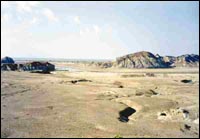
The Makran coast is balochistan`s southern strip and stretches for 754 kms. long sandy beaches,
Rugged promontories and tidal creeks characterize the coast-line. There ranges of hills, rising to over
1500 meter (5000feet), run parallel to the coast : the coastal makran range, 30 kms inland; the
Central makran range, 130 kms inland; and the siahan range, 200 kms away from the sea. There
Is very little rain in the Makran region; the few villages and towns along the coast and between the hills are sustained By spring water.
Many of the Makran people dark -skinned and have african Futures. The are probably descended from salves brought By arab merchants to the subcontinent. They subsist on fishing, date farming and camel breeding. Most of The men Work part-time in the gulf state and Oman, and send money home to their families.
Alexander the great marched half his army home along the inhospitable Makran coast in 325 BC, and Muhammad bin Qasim came from Baghdad, to sindh through Makran in 711 AD. The Makranis stood firm against the mughals,
But bowed nominally to the British Raj. it is only since 1971 that some effort has been made to develop the region .
There is no road along the coast, but daily flights connect the four main coastal towns of Ormara, Pasni, Gwadar And Jiwani with Karachi, and there are flights to quetta three times a week, Gwadar and Jiwani. both picturesque towns Flanked by cliffs and beeches, belonged to Oman for about 200 years. The Khan of kallat gave them as a present to The sultan in the 18th century, and in 1958 they were sold back to pakistan. Ormara is currently being developed as Major port. Turbat , the divisional headquarters for Makran, is a small inland town near the hills, With Little to recommend it but its 300 varieties of dates. Turbat is accessible by a rough road from lasbela, and by daily Flights from Karachi and quetta. panjgur, the principle date-growing area further north, can also be reached by air.
The track from khuzdar to panjgur is very rough.
|