 |
 |
|
|
|
strategy - SWOT analysisDefinition: SWOT is an abbreviation for Strengths, Weaknesses, Opportunities and Threats SWOT analysis is an important tool for auditing the overall strategic position of a business and its environment. Once key strategic issues have been identified, they feed into business objectives, particularly marketing objectives. SWOT analysis can be used in conjunction with other tools for audit and analysis, such as PEST analysis and Porter's Five-Forces analysis. It is also a very popular tool with business and marketing students because it is quick and easy to learn. The Key Distinction - Internal and External Issues Strengths and weaknesses are Internal factors. For example, a strength could be your specialist marketing expertise. A weakness could be the lack of a new product. Opportunities and threats are external factors. For example, an opportunity could be a developing distribution channel such as the Internet, or changing consumer lifestyles that potentially increase demand for a company's products. A threat could be a new competitor in an important existing market or a technological change that makes existing products potentially obsolete. it is worth pointing out that SWOT analysis can be very subjective - two people rarely come-up with the same version of a SWOT analysis even when given the same information about the same business and its environment. Accordingly, SWOT analysis is best used as a guide and not a prescription. Adding and weighting criteria to each factor increases the validity of the analysis. Areas to Consider Some of the key areas to consider when identifying and evaluating Strengths, Weaknesses, Opportunities and Threats are listed in the example SWOT analysis below: |
| Primary Activity | Description |
|
Inbound logistics
|
All those activities concerned with receiving and storing externally
sourced materials
|
|
Operations
|
The manufacture of products and services - the way in which resource
inputs (e.g. materials) are converted to outputs (e.g.
products)
|
|
Outbound logistics
|
All those activities associated with getting finished goods and services
to buyers
|
|
Marketing and sales
|
Essentially an information activity - informing buyers and consumers about
products and services (benefits, use, price etc.)
|
|
Service
|
All those activities associated with maintaining product performance after
the product has been sold
|
Support Activities
Support activities include:
|
Secondary Activity
|
Description
|
|
Procurement
|
This concerns how resources are acquired for a business (e.g. sourcing and
negotiating with materials suppliers)
|
|
Human Resource Management
|
Those activities concerned with recruiting, developing, motivating and
rewarding the workforce of a business
|
|
Technology Development
|
Activities concerned with managing information processing and the
development and protection of "knowledge" in a business
|
|
Infrastructure
|
Concerned with a wide range of support systems and functions such as
finance, planning, quality control and general senior management
|
Steps in Value Chain Analysis
Value chain analysis can be broken down into a three sequential steps:
(1) Break down a market/organisation into its key activities under each of the major headings in the model;
(2) Assess the potential for adding value via cost advantage or differentiation, or identify current activities where a business appears to be at a competitive disadvantage;
(3) Determine strategies built around focusing on activities where competitive advantage can be sustained

Introduction
The Ansoff Growth matrix is a tool that helps businesses decide their product and market growth strategy.
Ansoff’s product/market growth matrix suggests that a
business’ attempts to grow depend on whether it markets new or existing
products in new or existing markets.

The output from the Ansoff product/market matrix is a series of suggested growth strategies that set the direction for the business strategy. These are described below:
Market penetration
Market penetration is the name given to a growth strategy where the business focuses on selling existing products into existing markets.
Market penetration seeks to achieve four main objectives:
• Maintain or increase the market share of current products – this can be achieved by a combination of competitive pricing strategies, advertising, sales promotion and perhaps more resources dedicated to personal selling
• Secure dominance of growth markets
• Restructure a mature market by driving out competitors; this would require a much more aggressive promotional campaign, supported by a pricing strategy designed to make the market unattractive for competitors
• Increase usage by existing customers – for example by introducing loyalty
schemes
A market penetration marketing strategy is very much about “business as usual”.
The business is focusing on markets and products it knows well. It is likely to
have good information on competitors and on customer needs. It is unlikely,
therefore, that this strategy will require much investment in new market
research.
Market development
Market development is the name given to a growth strategy where the business seeks to sell its existing products into new markets.
There are many possible ways of approaching this strategy, including:
• New geographical markets; for example exporting the product to a new country
• New product dimensions or packaging: for example
• New distribution channels
• Different pricing policies to attract different customers or create new market segments
Product development
Product development is the name given to a growth strategy where a business aims to introduce new products into existing markets. This strategy may require the development of new competencies and requires the business to develop modified products which can appeal to existing markets.
Diversification
Diversification is the name given to the growth strategy where a business markets new products in new markets.
This is an inherently more risk strategy because the business is moving into markets in which it has little or no experience.
For a business to adopt a diversification strategy, therefore, it must have a clear idea about what it expects to gain from the strategy and an honest assessment of the risks.
Introduction
The business portfolio is the collection of businesses and products that make up the company. The best business portfolio is one that fits the company's strengths and helps exploit the most attractive opportunities.
The company must:
(1) Analyse its current business portfolio and decide which businesses should receive more or less investment, and
(2) Develop growth strategies for adding new products and businesses to the portfolio, whilst at the same time deciding when products and businesses should no longer be retained.
Methods of Portfolio Planning
The two best-known portfolio planning methods are from the Boston Consulting Group (the subject of this revision note) and by General Electric/Shell. In each method, the first step is to identify the various Strategic Business Units ("SBU's") in a company portfolio. An SBU is a unit of the company that has a separate mission and objectives and that can be planned independently from the other businesses. An SBU can be a company division, a product line or even individual brands - it all depends on how the company is organised.
The Boston Consulting Group Box ("BCG Box")
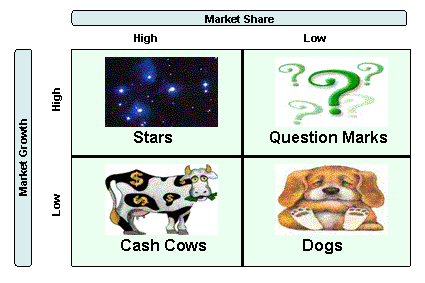
Using the BCG Box (an example is illustrated above) a company classifies all its SBU's according to two dimensions:
On the horizontal axis: relative market share -
this serves as a measure of SBU strength in the market
On the vertical axis: market growth rate - this provides a measure of market attractiveness
By dividing the matrix into four areas, four types of SBU can be distinguished:
Stars - Stars are high growth businesses or products competing in markets where they are relatively strong compared with the competition. Often they need heavy investment to sustain their growth. Eventually their growth will slow and, assuming they maintain their relative market share, will become cash cows.
Cash Cows - Cash cows are low-growth businesses or products with a relatively high market share. These are mature, successful businesses with relatively little need for investment. They need to be managed for continued profit - so that they continue to generate the strong cash flows that the company needs for its Stars.
Question marks - Question marks are businesses or products with low market share but which operate in higher growth markets. This suggests that they have potential, but may require substantial investment in order to grow market share at the expense of more powerful competitors. Management have to think hard about "question marks" - which ones should they invest in? Which ones should they allow to fail or shrink?
Dogs - Unsurprisingly, the term "dogs" refers to businesses or products that have low relative share in unattractive, low-growth markets. Dogs may generate enough cash to break-even, but they are rarely, if ever, worth investing in.
Using the BCG Box to determine strategy
Once a company has classified its SBU's, it must decide what to do with them. In the diagram above, the company has one large cash cow (the size of the circle is proportional to the SBU's sales), a large dog and two, smaller stars and question marks.
Conventional strategic thinking suggests there are four possible strategies for each SBU:
(1) Build Share: here the company can invest to increase market share (for example turning a "question mark" into a star)
(2) Hold: here the company invests just enough to keep the SBU in its present position
(3) Harvest: here the company reduces the amount of investment in order to maximise the short-term cash flows and profits from the SBU. This may have the effect of turning Stars into Cash Cows.
(4) Divest: the company can divest the SBU by phasing it out or selling it - in order to use the resources elsewhere (e.g. investing in the more promising "question marks").
Definition
Benchmarking is the process of identifying "best practice" in relation to both products (including) and the processes by which those products are created and delivered. The search for "best practice" can taker place both inside a particular industry, and also in other industries (for example - are there lessons to be learned from other industries?).
The objective of benchmarking is to understand and evaluate the current position of a business or organisation in relation to "best practice" and to identify areas and means of performance improvement.
The Benchmarking Process
Benchmarking involves looking outward (outside a particular business, organisation, industry, region or country) to examine how others achieve their performance levels and to understand the processes they use. In this way benchmarking helps explain the processes behind excellent performance. When the lessons learnt from a benchmarking exercise are applied appropriately, they facilitate improved performance in critical functions within an organisation or in key areas of the business environment.
Application of benchmarking involves four key steps:
(1) Understand in detail existing business processes
(2) Analyse the business processes of others
(3) Compare own business performance with that of others analysed
(4) Implement the steps necessary to close the performance gap
Benchmarking should not be considered a one-off exercise. To be effective, it must become an ongoing, integral part of an ongoing improvement process with the goal of keeping abreast of ever-improving best practice.
Types of Benchmarking
There are a number of different types of benchmarking, as summarised below:
|
Type
|
Description
|
Most Appropriate for the Following Purposes
|
|
Strategic Benchmarking
|
Where businesses need to improve overall performance by examining the
long-term strategies and general approaches that have enabled
high-performers to succeed. It involves considering high level aspects
such as core competencies, developing new products and services and
improving capabilities for dealing with changes in the external
environment. Changes resulting from this type of benchmarking may be
difficult to implement and take a long time to materialise
|
- Re-aligning business strategies that have become inappropriate
|
|
Performance or Competitive Benchmarking
|
Businesses consider their position in relation to performance
characteristics of key products and services. Benchmarking partners
are drawn from the same sector. This type of analysis is often undertaken
through trade associations or third parties to protect confidentiality.
|
_ Assessing relative level of performance in key areas or activities in
comparison with others in the same sector and finding ways of closing gaps
in performance
|
|
Process Benchmarking
|
Focuses on improving specific critical processes and operations.
Benchmarking partners are sought from best practice organisations that
perform similar work or deliver similar services. Process benchmarking
invariably involves producing process maps to facilitate comparison and
analysis. This type of benchmarking often results in short term benefits.
|
- Achieving improvements in key processes to obtain quick benefits
|
|
Functional Benchmarking
|
Businesses look to benchmark with partners drawn from different business
sectors or areas of activity to find ways of improving similar functions
or work processes. This sort of benchmarking can lead to innovation and
dramatic improvements.
|
- Improving activities or services for which counterparts do not exist.
|
|
Internal Benchmarking |
involves benchmarking businesses or operations from within the same
organisation (e.g. business units in different countries). The main
advantages of internal benchmarking are that access to sensitive data and
information is easier; standardised data is often readily available; and,
usually less time and resources are needed. There may be fewer barriers to
implementation as practices may be relatively easy to transfer across the
same organisation. However, real innovation may be lacking and best in
class performance is more likely to be found through external
benchmarking.
|
- Several business units within the same organisation exemplify good
practice and management want to spread this expertise quickly, throughout
the organisation
|
|
External Benchmarking
|
involves analysing outside organisations that are known to be best in
class. External benchmarking provides opportunities of learning from those
who are at the "leading edge". This type of benchmarking can take up
significant time and resource to ensure the comparability of data and
information, the credibility of the findings and the development of sound
recommendations.
|
- Where examples of good practices can be found in other organisations and
there is a lack of good practices within internal business units
|
|
International Benchmarking
|
Best practitioners are identified and analysed elsewhere in the world,
perhaps because there are too few benchmarking partners within the same
country to produce valid results. Globalisation and advances in
information technology are increasing opportunities for international
projects. However, these can take more time and resources to set up and
implement and the results may need careful analysis due to national
differences
|
- Where the aim is to achieve world class status or simply because there
are insufficient"national" businesses against which to benchmark.
|
The business portfolio is the collection of businesses and products that make up the company. The best business portfolio is one that fits the company's strengths and helps exploit the most attractive opportunities.
The company must:
(1) Analyse its current business portfolio and decide which businesses should receive more or less investment, and
(2) Develop growth strategies for adding new products and businesses to the portfolio, whilst at the same time deciding when products and businesses should no longer be retained.
The two best-known portfolio planning methods are the Boston Consulting Group Portfolio Matrix and the McKinsey / General Electric Matrix (discussed in this revision note). In both methods, the first step is to identify the various Strategic Business Units ("SBU's") in a company portfolio. An SBU is a unit of the company that has a separate mission and objectives and that can be planned independently from the other businesses. An SBU can be a company division, a product line or even individual brands - it all depends on how the company is organised.
The McKinsey / General Electric Matrix
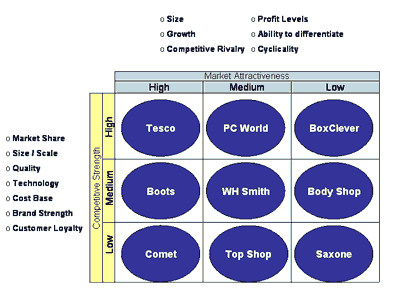
The McKinsey/GE Matrix overcomes a number of the disadvantages of the BCG Box. Firstly, market attractiveness replaces market growth as the dimension of industry attractiveness, and includes a broader range of factors other than just the market growth rate. Secondly, competitive strength replaces market share as the dimension by which the competitive position of each SBU is assessed.
The diagram below illustrates some of the possible elements that determine market attractiveness and competitive strength by applying the McKinsey/GE Matrix to the UK retailing market:
Factors that Affect Market Attractiveness
Whilst any assessment of market attractiveness is necessarily subjective, there are several factors which can help determine attractiveness. These are listed below:
- Market Size
- Market growth
- Market profitability
- Pricing trends
- Competitive intensity / rivalry
- Overall risk of returns in the industry
- Opportunity to differentiate products and services
- Segmentation
- Distribution structure (e.g. retail, direct, wholesale
Factors that Affect Competitive Strength
Factors to consider include:
- Strength of assets and competencies
- Relative brand strength
- Market share
- Customer loyalty
- Relative cost position (cost structure compared with competitors)
- Distribution strength
- Record of technological or other innovation
- Access to financial and other investment resources
Introduction
This model is similar in some respects to the well-established Ansoff Model. However, it looks at growth strategy from a slightly different perspective.
The McKinsey model argues that businesses should develop their growth strategies based on:
• Operational skills
• Privileged assets
• Growth skills
• Special relationships
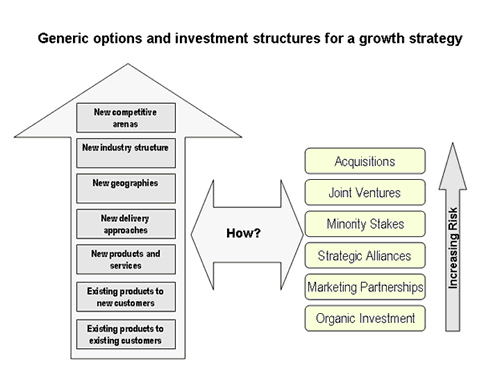
Growth can be achieved by looking at business opportunities
along several dimensions, summarised in the diagram below:
• Operational skills are the “core competences” that a business has which can provide the foundation for a growth strategy. For example, the business may have strong competencies in customer service; distribution, technology.
• Privileged assets are those assets held by the business that are hard to replicate by competitors. For example, in a direct marketing-based business these assets might include a particularly large customer database, or a well-established brand.
• Growth skills are the skills that businesses need if they are to successfully “manage” a growth strategy. These include the skills of new product development, or negotiating and integrating acquisitions.
• Special relationships are those that can open up new options. For example, the business may have specially string relationships with trade bodies in the industry that can make the process of growing in export markets easier than for the competition.
The model outlines seven ways of achieving growth, which are summarised below:
Existing products to existing customers
The lowest-risk option; try to increase sales to the existing customer base; this is about increasing the frequency of purchase and maintaining customer loyalty
Existing products to new customers
Taking the existing customer base, the objective is to find entirely new products that these customers might buy, or start to provide products that existing customers currently buy from competitors
New products and services
A combination of Ansoff’s market development & diversification strategy – taking a risk by developing and marketing new products. Some of these can be sold to existing customers – who may trust the business (and its brands) to deliver; entirely new customers may need more persuasion
New delivery approaches
This option focuses on the use of distribution channels as a possible source of growth. Are there ways in which existing products and services can be sold via new or emerging channels which might boost sales?
New geographies
With this method, businesses are encouraged to consider new geographic areas into which to sell their products. Geographical expansion is one of the most powerful options for growth – but also one of the most difficult.
New industry structure
This option considers the possibility of acquiring troubled competitors or consolidating the industry through a general acquisition programme
New competitive arenas
This option requires a business to think about opportunities to integrate vertically or consider whether the skills of the business could be used in other industries.
The Increasing Awareness of the Importance of Corporate Culture:
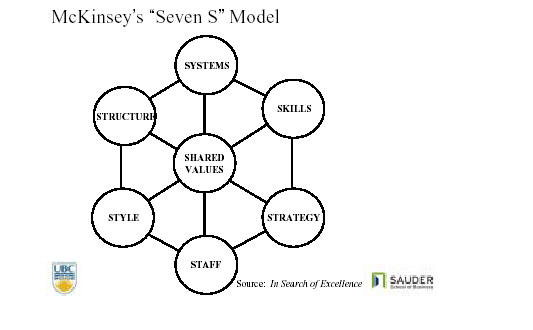
Perhaps the most important element which triggered the interest of American managers in the issue of culture was the emergence of Japanese competition. As Japan began to take a leading role in one basic industry after another, the question of cultural differences emerged as a causal factor to explain Japanese superiority. There are those who signal the deterioration of sound cultural values as the central reason behind the slippage of America as a worldwide industrial power. They suggest that Americans have gotten too fat, demanding too much from society without imposing any equivalent internal demands on themselves, and they they seem to have lost a sense of pride and self-satisfaction derived from a job well done. When contrasted with their Japanese counterparts, the gap seems to be enormous and still growing. Somehow, there is a basic erosion of standards of excellence that seems to undermine the basic fabric of American society. This is a message of gloom, and the popular press, as well as the academic writers, when contrasting American and Japanese management styles have been repeatedly conveying that message in recent years. The most notable exception, which might be the cause of its enormous popularity, has been the book in Search of Excellence by Peters and Waterman [1982], where they emphasize the lessons to be derived from America's best run companies. Paradoxically, it is interesting to observe that the best compliment that can be made to an American firm is that it resembles a Japanese company. We will not attempt to summarize Peters and Waterman's findings. What is more meaningful in this discussion is to reflect upon the framework they use to evaluate the best managed companies, which has become known as the McKinsey's Seven S model (Figure 5.13] According to that model, there are seven basic dimensions which represent the core of managerial activities. These are the "levers" which executives use to influence complex and large organizations. Obviously, there was a concerted effort on the part of the originators of the model to coin the managerial variables with words beginning with the letter S. so as to increase the communication power of the model. The Seven Ss are: 1] Strategy. A coherent set of actions aimed at gaining a sustainable advantage over competition, improving position vis-a-vis customers, and allocating resources. 2] Structure. The organization chart and accompanying baggage that show who reports to whom and how tasks are both divided up and integrated. 3] Systems. The processes and flows that show how an organization gets things done from day to day. [Information Systems, capital budgeting systems, manufacturing processes, quality control systems, and performance measurement systems all would be good examples]. 4] Style. Tangible evidence of what management considers important by the way it collectively spends time and attention and uses symbolic behavior. If it is not what management says is important, it is the way management behaves. 5] Staff. The people in an organization. Here it is very useful to think not about individual personalities, but about corporate demographics. 6] Skills. A derivative of the rest. Skills are those capabilities that are possessed by an organization as a whole as opposed to the people in it. [The concept of corporate skills as something different from the summation of the people seems difficult for many to grasp; however, some organizations that hire only the best and the brightest cannot get seemingly simple things done, while others perform extraordinary feats with ordinary people]. 7] Shared Values. The values that go beyond, but might well include, simple goal statements in determining corporate destiny. To fit the concept, these values must be shared by most people in an organization. Pascale and Athos [1981], in their book The Art of Japanese Management, use this framework to contrast American with Japanese firms. They argue that when things go wrong, Americans tend to manipulate the so-called three hard Ss - Strategy, Structure, and Systems. These have been a major center of concern up to this point. Perhaps the most important set of variables, however, is that describing the soft Ss - Style, staff, Skills, and Shared Values. This last one - Shared Values or Superordinate Goals - is centrally responsible for providing a core mission to the organization, used as an umbrella which embraces all the other managerial activities. We have addressed those concepts under the label "The Vision of the Firms" in Chapter 5. These four soft Ss are the primary forces which shape the culture of the organization. One more time, we should emphasize that the quality of strategic management depends on the goodness of fit among all those key managerial dimensions.The best run companies have been able to develop Strategies, Systems, and Structures which are not only centrally congruent, but also support and enrich the organization's Superordinate Goals, Style, Skills, and Staff.
In our introduction to business strategy, we emphasised the role of the "business environment" in shaping strategic thinking and decision-making.
The external environment in which a business operates can create opportunities which a business can exploit, as well as threats which could damage a business. However, to be in a position to exploit opportunities or respond to threats, a business needs to have the right resources and capabilities in place.
An important part of business strategy is concerned with ensuring that these resources and competencies are understood and evaluated - a process that is often known as a "Strategic Audit".
The process of conducting a strategic audit can be summarised into the following stages:
(1) Resource Audit:
The resource audit identifies the resources available to a business. Some of these can be owned (e.g. plant and machinery, trademarks, retail outlets) whereas other resources can be obtained through partnerships, joint ventures or simply supplier arrangements with other businesses. You can read more about resources here.
(2) Value Chain Analysis:
Value Chain Analysis describes the activities that take place in a business and relates them to an analysis of the competitive strength of the business. Influential work by Michael Porter suggested that the activities of a business could be grouped under two headings: (1) Primary Activities - those that are directly concerned with creating and delivering a product (e.g. component assembly); and (2) Support Activities, which whilst they are not directly involved in production, may increase effectiveness or efficiency (e.g. human resource management). It is rare for a business to undertake all primary and support activities. Value Chain Analysis is one way of identifying which activities are best undertaken by a business and which are best provided by others ("out sourced"). You can read more about Value Chain Analysis here.
(3) Core Competence Analysis:
Core competencies are those capabilities that are critical to a business achieving competitive advantage. The starting point for analysing core competencies is recognising that competition between businesses is as much a race for competence mastery as it is for market position and market power. Senior management cannot focus on all activities of a business and the competencies required to undertake them. So the goal is for management to focus attention on competencies that really affect competitive advantage. You can read more about the concept of Core Competencies here.
(4) Performance Analysis
The resource audit, value chain analysis and core competence analysis help to define the strategic capabilities of a business. After completing such analysis, questions that can be asked that evaluate the overall performance of the business. These questions include:
- How have the resources deployed in the business changed over
time; this is "historical analysis"
- How do the resources and capabilities of the business compare with others in
the industry - "industry norm analysis"
- How do the resources and capabilities of the business compare
with "best-in-class" - wherever that is to be found-
"benchmarking"
- How has the financial performance of the business changed over time and how
does it compare with key competitors and the industry as a whole? -
"ratio
analysis"
(5) Portfolio Analysis:
Portfolio Analysis analyses the overall balance of the strategic business units of a business. Most large businesses have operations in more than one market segment, and often in different geographical markets. Larger, diversified groups often have several divisions (each containing many business units) operating in quite distinct industries.
An important objective of a strategic audit is to ensure that the business portfolio is strong and that business units requiring investment and management attention are highlighted. This is important - a business should always consider which markets are most attractive and which business units have the potential to achieve advantage in the most attractive markets.
Traditionally, two analytical models have been widely used to undertake portfolio analysis:
- The Boston Consulting Group Portfolio Matrix (the "Boston Box");
- The McKinsey/General Electric Growth Share Matrix
(6) SWOT Analysis:
SWOT is an abbreviation for Strengths, Weaknesses, Opportunities and Threats. SWOT analysis is an important tool for auditing the overall strategic position of a business and its environment. Read more about it here.
Introduction
Financial information is always prepared to satisfy in some way the needs of various interested parties (the "users of accounts"). Stakeholders in the business (whether they are internal or external) seek information to find out three fundamental questions:
(1) How is the business doing?
(2) How is the business placed at present?
(3) What are the future prospects of the business?
For outsiders, published financial accounts are an important source of information to enable them to answer the above questions.
The Key Questions
To some degree or other, all interested parties will want to ask questions about financial information which are likely to fall into one or other of the following categories, and be about:
| Performance Area | Key Issues |
| Profitability | Is the business making a profit? Is it enough? |
| Efficiency | Is the business making best use of its resources? Is it generating adequate sales from its investment in equipment and people? Is it managing its working capital properly? |
| Liquidity | Is the business able to meet its short-term obligations as they fall due from cash resources immediately available to it? |
| Stability | What about the long-term prospects of the business? Is the business generating sufficient resources to repay long-term liabilities and re-invest in required new technology? What is the overall structure of the businesses' finance - does it place a burden on the business? |
| Investment Return | What return can investors or lender expect to get out of the business? How does this compare with similar, alternative investments in other businesses? |
The Main Tools of Review
The answers to the questions above (and others) will come from a careful, analytical review of financial information:
| Area for Review | Comments |
|
Review of the Business; Chairman's and CEO's Review
|
The accounts of all quoted companies (and many private companies) include some commentary from senior management on the strategy and performance of the business. This is often the most useful place to start. The statements (usually one each from the Chairman, CEO and Finance Director) will reveal many "qualitative" things about the business. These include a description of the business activities, objectives, developments and competitive environment. Political, environmental and macro-economic issues may also be raised. |
|
Cash flow statement
|
The cash flow statement will reveal where the company's resources have come from and how they have been applied during the year. |
|
Calculation of significant ratios between figures in the accounts
|
Ratio analysis is an important tool for understanding and comparing business performance. However, ratios and other financial calculations are rarely useful when looked at in isolation. it is important to carry out calculations of ratios and other significant financial figures with previous years (many companies publish five or ten year summaries as part of their annual reports) in order to identify positive or adverse trends). Comparison with other, relevant competitors and industry "norms" is also important. |
|
Copyright © 1997-2005 [A & A Trading Enterprises]. All rights reserved.
|

