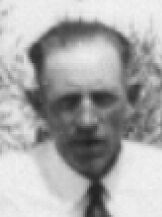
| Vern Sheffer | |
My name is Vern Sheffer. I was born in Colonia Garcia, Chihuahua. Mexico December 12, 1899.
My parents was polygamists. My father's first wife's name was Wealthy Halliday Sheffer. My mother was Sarah Elizabeth Darton Sheffer. My father was Nicholas Vance Sheffer. Aunt Wealthy never had any children that lived. I think that was the reason they decided to get another woman, so they could have a family. My mother had eight children, four still living. The first two died as infants; their names was Sarah and Wealthy, then Almina. She died at about fifteen or sixteen years. Then Clara, still living. Then Vance died as an infant. Then Rulon still living. Then Vern still living. Then Prudence still living.
My parents went to Old Mexico because the U.S. Government made laws prohibiting polygamy in 1893. The Mexican Government would allow it there. That was the reason they went there.
I don't remember my father at all for I was only four years old when he died. I was raised by those two women. That's the reason I'm such a SISSY.
Those two women lived together just like sisters. I really never knew from the way things went which was the mother.
Aunt Wealthy went right on through life doing everything she could to raise the family. Neither one of those women ever married again and Aunt Wealthy lived to age 96 and mother to age 89.
My memory of the first few years is rather dim. One of the first things I remember, Nathan Wheaton and I went out take the cows out on the range. We were going through a patch of jack pine, we heard a woman scream, then a baby started crying. We tied our horses up and went to see if we could help. We came to a small clearing and there stood a BIG black panther showing his teeth and weaving his tail. Just what happened the next few minutes I was too scared to know. We was in town and our horses running their best when I came to.
The next thing I remember was when I slid off the hay stack and hit the pitch-fork with the tines UP. That put me in bed for some time. Mother was in Juarez after fruit and Aunt Wealthy was teaching school. Grandma Darton was living with us at the time and she had locked the door and gone to the neighbors. Rulon ran to the school house and got Aunt Wealthy, and they got to the house as quick as I did, Aunt Wealthy tried the door and it was locked, she turned and gave Rulon a shove and said , "Go get the ax." Then she tried the other door, grandmother hadn't locked it, every time any one came in the door I would say, "Did you bring mother with you?" I think I was about nine-years-old then.
Another one was, I was out in the timber above the farm with my dog (just a pup), and he came running at me with foam running from his mouth. I kicked him away and he came at me again. I kicked him away again and the third time he just kept running, and I never saw him again, he had "Rabies" or in those days they called it "Hydrophobia." I had seen a big white dog just two or three days before that with the same disease; he went running right up through town and two men were chasing him with guns.
Then just before we left Mexico we had turned the cows and calves out. Then we didn't leave as soon as they thought so I went out to see if I could find some of the cows so we could have milk. I heard a rock rollup on the mountain side and there was two Mexicans. Each had a bullet belt crossing each shoulder and one around the waist. I will never forget how those bullets shinned. I don't need to say I stayed hid till they was long gone. Then I sneaked off for home.
Then there was the time Randolph Allen and I went to Juniper Lake No. 2 and killed a big white swan. We was really proud of that. We was packing it home, we had a big shaggy dog with us and every once in a while the dog would turn back the way we had come from. The hair would stand on his back and he would growl. We went until we crossed a clearing in the brush; then we hid to see what it was and a big gray wolf came out. We jumped out and hollered, "Sick him." The dog went after him and never came back. We hunted for the dog every chance we got for a long time. We never even found any sign of him.
One time a group of Gypsies came to Garcia. They had some bears, monkeys, and baboons. One of the men with a bear told me if I would go get five cups of sugar for the bear he would let me ride the bear down through town, so I did. The events that happened there made that the best circus I have ever seen.
One time mother went to Juarez with a freighter to get some fruit. Rulon and I hung onto the back of the covered wagon for a way. Then I climbed up in, then Rulon stopped and kept calling to me, but I didn't get out. He went back home and I went to sleep. When they stopped for dinner I woke up and you can guess at the surprise mother had to find me there.
It was July 12 when we left Mexico and landed in El Paso, Texas U.S.A. There was a couple of events that happened there. One was my newspaper experience. Rulon went with me to the newspaper stand and I got 12 papers and started up town. I wound up at the railroad station and was lost. I asked a policeman the way home as I happened to know my address. I started home and some time later I met Rulon face to face, and he said, "Where are you going?" I said, "Home." And he said, "Well come on!" we almost fought over who was going home. I was lost again. We went right by the newspaper stand. Rulon said, "Aren't you going to turn your papers in?" I said, I don't know where I got them." I hadn't sold a paper.
My mother got me a job as cash boy in a store, they was having a sale for a week, they put me at a soap stand just inside the door. Most people came there to get their change. In those days gold was in circulation and most everyone had a $20.00 gold piece. I handled more gold that week than I have ever seen in my life. Someone had to take me to the store every morning and come and get me at night. If they didn't I would get lost. I could go out ion the mountains and roam around all day and go straight home, but in a city, I am still having trouble.
We left El Paso in October of the same year and came to Utah; a small town called Hayden. There was not much excitement there for some time. Just herding the old milk cow and fighting gnats. After we had been there a year or two Rulon and I got a job for a fellow named Ed Gardner digging post holes and setting posts at 10¢ each. We made fairly good money at that. We kept track of them until we passed the 5,000. Of course by then we was getting old enough to go out on jobs, and we went in different directions. My first job as I remember was with the Rasmussen Brothers in Roosevelt making brick. Most of those old brick buildings in Roosevelt and some in Vernal I helped make the brick. We would make brick in the summer and go to the coal mines for winter. The second winter in the mines I started contracting on my own at $2.00 a ton. I stayed on that job about ten years.
After living in Hayden about two years we moved to another small town called Cedarview. The people there helped us get our house, a one room cabin with a room in the attic for us boys-- a bedroom. About a year and a half before I was married I had been working some at the saw mill and Rulon had also been working there. We had to take lumber for our pay so I hired a team and hauled the lumber home. Then I went to herd sheep for Sern Hanson. I had enough money to buy doors, windows and nails. Well the old house was right where I wanted to put the new one, so I jacked it up and moved it down in the lot. Then I got a team and hauled some sand stone and made a foundation and built a nice two-room house. I didn't have enough money to by lath so I went and hired a team and went to the saw mill and got what they call edgings and used them for lath. Then I went up to the jip plant and burned the jip and took it home and did my own plastering. I was really proud of that job.
After I was married we lived up close to the coal mines, 24 miles from Cedarview. Mother's cow got bloated and died. I hooked my team up, loaded a cow on the wagon and took her to mother. In about three or four months I got a letter saying she didn't like that cow, so I loaded another cow and went and traded with her.
While working at the mines I met a beautiful little girl named Berenice Turner. After courting her for some time her parents sent her to Murray to her grandmothers to break us up which worked very well for two years; then she came back and that finished it. We was married August 3, 1923. We took up a homestead and built our first house on it. I was still working in the mines and started buying a cow when I would get enough money. We started a dairy farm. We was real successful at that until 1931 then the drought hit. That was the summer Bert got his eye put out. I had to mortgage my hay to put him in the hospital in Salt Lake. I never could raise the money to pay off the mortgage so the guy came and hauled the hay off. Hay went up by spring to $50.00 a ton and cows went down to $50.00 a head. We was milking fifteen cows then and when spring came we only had five cows left and we was broke. The drought continued for eight or ten years which really put us out of business.
One thing it didn't put us out of business was raising boys.
| Klin | was born | April 28, 1924 | |
| Ivan | " " | June 4, 1926 | |
| Bert | " " | January 22,1928 | |
| Don | " " | July 22, 1930 | |
| Jack | " " | June 12, 1921 | |
| Gene | " " | September 16, 1934 | |
| Dan | " " | November 7, 1936 | |
| Rulon | " " | November 8, 1938 | |
 Vern and his sons (left to right): Rulon, Dan, Vern, | |||
We had five heifers which became cows, but the drought was so bad the government shipped feed in as long as they could find any, then they came and paid us $20.00 a head and just took them out and shot them. They left us three cows; it depended on the size of the family how many cows you could keep. They paid $10.00 for anything under two years old. They took them into a big wash north of Tridell and shot them, then took bulldozers and buried them. There was thousands of sheep went the same way. The government then set up the W.P.A. and let me work eleven days for $44.00 each month. I had to take a grub box and bed and got to the Buck Pasture Reservoir to work. After buying grub for a trip like that I didn't have much left for my family. After they finished the reservoir I went on a job in the valley, an Indian sponsored job, and they put me in foreman. I had twenty-two white men, then they started laying white men off and putting Indians on. In about two weeks I had all Indians.
When the snow came they sent us up on the mountain to cut logs for bridge stringers. They gave us tents for each two men. In the group was a man that had been in the pen for thirteen years for murder. He was a half-breed and none of the others would camp with him so it was my job. I never camped with a nicer guy in my life. He just waited on me hand and foot. His name was Harris Murray. He was awful nervous. He had a real nice sweater; they had taught him a certain way to fold it up. When he would take it off he always folded it the same. He would get a pile of wood in the tent before he would sit down, then he would fold the sweater, put it on the wood pile and sit down on it. He would start stacking the wood, one stick at a time along the other side of the tent, when he got it all moved he would get up and shake the sweater out and fold it again and sit down on it again. Some nights he would move the wood pile four or five times before bedtime.
When we left there and went home I had an old blue milk goat he wanted. He had a roll of bedding he wanted to trade with me. I told him the goat wasn't worth that much. When we got to my place he just rolled the bedding off and said, "I'll be up after the goat tomorrow." There was five bed size blankets, genuine Navajo blankets and three army blankets, they must have been well over $100.00. I never saw him again. I only worked at that job three of four months. After that I could see I wasn't going to get rich at that.
I went to Arizona with Rulon and Fern when they moved down there, and on that trip we came through Hurricane and seen all those fruit trees so I decided the boys could help make a living, so I moved to Hurricane. That was in July 1941. That proved to be the worse thing I could of done because soon after we got here Berenice got sick. She got high blood pressure and kidney trouble and heart trouble and was in the hospital more than she was out. The Doctor couldn't find anything to help her, then Dr. Williams came to Cedar City. He had been in the South Pacific in the army and had the same trouble with patients there. He knew almost instantly what her trouble was. Her blood just wouldn't change with the seasons. He told me to get her back to climate she was used to. The next day we took her back to Avalon. You wouldn't know she had been sick for about eleven months.
Then on the first day of May she took sick and I put her in the hospital in Roosevelt. The Doctor came to me on the 29th of May and told me to take her to the L.D.S. Hospital in Salt Lake City. So on the 30th of May I took her to Salt Lake. She was there until the twelfth of July. The Doctor told me I could take her home, that I could do as much for her as they could. So I took her back to the Roosevelt hospital. They told me there that they would furnish a bed, but they wouldn't be responsible for her, and some of the family would have to sit with her at all time. Don and Maggie was living up there then, and Maggie--bless her heart--would go sit twelve hours then I would go sit twelve hours. Then on August 2, 1949 she died. I was with her when she went. Up until we moved to Hurricane she was as healthy and strong as anyone could be. She would get out and help me milk the cows, feed the pigs, pitch the hay, and any and all things that needed to be done. And all this time she would like that. When she got sick I was bewildered. I couldn't understand. I didn't know what to do.
When Klin was born, that was before we had stared our dairy farm, I had the Little Water Mine leased. Berenice went down to mothers place so she would be close to the Doctor. In those days the babies was born in the homes not hospitals. So after he was about two weeks old, she came home with that little bundle, that was our first boy. We was getting started with our dairy farm when Ivan was born. Again Berenice went to mothers place in Cedarview. He was our second boy. Changes were few when Bert came along also born in Cedarview. By this time our business was growing and we leased 160 acres farm, that was when Don was born. He was born in our own home at Lapoint, Utah. He was our fourth boy. We only stayed there one year, then went to Randalett, Utah and leased 320 acres and was going strong when Jack was born. Again Berenice went to mothers place. He was our fifth boy. Jack was just three weeks when Bert got his eye put out and that was when everything went wrong. That was the year that awful drought started. We took the five cows we had left after the first year of the drought and moved back to Lapoint. When Gene was born Berenice went to a maternity home in Vernal. He was our sixth boy. We bought a 40 acre farm in Tridell. It had a fairly nice home on it and Dan was born there. He was our seventh boy. While living there Rulon was born. He was our eighth boy.
When Gene was about three months old he had pneumonia, and was very sick. All the heat we had was the old cook stove. Either Berenice or me sat by the warmest place and held him day and night until he was well again. He was the only one we had any trouble with in that line.
Just before Berenice got sick we had bought 130 acres of land in Avalon. It didn't have a house on it, we hadn't moved on it yet. After Berenice died Ivan, Dan, Rulon and I built a cabin on it and moved in. We was there about three years, then I sold out and Dan and Rulon went to live with Don and Maggie. Ivan was married and I went to Salt Lake and stayed with Klin and Cleone for a short time.
I am very proud of my boys, for their accomplishments after all those depression years and draw backs they had. That was enough to discourage most anyone. Things got mighty tough at times with ten pairs of feet going under the table, eight of them growing boys. I am also proud of the way they have got along together. It seems to me they are very well united and seem to have genuine brotherly love for each other.
I hope my daughters-in-law love me as much as I love them. There won't be much trouble for any of us.
I now have 27 grandchildren and one great grandchild.
I had met Cleone and had been out on picnic parties in groups a number of times and found her to my liking very much, and in the meantime she had divorced her winno so to Hurricane I go. Being a very aggressive guy and we was both passed sixteen, in about three or four months we was married on May 16, 1952. It has been seventeen years in May.
This being my life's history I feel I am the luckiest guy in the world. I had two of the best women in the world. Of course some of you won't think so, but I do. We have had a wonderful life together even though there has been many hair raising events. We have traveled quite a bit of the west and enjoyed ourselves. By this marriage I got four lovely daughters and a son, so now I have a rusty dozen. I have also been able to put on a good enough front to pretty much win the love and respect of all of Cleone's children and grandchildren. I am very proud of that fact alone.
I would like very much to advise each and every one that reads this to right now get a notebook and start making notes and dates for some day, you may want to write your life history. Don't wait until you are 69 years old then try to remember all you want to put in it.
On Labor Day 1953 a group of people came up to Hurricane from Las Vegas, Nevada and we all went out the Short Creek--- was out there all day. When we got home that night there was a note on the door telling me to call Loren Squires and he told me that they, the highway patrol, had been trying all day to find me. He told me there had been a serious accident in Vernal and they wanted me up there. He asked me if there was anything he could do, and I told him yes. Just call the cops off me, I was coming through. I went up to King's and got Mother. We left here at ten-o-clock that night, stopped in Cedar City and got Dan and Rulon and went on. We stopped in Provo and got a Taxi for mother and she went to where Aunt Wealthy was staying. She had been with us all day and didn't feel like going on. I didn't know for sure Gene was dead or didn't even know who had the accident until I got to Vernal. We got to Vernal six-o-clock next morning.
In 1966 some of the boys came up with the idea of a family reunion. I think it was Klin and Bert.
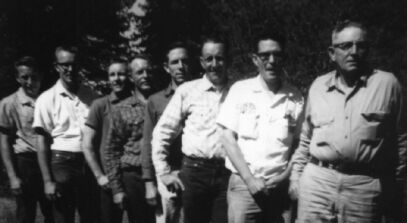 Left to right: Rulon, Dan, Jack, Don, Bert, Ivan, Klin and Vern. |
I think it was a most wonderful thing and hope it goes on and on. I am very proud and happy that all three years so far, they have all been there. Not even a drop out. I think it is a wonderful way to keep in touch with one another, to get pictures and see how the kids grow up and develop. Learn one another's pleasures and sorrows and see how you old folks are getting older and older. Then you can feel sorry for me.
 Home Page