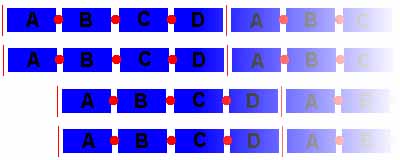
First Instruction...
Second Instruction...
Third Instruction...
Fourth Instruction...
In a CPU there are the ALU and FPU units.
These two units can work in parallel, because that both carry out two
different instructions.
Thus a larger computing speed is obtained.
A superscalar processor (opposed to the scalar processors: 1 layer)
comtains more than one layer.
All the layers of a unit work in parallel and thus more one has layers
and more the numbers of instructions carried out at the same time increases
(a number of instructions = a number of layers).
There can be layers with ALU, FPU, MMX, 3D unit...
Scalar processor with two Layers: (two layers is the minimum for a superscalar processor)
|
First Instruction... Second Instruction... Third Instruction... Fourth Instruction... |
One 486 (100 Mhrz) is approximately twice less fast than Pentium 100.
However they work at the same frequency! But Pentium is Superscalaire:
it has two units ALU (ALU1 and ALU2).
Intel informations:
| ALU | FPU | |
| 486 SX | 1 | 0 |
| 486 DX | 1 | 1 |
| Pentium | 2 | 1 |
| Pentium Pro | 2? | 1? or 2? |
| Pentium II | 2? or 4? | 1? or 2? |
Future processors are envisaged:
The new processors will be: with pipeline, superscalars (2/4 ALU, 2
FPU, 2 MMX, 1/2 3D).
The 3D unit is likely to be very much used by the accelerating cards,
it will be very quickly superscalar (with 2 or 4 layers).
Future processors :
| Units: | ALU | FPU | MMX | 3D |
| K6 3D | 2 | 1 or 2 | 2 | 1 |
| Cayenne | 2 | 2 ? | 1 | 1 |
A superscalar unit can’t avoid waitings and certain stages (A and C
especially) work during more than one cycle.
Moreover it happens that a Layer1 awaits another Layer2 if it needs
the result of Layer2.
One thus needs for the CPU a unit which deals with these characteristics
in order to make pass the maximum of independent instructions.
If you want more informations:
NACSE Superscalar Simulator
http://www.nacse.pdx.edu/Simulator/