Culture and Customs
A Religous Journey through Life
"Hinduism is the oldest of all living religions, perhaps as old as the world itself. It has been termed as the mother of all religions.
It is also known by the names Sanatana-Dharma and Vaidika-Dharma.
[Sanatana-Dharma .means eternal religion. Sanatana-Dharma is so called, not only because it is eternal, but also because it is protected by God and because it can make us eternal.
[Vaidika-Dharma .means the religion of the Vedas. Hinduism is a revealed religion. Unlike Buddhism, Christianity, Islam and many other religions Hinduism owes its origin to no prophets. While all these religions have a fixed date of origin, no such chronology can be fixed for Hinduism. Hinduism is not born of the teachings of particular prophets. It is not based on a set of dogmas preached by a particular set of teachers.
The Vedas are the foundational scriptures of Hinduism. The ancient Rishis and sages of India have expressed their intuitive spiritual experiences (Aparoksha-Anubhuti) .in the Upanishads. These experiences are direct and infallible. Hinduism regards the spiritual experiences of the Rishis of yore as its authority. The priceless truths that have been discovered by the Hindu Rishis and sages through millennia constitute the glory of Hinduism.
The Vedas are the eternal truths revealed by God to the great ancient Rishis of India. The word Rishi .means a seer from dris, to see. He is the Mantra-Drashta, a seer of Mantra .or thought. The thought was not his own. The Rishis saw the truths or heard them. Therefore, the Vedas are what are heard (Sruti). The Rishi did not write it. He did not create it out of his mind. He was only the spiritual discoverer of the thought, which existed already. He is not the inventor of the Veda.
The Vedas represent the spiritual experiences of the Rishis of yore. The truths of the Vedas are revelations. All the other religions of the world claim their authority as being delivered by special messengers of God to certain persons, but the Vedas do not owe their authority to any one. They are themselves the authority as they are eternal, as they are the 'Knowledge of the Lord.'
Next in importance to the Sruti .are the Smritis .or secondary scriptures. These are the ancient sacred law-codes of the Hindus dealing with the Sanatana-Varnasrama-Dharma. They supplement and explain the ritualistic injunctions called Vidhis .in the Vedas. The Smriti Sastra is founded on the Sruti. The Smritis are based on the teachings of the Vedas. The Smriti stands next in authority to the Sruti. It explains and develops Dharma. It lays down the laws, which regulate Hindu national, social, family and individual obligations.
From time to time, a great lawgiver would take his birth. He would codify the existing laws and remove those, which had become obsolete. He would make some alterations, adaptations, readjustments, additions and subtractions, to suit the needs of the time and see that the way of living of the people would be in accordance with the teachings of the Veda. Of such lawgivers, Manu, Yajnavalkya and Parashara are the most celebrated persons. Hindu society is founded on, and is governed by the laws made by these three great sages.
The laws of Manu are intended for the Satya Yuga, those of Yajnavalkya are for the Treta Yuga; those of Sankha and Likhita are for the Dvapara Yuga; and those of Parashara are for the Kali Yuga. The laws and rules which are based entirely upon our social positions, time and clime, must change with the changes in society and changing conditions of time and clime. Then only the progress of the Hindu society can be ensured."
An extract from .All About Hinduism .by Sri Swami Sivananda (first published in 1947)
Sistlas are Vaidiki (believers in Vedas) Brahmins of Velnadu region of Andhra. As has been described in the History of Sistlas, (view
page), the founding fathers of Sistla family have been some of the greatest exponents of Sruti and Smriti. This hallowed genealogy has retained most of its piety and propriety as it percolated down to the Cyber-age. Despite many an upheaval in the social and cultural propensity of India, Sistlas, (as do many other Brahmin families of South India,) retain their most basic and fundamental character, i.e. an infallible faith in the "religion of the Vedas."
Sistlas are strict followers of the Achaar Samhitas (code of conduct, spiritual as well as social) laid down by the great sages in the Vedas. Brahmin families of Andhra are basically highly ritualistic and puritanical. Almost all deeds in their day to day life take inspiration from religion.
The spiritual discipline of the child begins right from birth. Starting young, at various ages the child goes through various rituals that strengthen the spiritual, moral and social character of the individual.
[ On the eleventh or twenty-first day of birth of a child, Punya Vachanam (a purification ceremony) is performed, reciting Vedic Mantras, to purify the body and mind of the child. Simultaneously, a Shanti ceremony is also performed invoking the deities for the welfare of the child, in case it is born when the ruling star is inauspicious. AppropriateHavans .are performed in the process.
[ At the age of three, the first haircut, known as Siromundanam .is performed - symbolic of shedding off ego and getting accustomed to it. This is generally in case of male child.
Keeping the head completely shaven and wearing an unstitched single cloth is believed to be symbolic of 'humility' in many other religions as well.
[ Aslo at the age of three, the child is introduced to learning. The first letters that are taught are "Om", "Na", "Maha", "Si", "Va", "Yaha" - which, when put together, read "Om Namaha Sivayaha" - the Panchakshari . mantra, a prayer to Lord Siva. Rest of the alphabets are taught only after letters of this prayer mantra are fully learnt.
[ The most important, particularly for a Brahmin boy, is the Upanayanam. - the 'Thread ceremony', generally performed in the fifth or seventh year. A "sacred" thread of three strings bound in a 'divine' knot, known as Brahma Mudi .is put on the boy, (going over the left shoulder and under the right arm) as per the Vedic rites. The boy is thus initiated into Brahminhood. This is known as the "second birth" and the boy becomes a Dwija .(twice born). Gayatri Yagna .is performed by the boy, who is preached the Gayatri Mantra .by the guru, through the father. This Mantra .is to be chanted at least 108 times a day and becomes part of the Sandhya Vandana .- prayers during the four Sandhyas .(dawn, midday, dusk and midnight). The "sacred thread" known as Yagnopaveetam, is to be worn by the brahmin at all times, all his life and is to be treated sacred. Each year, on the Pournami .(full moon) of Shravana .month, at the first Sandhya Vandana, the old Yagnopaveetam is replaced by a new one.
[ Girl around the age of twelve, when attains puberty, is 'honoured' to have become a "grown-up". After her first menstrual period she is felicitated by ladies of the family and the neighbourhood, in the form of a festivity. If the ruling star of the girl is not "auspicious" at the time of puberty then a Shanti Puja .is performed according to Vedic rites after giving a 'purification' bath to the girl on the fifth day. During the menstrual period itself, women are rested for three or five days - seating them seperately, so that they do not come in contact with any infectious agency - this practice continues till late age.
[ Marriage is the next important function. Traditional Hindu marriages used to last about a week, with a number of rituals, festivities and functions. Marriage in Andhra Brahmin family even now lasts for three days. It is performed with Vedic Mantras invoking various Gods, particularly Agni .- the God of Fire, as witnesses to the wedding. A number of Havans and Pujas .are performed - both by the bride and the groom, seperately as well as together. The bridegroom then ties the "marriage knot" - (in fact three knots, each time taking a vow to abide by the duties of a husband as prescribed) - to a neck-wear, known as Mangal Sutra .(string of welfare and prosperity). This symbolises the bondage. The bride and the groom then make a Pradakshina .(going round the fire of the Havan.) for at least seven steps, again taking prescribed vows, indicating that thereafter they tread together. The bride wears the Mangal Sutra .all her life. It indicates the welfare and prosperity of her husband.
[ The Mangal Sutra .is usually made of two coin sized pieces of gold, each one given by the parents of bride and groom. In case of finacial restrictions, instead of the gold coins a wholesome peice of dry turmeric root is tied. Turmeric always denotes welfare for the ladies and is used in all rituals.
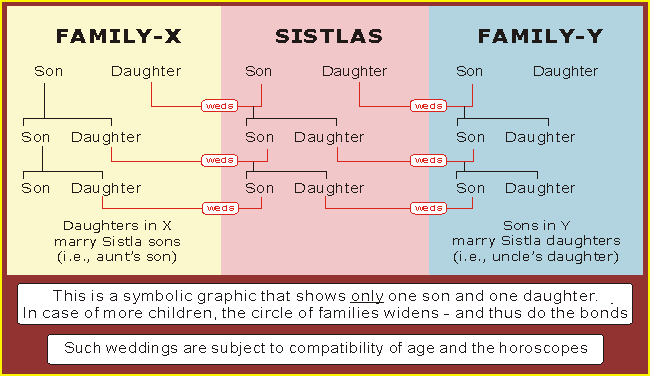
[ A unique custom of Andhras is "Manerikam" - marriage between children of a brother and sister, first cousins, as is referred to in English. Yet, unlike Muslims this relationship is limited only between children of a brother and sister in a specified pattern. The following chart shows how it goes -
[ During the fifth, seventh or ninth month of pregnancy various Pujas are performed by the elderly women in the family as well as in the neighbourhood, for a pleasant delivery and welfare of the mother-to-be. This function, known as Seemantham, is essentially an all women affair.
[ At the time of death, the children perform obsequies through specified Havans, for twelve days, keeping themselves in "Deeksha" .- a sacred obsession. The ashes and other remains of the deceased are immersed in holy rivers amidst Vedic recitals. Thereafter, for twelve months such ceremony is performed every month, on the date of death - and after that every year. During the ceremony Lord Vishnu (the Gadadhar.), the Soul of the deceased and that of the elders upto three generations, are invited in the form of "Bhootas" .(Holy Ghosts) and fed ritually prepared food. In case of a deceased female, three generations - mother, grandmother and great-grandmother, are invited, worshipped and fed in the form of "Sumangali". .(a lady whose husband is eternally alive).
Along with these, there are many festivals that invite cultural unity and invoke religious reverence. Andhras celebrate almost all the festivals that are traditionally celebrated in various parts of India. All festivals begin with performance of a "puja" .according to the Vedic rites.
Prominent among the many are -
[ Ganesh Chaturthi - In all Hindu rituals Lord Ganesh is invoked at the onset. No ceremony is performed without "Om Ganeshaay Namah". Yet, on the fourth day of Bhadrapada .month as per the Hindu calender, specific 'puja' is performed for three days, with twenty-one different varieties of leaves, believed to be the favourites of Lord Ganesh. In some places the 'puja' goes on for ten days - after which the idols of Lord Ganesh are immersed in Holy rivers, sea or lakes.
[ Ugadi - Festival of the beginning of the Hindu New Year (as per the Lunar Calender) comes as a harbinger of Spring. In the customary 'puja', a concoction of jaggery, raw mango and Neem (Margosa) flowers is used as "prasadam." - symbolising 'strength to withstand the bitterness of life'. In some states it is celebrated as "Gudi Padwa".
[ Sankranti - It is the festival of the two "journeys" of the sun. Each year the sun 'travels' north to south for six months - called "Dakshinayana", and from south to north for the other six months - called "Uttarayana". Sankranti is celebrated the day sun changes its direction each time - Kark .Sankranti and Makar .Sankranti respectively. On this day, (Makar Sankranti) eating "Til" .(sesamum seeds) as a "prasadam". is a must. (Sesamum seeds are crushed with jaggery and formed into little balls called "Til Laddoo"..)
- [ It is believed that this day (on Makar Sankranti), Bali, the king of rakshas .(demons), who was sent by Lord Vishnu to rule "Pataal" .(the Netherworld), would come up, unseen, in his chariot, to see his former kingdom of Earth. Therefore, women decorate the entry to the homes with "rangoli" .(floor paintings in a variety of colours) in the form of chariots.
- [ It also the festival of harvest of rice in South India.
[ Maha Shivratri - On the night of Krishnapaksha-Chadurdashi (29th day) of Magha month of the Hindu Lunar Calender, a 'grand puja' of Lord Shiv is performed, which carries on through the night.
[ Ksheerabdi Dwadashi - On this day, as on Maha Sivratri, devotees keep awake whole night worshipping Lord Krishna and chanting verses from Srimad Bhagavat Gita.
[ Deepavali, Dushehra, Ram Navami, Krishna Janmashtami and many other festivals are celebrated in Andhra the same way as in the rest of the country.
[ Other 'pujas' like "Satyanarayan Vratam" and "Venkateswara Kalyanam" are performed as prescribed in 'Puranas' .on occaisions like birthdays, when starting a new professional venture, success in a particular endeavour, etc.
[ Many other occaisions, such as each Lunar and Solar Eclipse, each new Monday, Ekadasi (11th) of each month of the Hindu Lunar Calender etc. - are also treated with religious importance.
[ In addition to all these, there are a number of 'pujas' and 'Vratams' .(religious vow) that the women folk perform for the welfare of the family in general.
Committed Brahmins follow "Dharma" .as prescribed in Vedic scriptures and accordingly perform 'pujas' and make 'tarpans' .(libation of Holy water to the deceased ancestors) - not only of the family but also of the entire humanity.
- "Vasudhaiva Kutumbakam"
- (The Whole World is One Family, is what the Vedas preach.)