 ...................... We, the People ........................
Andhra society is one of the ancient societies of India. Tales about Andhras are depicted in the great Hindu epics like Ramayana and Mahabharata, in ancient Puranas, and Budhdhist Jataka Tales.
Ramayana depicts an interesting tale. Maharishi Viswamitra condemned the "Naramedha Yagam", (human sacrifice in oblation), freed Sunassepu and adopted him as his son. Viswamitra's children disliked this act by their father and were therefore cursed. Viswamitra's children then migrated towards east and south. It is believed that these children of Viswamitra were Andhras.
[ Viswamitra invented the coconut tree, which resembles humans in many ways. Breaking of the coconut at the sacrificial altars and in temples, as an alternate to Naramedha, a practice followed to date, was introduced by Viswamitra.
According to the great epic Mahabharata, a tribe called "Andhras" arrived at the banks of Yamuna River during the war. Andhras and Kalingas supported the Kauravas during the battle between Kauravas and Pandavas. Sahadeva defeated the kingdoms of Pandya, Dravida, Odhra, Kerala, Andhra, and Kalinga while performing the Rajasooya yajna. Further references of Andhra tribes and kingdoms appear in many Upanishads that followed Mahabharata.
In Jataka tales, written during 400-200BC, the tribes living south of the Tel River, a subsidiary to Mahanadi, were referred to as Telugu, which were Andhras. These tribes established relationships with the more peaceful southern tribes and expanded to Telangana.
[ Of the four major languages from South India, Telugu, Kannada, Tamil and Malayalam, Telugu is closest to Sanskrit.
The history of the area corresponding to present-day Andhra Pradesh dates from the Maurya Empire. During the reign of Bindusara, second ruler of the Maurya dynasty, Andhradesa became part of the Maurya Empire. The emperor Asoka, his son and successor, refers in his inscriptions to a people called the Andhras. The first known Andhra dynasty, the Satavahanas, probably held administrative posts under the Mauryas. They came to power when the Maurya Empire disintegrated, following the death of the emperor Asoka.
The Satavahanas ruled from about 800 B.C. to 350 B.C. Prathistan (Paithan) was their capital. The Satavahanas encouraged various religious groups and were patrons of Buddhism and Brahmanism. Archaeological finds from Amaravati on the East Coast show the great skill and artistry of early Andhra sculptors and builders. Some of the Ajanta cave paintings date from this period. Nagarjunakonda became the centre of learning at the beginning of the twentieth century. After the end of the Satavahana Empire, several dynasties emerged in Andhra. The most prominent were the Pallavas (225-610), the Ishvaku (250-340), and the Vishnu Kundins (440-610).
The 7th century saw the rise of one of the most powerful and politically stable dynasties of Andhras, the Chalukyas. Though never in conflict with each other, the Chalukya dynasty ruled almost the entire southern peninsula in two segments. Western Chalukyas founded a kingdom at Vatapi (modern Badami) near Bijapur in present Karnataka State about the middle of the 6th century AD. By the reign of Pulakeshin II ( 610-42) they had extended their control north into present Madhya Pradesh and Gujarat and south to Kerala and Tamil Nadu. Shortly eclipsed by the Rashtrakuta dynasty in the middle of the 8th century, the Western Chalukya Kingdom was revived about 975, with its capital at Kalyan, near modern Bombay. During the 11th century the Western Chalukyas came into frequent conflict with the Chola kings of south India. King Somesvara I (1042-68) won a great victory over the Cholas at the Battle of Koppam (1054). The Eastern Chalukyas ruled a kingdom in Vengi (eastern Andhra Pradesh) from about 625 until 1070, when they merged with the Cholas to form the Chalukya-Chola dynasty.
Fragmented political control continued until the rise of the Kakatiya dynasty (1081-1323). The Kakatiyas ruled the entire Andhradesam. Warangal, northeast of the present city of Hyderabad, was their capital. The southward expansion of the Delhi sultanate ended Kakatiya supremacy. Although the Kakatiya ruler repulsed the initial attempt of Ala-ud-din Khalji to conquer the Deccan, he was defeated in 1309, and became a tributary of the sultan. The Kakatiyas enjoyed a short-lived independence after the death of Ala-ud-din Khalji. However, his successor, Ghiyas-ud-din Tughluq, annexed the Kakatiya kingdom after a five-month war ended in the fall of Warangal in 1323. The rise of the Vijayanagar Empire in the mid-1300's prevented Turkish expansion further south.
Medieval history in the Deccan centres around the struggle for supremacy between the Bahmani and Vijayanagar kingdoms. The whole of Andhradesam, except the Telangana region, formed part of the territory of Vijayanagar. Vijayanagar - the City of Victory - was the capital of this great military empire. One of its most successful rulers, Krishna Deva Raya, was responsible for a period of territorial expansion and economic prosperity. He was renowned as a great warrior, statesman, scholar, builder, and patron of the arts. His kingdom did not survive for long after his death in 1529.
Political and territorial realignment in the Deccan followed the Battle of Talikota in 1565 (in which the army of Vijayanagar was routed) and the earlier disintegration of the Bahmani kingdom in 1538. The Bahmani kingdom split into five independent principalities. One, Golconda, under Quli Qutb Shah ruled the Telangana region. On the decline of Vijayanagar power, the ruler of Golconda extended his territory to the whole of Andhra, bringing the area under one political authority at last.
Golconda emerged as an independent kingdom when the Mughal Empire was at its greatest. Inevitably, the Mughals advanced south, intending to extend their territory into the Deccan. Although the rulers of the Deccan resisted, they were powerless against the Mughals. Golconda was annexed in 1687 and Andhra became a province of the Mughal Empire.
In 1724, Nizam-ul-mulk Asaf Jah, the Mughal viceroy of Deccan, carved out an independent kingdom, Hyderabad. Hyderabad, comprising almost the whole of present-day Andhra Pradesh, was the most important centre of Muslim culture in central and south India during the 1700's and 1800's. A succession of nizams ruled it from 1724 to 1947. Their court culture was Islamic, but Hindu culture also flourished in the state.
Through the 1700's, British and French merchants each formed alliances with local powers. At the end of the 1700's, the British reached an agreement with the nizam of Hyderabad. He accepted British support in exchange for recognition of British rights to trade. By the beginning of the 1800's, Andhra came under the political control of the East India Company. The districts of Anantapur, Cuduppa, Nellor, Chittoor, and Kurnool were annexed by the company, and the territory of the nizam was brought under its indirect rule. Hyderabad became one of the 550 princely states, which stayed largely independent until 1947.
Colonial rule led to the impoverishment of the Indian people. Anti-colonial feelings were first expressed through peasant and tribal revolts. Later, a national movement was organised by the educated classes. Sri Kandukuri Viresalingam Pantulu began a social-religious movement, which made possible the emergence of a democratic movement. The writings of Gurujada Apparao and Unnava Lakshminarayana began a literary renaissance. Important leaders in the movement included T. Prakasham, N. Sanjeeva Reddy, and Pattabhi Sitaramayya.
At independence in 1947, the present state of Andhra consisted of a part of the British presidency of Madras and the state of Hyderabad. The nizam of Hyderabad might have joined fellow Muslims in the newly created Muslim state of Pakistan. However, after political disturbances in 1949, the Indian government took direct control and incorporated the region into the Indian Union.
Movements for the linguistic reorganisation of states were organised throughout the country by the national movement. In Andhra, Potti Sreeramulu, a politician, starved himself to death in 1953 in protest against the government's refusal to grant the demand for separate statehood to Andhra. In October of the same year, the government created Andhra Pradesh out of the Telugu-speaking districts of the Madras presidency. The Visalandhra movement demanded inclusion of Telugu-speaking areas belonging to the former state of Hyderabad. Consequently, the present state of Andhra Pradesh was formed in 1956. Hyderabad became the capital of the new state.
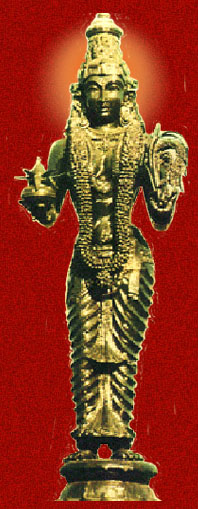
Telugu Talli
Mother Goddess of Andhras