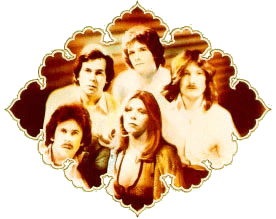
he mainstream Renaissance
lineup is most well known for their rich symphonic textures, stunning vocals and poetic
lyrics. They released nine albums evolving and developing their style from 1972 to 1983,
two anthologies and a live double album. Their style mixed classical progressions with
poetry and blended it with elements of rock, jazz and folk often embodying hauntingly
beautiful and international themes. he mainstream Renaissance
lineup is most well known for their rich symphonic textures, stunning vocals and poetic
lyrics. They released nine albums evolving and developing their style from 1972 to 1983,
two anthologies and a live double album. Their style mixed classical progressions with
poetry and blended it with elements of rock, jazz and folk often embodying hauntingly
beautiful and international themes.
In The Beginning:
1969 - 1972
Renaissance's history actually begins in 1969, when -- after the breakup of the Yardbirds
and a short stint as the acoustic group Together -- drummer Jim McCarty and
guitarist/vocalist Keith Relf were joined by classically-trained pianist John Hawken who
had earlier played with The Nashville Teens, bassist Louis Cennamo and Keith's
sister, vocalist Jane Relf. They released the band's debut self-titled LP in 1969,
produced by former Yardbird Paul Samwell Smith. The Renaissance (also
released as Kings And Queens in Europe) album included two lengthy tracks
and was dominated by Hawken's piano; it fused classical music and rock with eastern
themes, elements of jazz and folk, inaugurating the group's unique musical style. The band
toured extensively, feeling pressures as the Yardbirds had, but played some of the
major rock venues of the day including the Fillmore in New York and San Francisco.
A second LP, Illusion, emerged from the original lineup in 1971 with just
six songs and although initially released in Germany that year, it was not broadly
released until 1973. Cornish poetess and friend of Jane Relf, Betty Thatcher came aboard
to create lyrics for the tracks "Golden Thread" and "Past Orbits Of
Dust." She would go on to provide Renaissance a lyrical foundation for their
entire career with the exception of a final mainstream album and would continue writing
with the principal performing artists afterwards as well.
Actually, the original lineup started falling apart prior to the second album's
completion, giving rise to personnel and style changes over the next year before reaching
a stable lineup. McCarty hated to fly and left the band in 1970 when they were about to
embark on a European tour; Keith Relf and Louis Cennamo left shortly after to pursue a
heavier style, eventually forming Armageddon. But before the original Renaissance
had completely fallen apart, McCarty brought back his friend, guitarist and songwriter
Michael Dunford to carry on and recruit new band members. Dunford had worked with John
Hawken in The Nashville Teens and had been playing with the Plebs backing
American artists but was introduced to the Renaissance lineup in 1969. Keith Relf
and Jim McCarty opted for more of a background role where they could concentrate on
writing songs.
When it appeared that there was not enough material to fill the second album, the
original lineup got back together, without Hawken, but adding Michael Dunford to complete
the Illusion album with the recording of "Mr Pine" in the summer
of 1970. Session player Don Shin, with whom Louis Cennamo had played in James Taylor's
backing band, joined the original lineup for the track "Past Orbits Of Dust" on
electric piano. Hawken returned to lead the band while Dunford recruited vocalist Terry
Crowe, drummer Terry Slade to replace Jim McCarty, and Neil Korner to replace Louis
Cennamo on bass. This lineup -- Dunford, Hawken, Korner, Crowe, Slade and Jane Relf --
went on to tour Europe in September and October 1970.
After the Illusion album's drawn out completion and the European tour,
Dunford and McCarty, still behind the scenes with Renaissance, continued to handle
turnover in the band's lineup. Jane Relf quit after the tour completed in the fall of 1970
and was replaced by American female vocalist, Binky Cullom from late October to December
1970. John Hawken, dissatisfied with the new vocalist among other reasons, left to join Spooky
Tooth and was replaced by keyboard player John Tout around the same time. Hawken later
joined the Strawbs in 1973-1974.
Louis Cennamo left to join Colluseum and played on the Daughter Of Time
album. He then put together Axis with ex-Jody Grind members, then joined Steamhammer
which evolved into instrumental band Bogomas which ultimately folded in 1973. In
February 1974 he met up with Keith Relf again; they left for America with ex-Steamhammer
guitarist Martin Pugh. In Los Angeles they formed Armageddon with drummer Bobby
Caldwell, rehearsed for several months and flew back to London to record an album only to
break up immedately afterwards.
So by late 1970 all of the original performing band members had left and been
replaced. A bootleg video shot in late autumn 1970 of a live Renaissance
performance in Germany serves to commemorate this lineup and the significant transitions
occuring at the time.
Further changes were needed so Renaissance manager Jon Michelle worked with
Dunford and McCarty to fill in the new lineup. Melody Maker advertisements
were placed for new artists including one for a female singer. Annie Haslam, a brilliant
young singer with formal classical vocal training, a beautiful five-octave range and a
vivacious personality, answered the Melody Maker advert and got an audition
with the band where she met founding members Keith Relf and Jim McCarty. Annie, who had
been trained by Sybil Knight, the famous opera singer, learnt the Kings And Queens album
back to front before the audition and her vocal performance of the song "Island"
got her the job on New Year's Day 1971. Annie's stunning voice would begin a
transformation of the band and become one of the most recognised and well respected in the
industry. The lineup of Annie Haslam, John Tout, Terry Crowe, Neil Korner, Terry Slade and
Michael Dunford toured Europe extensively leading to further personal and acoustic
transitions. Danny McCullough, Frank Farrell and John Wetton each took their turn at bass
during the period. Keith Relf and Jim McCarty were still very much involved in the
direction of the band behind the scenes and while Relf eventually became disinterested,
McCarty remained involved until 1973.
Miles Copeland had met John Tout years before in Beirut when John was with Ruperts
People; after making contact again, he took over as the band's manager and John Sherry
became the band's agent in 1972. At that time Ed Bicknell, who later became Dire
Straits successful manager, was one of the booking agents involved. The current group
was disbanded and a new band was formed around Annie Haslam and John Tout while Dunford
was asked to concentrate on writing. Copeland arranged further auditions; bassist Jon Camp
was selected to replace Neil Korner and drummer Terence "Terry" Sullivan
replaced Terry Slade. This lineup of Renaissance played 11 gigs in 14 days and then
went into the studio to record what would become their first album entitled Prologue.
Michael Dunford wanted to focus on writing and production so he was replaced with young
guitarist Mick Parsons. Tragically, Parsons was killed in an automobile accident right
before the album was recorded so Rob Hendry was brought in last minute to replace him,
only to leave not long after the album -- dedicated by Renaissance to Parsons --
was released.
The completed and finally almost-stable Renaissance lineup -- Annie Haslam on
vocals, John Tout on keyboards, Jon Camp on bass, Rob Hendry on guitar and Terry Sullivan
on drums -- released their first album, Prologue, in 1972. With six tracks
evolving out of the original Renaissance sound to be more richly produced, it
included two McCarty-Thatcher songs, two Dunford-Thatcher collaborations and two
Dunford-written instrumentals with vocals but no lyrics. When asked how the band remained
solvent during the period from when Annie Haslam joined and the release of Prologue,
Michael Dunford replied, "the band toured just about everywhere."
Michael Dunford contributed significantly, working closely with Betty Thatcher to
achieve success with Prologue. Earlier Betty Thatcher had sent her poems
from Cornwall to Jim McCarty who would write songs around them. When Michael Dunford took
over writing for Renaissance, he sent sheet music and demo tapes of his romantic
songs to Cornwall where the poetess would add lyrics to them. They continued their
collaboration through the post, writing the majority of the band's music in this legendary
way. But Dunford would return in a larger role to play with the band later.
On The Frontier:
1973 - 1980
Still in the Renaissance background writing when he could with Betty Thatcher,
Jim McCarty wrote songs, including a single recorded by Jane Relf entitled "Without A
Song From You" b/w "Make My Time Pass By." He formed a group in 1973 called
Shoot whose only release, On The Frontier, featured a title track
written by McCarty and Thatcher that Renaissance liked, and therefore included
their rendition of it on their album Ashes Are Burning. It would be not be
the last track from the duo that Renaissance recorded. John Tout, by then Renaissance's
keyboard player, also "guest"-appeared on the Shoot album performing on
the track "Old Time Religion." Jim McCarty's final contribution to Renaissance
is his collaboration with Michael Dunford on the track "Things I Don't
Understand" which appeared on the Turn Of The Cards album.
The new Renaissance lineup toured extensively beginning in 1973 to promote Prologue
while the material for their next album was written. Rob Hendry departed after Prologue
was released while Michael Dunford concentrated on writing new songs. Dunford recalls that
Peter Finer played guitar with Renaissance during these tours.
Their second and even more successful album, Ashes Are Burning, released
in 1973, included an orchestra brought in for the recording and although Andy Powell
played electric guitar on the title track, the second album was generally more acoustic
than the first album. Dunford's extensive acoustic guitar parts and the band's orchestral
arrangements began to emerge as a key component of the Renaissance sound and the
electric guitar was primarily set to one side. It would not return until years later.
Dunford actually rejoined the band as their official guitarist prior to release of Ashes
Are Burning, but his role as guitarist was excluded from the sleeve notes which
were conceived and printed a long time prior to the release.
Miles Copeland formed BTM in 1974 and took Renaissance with him. The band
changed labels to Sire in the USA for 1975's release of Turn Of The Cards.
The album received a lot of airplay, and now highly successful across both Europe and
North America, Renaissance had a loyal following that attended concerts accompanied
by the philharmonic orchestras in Manchester, Birmingham, London and New York. The tour
included a performance at the Royal Albert Hall and two other UK venues playing with the
Royal Philharmonic. A 1975 British concert tour program, published in 1975 features lyrics
to "Mother Russia" artistically hand-lettered by Annie Haslam, and commemorates
their music and the musical moods of the day.
Renaissance also played with the New York Philharmonic at Carnegie Hall. A
double live album of their 1975 three-night sell-out Carnegie Hall performance was
released in 1976 that featured the title track lasting almost thirty minutes from their
then forthcoming album Scheherezade And Other Stories released later in
1975. The New York Philharmonic perfectly complemented Renaissance's vocal
harmonies. As a hallmark of their success, WNEW-FM (New York) named Renaissance one
of the top five artists of the year in 1975 (and would in 1976 as well) and Record
World named them the Best Vocal Combination Of The Year in 1975. Many
critics and fans alike consider Scheherazade to be one of the finest Renaissance
albums, and one of the finest classical/rock fusion albums ever. Michael Dunford realised
the potential of the "Song Of Scheherazade" and formed his initial concepts for
a musical based on this piece after seeing the audience reaction to it being performed
live with a full orchestra.
The "ultimate" Renaissance performance was held in in Radio City Music
Hall in December 1976 and featured the band rising to the stage in a brand-new yellow
taxicab with Annie behind the wheel. Annie Haslam recalls, "The crowd was
screaming, waiting for us to come out, and up we came, with me honking the horn. We got
out of the taxi and six super-troopers came right up on us. It was fantastic."
The staging was spectacular and a castle backdrop complimented the bands' attire
perfectly.
The band continued touring and recording in an attempt to capitalize in their mid-1970s
successes. Another label change was made, this time to the giant Warner Brothers Records. Novella,
from 1977 included Jon Camp's solo vocals to some extent while still featuring orchestral
arrangements and the beauty and range of Annie Haslam's voice which had developed
significantly. Camp took more of a lead in writing the band's material introducing shorter
songs and changes to the band's sound making it more electric and almost new wave-ish.
Annie released her first solo album entitled Annie In Wonderland in 1977,
produced by Roy Wood who Annie was living with at the time just outside Birmingham. Roy
had gotten Annie to experiment more with her voice in the studio as evident in the song
"Northern Lights" on the A Song For All Seasons album released in
1978. "Northern Lights" became a top 10 hit for the band on the UK charts and
several versions of the single were released including a 7" picture disc featuring a
lovely photo of the band's lineup. The album saw further changes, including the prominence
of synthesizers and re-introduction of electric guitars, orchestral arrangements by ELO's
Louis Clark, and the band's first outside producer, David Hentschel. The band left Miles
Copeland and signed with the well-known New Jersey promoter, John Scher.
As they became even more well known, Renaissance was also sought after to do
music for film and television. In a 1977 radio interview with Alison Steele, John Tout
remarked, "Somebody wants us, I'm not quite sure who it is, I don't know whether
Annie knows ... We're doing [music for a film version of] the book, The Last
Unicorn; they are turning it into a full length cartoon film and they have asked us to
do the music for that. And at the moment we are working on an English children's
television drama series which is also very exciting ..." This television series
was The Paper Lads. The opening theme, "Back Home Once Again,"
written by Jon Camp and Michael Dunford and recorded by Renaissance, was originally
released in late 1977 as a 7" vinyl single backed with the track "The Captive
Heart" from Novella. "Back Home Once Again" was also included
on the 1978 album A Song For All Seasons.
The soundtrack for The Last Unicorn was actually written and performed by
the band America. It seems that the Renaissance role in the film disappeared
sometime after the radio interview was originally aired.
Azure d'Or, released in 1979, is viewed as a turning point when Renaissance's
music changed significantly and the band went in a different, more commercial direction.
The symphonic epics were replaced by shorter tracks with many synthesizer overdubs and --
for the first time since the early days -- no orchestral instruments. While some songs
might have joined the classics that Renaissance had done earlier, many fans were
slow to take the change, and the album was viewed as being largely unsuccessful.
An Azure d'Or track listing published prior to the album's release in the
Renaissance Appreciation Society newsletter included the song "Island Of
Avalon," but it was missing when the album was released. Viewed by some critics as an
excellent track, the band didn't devote their normal amount of time to it and therefore
felt it wasn't good enough to include on the album. The song was eventually released in
April 1979 as the b-side of the "Winter Tree" single which had been included on
the Azure d'Or album. Some have never understood why the instrumental track
entitled "The Discovery" made it onto the album while "Island Of
Avalon," which is a much more typical Renaissance track with Annie Haslam's
strong female vocal lead was left off.
Upon return from a short tour of Israel in 1980, eight-year veteran John Tout had grown
tired of the music business and touring lifestyle so he left Renaissance and
eventually pursued a career with British Telecom. Most likely due to stress following his
sister's death, Tout made a major mistake in a song during a concert and walked off stage,
leaving the band to finish the set without keyboards. The band decided it couldn't risk
that happening again so it was mutually decided that he should leave. When Terry Sullivan
learned that his long time friend John Tout was sacked, he decided to leave the band as a
matter of principle. Warner Brothers/Sire dropped the group after sales of Azure
d'Or proved disappointing and after turning down several offers from other labels,
Renaissance faced a very uncertain future.
Bonjour Swansong:
1981 - 1983
The remaining three members regained their individuality and started fresh having
separated from their prior management arrangements. Jon Camp joined Roy Wood's band Helicopters.
Annie Haslam and Michael Dunford formed a group called Nevada and brought Peter
Gosling on board; Dunford thought Nevada could grow alongside Renaissance.
Nevada did some demos including "Mr. Spaceman," got a deal with
PolyGram and released the singles "In The Bleak Midwinter" b/w "Pictures In
The Fire" in 1980 and "You Know I Like It" b/w "Once In A
Lifetime" in 1981 on the Polydor UK label. Of the four songs, all except "Once
In A Lifetime" feature Annie Haslam's lead vocals. The band's sound and style --
although different from that of the Renaissance to date -- is similar to one that
would emerge on Renaissance's final two albums in some respects. Lead vocals on
"Once In A Lifetime" were provided by Peter Gosling; the song was completely
different and is reminiscent of Peter Gabriel's work. "In The Bleak Midwinter"
got some airplay, charted at number 71 in the 8 January 1983 UK Top 100 and appears to
have been one of the trio's favourites. This song was liked by audiences and the band
alike and was performed live by Renaissance later in their career.
By 1981 Michael Dunford, Annie Haslam and Jon Camp wanted to get Renaissance back
together so they enlisted Peter Gosling who had worked with Nevada for keyboards
and Peter Barron for drums. A new, very different, Renaissance album entitled Camera
Camera appeared later that year on Miles Copeland's IRS Records, home of groups
such as The Police and The Go-Gos. Dominent popular trends in the music
industry, coupled with the lack of orchestral work, damaged the album's appeal, but the
songs worked quite well live, making three subsequent Renaissance tours extremely
successful with fans coming out in large numbers to warmly welcome them back. Camera
Camera actually cracked the Billboard charts for a short time, and
was relatively well received by critics.
The final Renaissance album featuring new material, Time-Line ,
came out in 1983 as a followup to Camera Camera. It was a completely new
musical direction for the band and was the largest departure from their earlier orchestral
style, including dance rock, ballad and progressive influences, but was still bound
together by Annie Haslam's vocals. Betty Thatcher -- who had provided a lyrical foundation
since the first Renaissance album -- departed, and Jon Camp took over the lyricist
role on Time-Line, contributing to further changes. The album was
constructed with the dense, rich production that had become the band's trademark. A
furious debate amongst Renaissance purists ensued with one side favouring the
earlier sound, and the other supporting the band's latest changes, including their rougher
texture. The album didn't work commercially, and (despite several of the tracks being
excellent pop songs) received the most scathing reviews of the band's history. Soon after,
Annie, Michael and Jon found themselves back as a threesome.
Not ready to give up, Renaissance placed another ad in Melody Maker
and were inundated with around 300 replies. They recruited drummer Gavin Harrison and Mike
Taylor in 1983. The Time-Line tour demonstrated that their fans' enthusiasm
had not diminished one bit; Renaissance continued to play to packed houses. The
touring wasn't enough to sustain interest in the group, however, and the two newest band
members left after the tour. IRS Records was a 'New Wave' label where Renaissance
was hopelessly out of place so IRS dropped the band in 1984.
At least three tracks recorded leading up to and during the Time-Line sessions
weren't released with the album. "Africa" and "America" were finally
released on the two CD Renaissance pseudo-box set by Repertoire Records
entitled Da Capo with songs selected by Annie Haslam. A printing error in
the liner notes accompanying this release revealed the name of a third unreleased track,
entitled "Writers Wronged." "America" was actually pressed as the
final track however the liner notes said the final track was "Writers Wronged."
The second pressing of Da Capo has been done correctly and "Writers
Wronged" is the final track.
Distant Horizons:
1984 - 1987
Renaissance soldiered on without a recording contract. Jon Camp left to join Cathedral,
leaving the band without his distinctively melodic bass guitar for the first time in over
a decade. Keyboard player Raphael Rudd and bassist/guitarist Mark Lampariello, both from
the USA, joined Annie and Michael as the newest version of Renaissance and toured
as an acoustic quartet from 1985 through 1987 when they finally called it a day and
disbanded. Their final concert was held on June 6 at the Club Bené in Sayreville, New
Jersey before a dedicated audience of friends and fans, many of whom had followed them
since the early days. But that's not the end of the artists' history by any means.
In 1990 Sire Records released a Renaissance two volume CD compilation (each sold
separately) entitled Tales of 1001 Nights. These compilations did not
include tracks from the last two albums, Camera Camera and Time-Line,
but were accompanied by liner notes that referred to them. Volume I spanned
the band's music from 1974 to 1976 and Volume II covered 1976 to 1979; Sire
achieved six-figure sales in the USA and Canada on these first Renaissance CD
compilations with neither promotion nor marketing campaign. Other Renaissance products,
principally the first four mainstream-era albums, have been released on the CD format in
various territories to the same effect. Clearly fans that followed Renaissance
before have converted to CD and passed the word along to an ever emerging audience.
Indeed, now every Renaissance album is readily available in the CD format, and HTD
Records (UK), OneWay Records (USA), Warner Brothers Europe and Repertoire Records
(Germany) are heavily engaged in reissuing Renaissance's albums.
There is a long standing controversy over the timings on the Scheherazade and
Other Stories LP. While the timings for each section of the piece match up with
the breaks in the music, there is a discrepancy in the titles of each section between the
record label and the album's accompanying lyric sheet. For example, the track that begins
at 2:37 is called "The Betrayal" on the record label but according to the lyric
sheet, the song is actually "The Sultan." Likewise, the song that begins at
10:10 is called "Love Theme" on the label, but the lyric sheet calls it
"The Young Prince and Princess." This discrepancy has been carried through to
Sire/Warner's 1001 Nights compilation, in that the track listed as "The
Young Prince and Princess," while the same track that begins at 12:40 on the LP is
actually "Festival Preparations." The perpetuation of this mistake stopped with
Repertoire's 1995 release Da Capo where the track listed as "The Young
Prince and Princess as Told by Scheherazade" is the actual track.
No Beginning No
End: 1987 - 1997
Renaissance fans following the music press and internet web pages know there are
further unreleased Renaissance and Nevada recordings and new CD releases
including these are popular topics of discussion. Radio broadcasts of both demonstration
tapes and live concerts in the late 1980s revealed them to the fans. "The Animals Are
Back," "Dreamaker," "No Beginning, No End,"
"Communication" and a different version of "Northern Lights" are among
these. "Communication" was written by B. A. Robertson and Mike Rutherford from Genesis,
however Annie Haslam was the first to record it. Unfortunately this recording, like
several of the others, did not go beyond the demonstration stage.
"Dreamaker" features lyrics by Jon Camp and music by Michael Dunford;
alternative lyrics for the song with a completely different theme were written by Betty
Thatcher years later for the same music resulting in "Love Lies, Love Dies." Two
versions were subsequently recorded and released -- one by Annie Haslam and the other by
Michael Dunford. An Annie Haslam "Northern Lights" demonstration recording was
also broadcast during this time period with "No Beginning, No End" also written
by Michael Dunford with lyrics by Betty Thatcher Newsinger.
While there are many bootleg tapes of the band's live performances circulating in the
fan community, only one of them appears to have been marketed commercially in that it was
sold more or less on the open market in CD format. Entitled Live In London (1975),
it is a live recording of the band performing tracks from Turn Of The Cards
and Scheherazade at the London Hippodrome and appears to be a reasonably
good quality transcription of a radio broadcast. Another bootleg entitled Moments Of
Truth has been confirmed to be an alternative "release" of the same
recording.
The long-awaited Renaissance rarities album of previously unreleased songs
finally emerged on the HTD (UK) label through the collaboration of Michael Dunford and
Annie Haslam. The music was recorded between 1979 and 1988, much of it between Time-Line
and the breakup of the mainstream band, and fills a gap in the band's evolution. Songs
From Renaissance Days released in April 1997 includes a vast array of rare tracks
including: "Africa," "Island Of Avalon," "Writers Wronged,"
"Dreamaker," "America," "Only When I Laugh," "The Body
Machine," "No Beginning No End," "Northern Lights" (1988 Version)
and "You." The album's artwork was designed and produced by Annie Haslam.
Remixed by Michael Dunford and supported by Annie Haslam in the USA, the first CD from
a two-hour live performance recorded on 14 October 1977 at the Royal Albert Hall during
the Novella tour, entitled Renaissance Live With The Royal
Philharmonic Orchestra - Part 1, was released by King Biscuit Flower Hour Records
in February 1997. Originally made and used for radio broadcast, Michael Dunford points
out, "it's not at all like the Carnegie Hall album, it's a bit rougher, and
you get a real feel of the live show from it." Part 1 features a stunning
orchestral arrangement of the track "Prologue" used to open the show. Harry
Rabinowitz conducts the Royal Philharmonic Orchestra throughout the concert. The concert
is completed with Part 2, released in March 1997, also featuring the
previously unreleased track "You" and "A Song For All Seasons"
recorded live 28 July 1979 in Asbury Park, New Jersey. The artwork for Part 2
contains an error stating "Prologue" is pressed where "A Song For All
Seasons" has been placed on this album.
Where Are They Now?
In recent years, following the great success of many progressive '70s bands in
reuniting and even, in many cases, continuing to tour and record on an ongoing basis,
attempts were made to assemble all the original members from the most well-known Renaissance
lineup. However, enthusiasm on the part of some was unable to overpower individual
artistic persuits, views on the business and long-standing differences, so the best-loved
version of Renaissance remains a closed book.
Annie Haslam
Annie Haslam's solo career has continued to develop and she has a significant loyal
following around the world. In 1977 she contributed as lead vocalist to a multi-artist
effort entitled The Intergalactic Touring Band also involving Larry Fast who
would later perform on and produce one of her solo albums. Two years later she contributed
backing vocals to the track "Dancin' On The Rainbow's End" on a Roy Wood album
called On The Road Again. She made a similar contribution to the track
"The Rain Came Down" on Wood's album Mustard released in 1975.
In 1984, following the release of Time-Line, Annie Haslam devised the
original concept and teamed up with Louis Clark, who had conducted earlier orchestral
arrangements on A Song For All Seasons, the Royal Philharmonic Orchestra and
Betty Thatcher to make the album Still Life initially only released in the
UK and broadcast on the BBC; this album was subsequently reissued both in Japan and the
USA. Annie's stunning vocals express Betty Thatcher's lyrics to highly memorable classical
movements, some of which are accompanied by The Royal Choral Society. The album was
engineered by Dick Plant who had done so for Renaissance's releases from Novella
onwards.
Annie contributed vocals to a single entitled "So The Story Goes" which was
released during the 1985 Christmas season as part of a 200-strong various artist group
doing work for charity that called themselves Philadelphia For Philadelphia. More
than 10,000 copies of the single were sold and the producers were given awards for their
work by local Philadelphia and Pennsylvania state government officials.
Annie then moved to the United States and re-joined forces with keyboard player Raphael
Rudd and guitarist Mark Lampariello to form The Annie Haslam Band and secured a
deal with Epic Records. Her debut album on Epic self-titled Annie Haslam was
produced by Larry Fast in 1989 with Denny Bridges doing the engineering. Justin Hayward's Moody
Blues sound emerges several times in the album but most notably in the track "The
Angels Cry" that he worte and performs with Annie and her band. The album has a more
adult contemporary feel than her earlier work but Annie's vocals carry it to explore a
further range and depth of her talent. The album went largely un-noticed, except by her
fans, because Epic failed to promote it.
Raphael Rudd and Mark Lampariello went their own way touring with a group of other
talented musicians afterwards. Raphael Rudd went on to record an album entitled Skydancer
that includes a tremendous vocal track by Annie Haslam entitled "Seasons"
recorded in August 1989. The album was released in Japan in 1991. Raphael Rudd's 1996
double CD set entitled The Awakening includes the Skydancer
tracks on the one CD and work recorded with Annie Haslam, Pete Townshend, Phil Collins and
others in 1978 on the other CD. Annie's vocals are featured on the album's tracks from the
1978 recording including "Seasons," "Willow Song" and she also sings
"The Awakening" with Pete Townshend. Writes Raphael Rudd, "I knew that
this magical project was complete when Annie Haslam of Renaissance agreed to lend her
tremendous vocal talents to "Seasons" - a piece I had written with Annie in
mind. As these things go, fate also dealt me a continuing relationship with Annie when I
joined Renaissance in 1983. We even performed "Seasons" together for several
years on tour."
During 1988, Annie Haslam contributed to a multi-artist studio effort featuring the
poetry of Sir John Betjeman set to music by Mike Read called Poetry In Motion
which was eventually released in 1990. The album was produced by Rod Edwards, who also
worked with Annie on the demonstration recordings that ultimately led to her deal with
Epic Records. On Poetry In Motion, Annie sings an unusual song entitled
"Hunter Trials" which was recorded in Read's conservatory (due to the excellent
acoustics) on a very hot day, wearing shorts, using the Rolling Stones mobile
recording studio parked just outside Read's home. Read said he was so happy with the
result that several of the other tracks for the album were recorded in the same manner.
Justin Hayward is another one of the many musicians involved on this album. "Hunter
Trials" was actually broadcast to a Philadelphia audience during a radio interview
with Annie Haslam in 1988, almost two full years prior to the Poetry In Motion
release.
The Annie Haslam album was released in Japan as Moonlight Shadow
on Virgin Records. A high profile music video of the title track was made in a church
setting to promote the album in Japan. Her later promotional tour there was very well
received. She was very popular and this led to the 1991 Japanese CD re-releases by
Sire/Warner-Pioneer of Renaissance's Novella, Azure d'Or, A
Song For All Seasons and Annie In Wonderland. It also led to the
Japanese CD re-release by Apollon International of Still Life. Annie
collaborated with Akio Dobashi on his 1990 Virgin Records Japan release Fox.
Annie emerged writing her own poetic lyrics and went on to perform with typically stunning
vocals on four of the album's ten tracks accompanied by Dobashi. A music video of the
track "Lost In Love" featuring Annie was made to promote the album in Japan.
Singing better than she believes she has ever done before, Annie survived the breast
cancer she was treated for in 1993 and then got back into business with a band called Annie
Haslam's Renaissance. She wrote poems and Tony Visconti put them to music and likens
it to how Thatcher and Dunford "used to work in the old days." Visconti also
co-wrote six of the tracks.
The album resulting from the collaboration is entitled Blessing In Disguise.
Released in 1994, it has fourteen songs and spans the entire range of Annie's musical
abilities including tracks with a texture reminiscent of Renaissance's earlier work
and those that go on beyond where the band left off. Both Betty Thatcher-Newsinger and
Michael Dunford contributed to Blessing In Disguise in co-writing "Love
Lies, Love Dies" also performed on The Other Woman by Dunford and his
new vocalist. Betty Thatcher-Newsinger also wrote lyrics for "The Sweetest
Kiss."
The song "Love Lies, Love Dies" uses essentially the same music as the
earlier "Dreamaker" released on 1997's Songs From Renaissance Days,
making it another example of songs the artists have performed with two different sets of
lyrics. Another pair is "Save Us All" from Still Life and
"Cold Is Being" from Turn Of The Cards which both use Albinoni's
"Adagio Giazotto" as their musical foundation.
Annie Haslam's 1995 recordings include her single "Lily's In The Field" and,
on the Yes tribute,Tales From Yesterday she sings "Turn Of The
Century," both with Steve Howe; she also recorded the track "Ripples" for
the Genesis tribute Suppers Ready. All three of these were recorded
with David "Squiggy" Biglin on keyboards and were engineered by Denny Bridges
both from Annie Haslam's Renaissance.
Annie still tours extensively and adores performing at intimate venues where she can
chat and interact with her fans from the stage. She has been very active in a charity that
helps Bosnian orphans and organised a sold-out multimega-artist benefit concert. The 1995
track, "Lily's In The Field," written and perfomed by Annie Haslam with Steve
Howe and arranged by David Biglin, was sold as a limited edition CD at the Benefit Concert
for Orphan Children in Bosnia - Hercegovina held in New York on 21 November 1995. A
special dedication to Alison Steele was made by Annie Haslam in the concert brochure and
posters promoting the event. Annie and Alison grew very close over the years and Alison's
support of both Renaissance and Annie Haslam's solo career was evident in the
amount of promotional airplay she gave their music as well as the frequent interviews
conducted on her "Nightbird" radio broadcast in New York City.
"Lily's In The Field" is Annie's second release performing with Steve Howe.
The two decided to do an album together and recording has been underway in the UK and USA
since the summer of 1995; live performances of some of the new songs have been very well
received by their fans. The project is expected to complete and result in an album release
now planned for 1997.
Annie Haslam switched management to The White Dove Organisation in 1996 where
she has an exclusive contract today. At this writing, Annie is recording a new album with
her current lineup, and although some of the songs have already been completed, the album
is planned for release during 1997. Annie's first concerts in Brazil are scheduled for
March 1997. Both Annie's solo project and Renaissance songs will be performed
acoustically with David Biglin accompanying on guitar, keyboard and vocals and Denny
Bridges doing the engineering.
Recordings of Annie Haslam's music also circulate among the fan community. One of the
most recent include her performances with the band Sojourn and feature a selection
of Christmas carols. One very high quality bootleg CD was offered "commercially"
entitled Waterfalls Of Sounds, but it is now deleted. It is a recording of a
live performance by The Annie Haslam Band in September 1990 and includes several
well-known tracks from the Renaissance albums and the Annie Haslam
album.
Sojourn opened for Annie Haslam many times, including a concert at the TLA in
Philadelphia in June 1996. Like the band October Project, Sojourn is very fond of Renaissance
and Annie Haslam's music and recently signed with Mercury Records but has had to change
their band name to Grey Eye Glances for legal reasons. Unfortunately, October
Project split up in the summer of 1996, largely disappointed by lack of support by
their record company. Annie Haslam introduced Terry Sullivan to October Project in
one of their outstanding live performances. After an early 1996 Philadelphia performance
that Annie attended, OP's lead vocalist Mary Fahl asked a fan how she liked the concert;
when Mary heard that Annie was in the audience, she exclaimed, "You mean Annie
Haslam was really in the audience and heard me perform ... wow!!"
In what is becoming a regular event, Annie holds a Candlelight Concert during the
Christmas holiday season. Like those at the clubs in the northeast held throughout the
year these concerts are highlighted by songs spanning her entire career. The Candlelight
Concerts however feature special performances by Raphael Rudd and her band's unique
rendition of poplular Christmas carols. Tony Visconti was a guest performer at the 1995
Candlelight Concert.
Plans for a Brazilian tour were initiated in late 1996 following Annie's 21 June
performance at the Bottom Line in New York. Annie and David "Squiggy" Biglin
wrote a new song entitled "Brazilian Skies" and recorded backing tracks for it.
Annie, Squiggy and their expert soundman Denny Bridges subsequently traveled to Brazil in
March 1997 and played four shows to sellout crowds, in São Paulo, Rio De Janeiro and
Pétropolis, organised by long-time fans Luiz Octavio Drummond and Carlos Edmar. The
concerts featured songs spanning Annie's entire career, including "Let It
Grow," Brazil's favourite among the many Renaissance classic tracks performed.
Digital recordings were made during the shows for a live album that will include some of
Annie's newest songs -- "Seashell Eyes," "Summon The Angels,"
"Sometimes," and the all-new "Brazilian Skies" -- amongst other
classics. Squiggy recorded backing tracks for six songs which worked well to add texture
during the concerts and on the live recordings. With a working title of Under
Brazilian Skies, the album is expected to be released during 1997. A full review
of the concerts including set lists, by this author can be accessed from the Reviews
and Interviews index of the Northern Lights web site.
Michael Dunford
Michael Dunford's story offers another thread to the Renaissance history. He and
Betty Thatcher-Newsinger were a significant driving force behind Renaissance during
the period 1972 through 1983 and wrote the majority of the group's material. Michael has
been working on a musical and stage production of Scheherazade since 1988,
but to date, nothing has emerged, although Michael reports that work is still actively
underway.
In a session recording tracks for the new musical featuring lyrics by Betty
Thatcher-Newsinger, Michael met an American vocalist named Stephanie Adlington. Michael
called Stephanie a few weeks after the sessions and asked her to record a new demo of
"Northern Lights" and then recorded the first demos for the album that would
become The Other Woman. He and Betty Thatcher-Newsinger wrote new music and
lyrics during 1994 and the new album was released in the UK and Europe early in 1995.
Stephanie Adlington grew up in West Virginia to the sounds of The Doobie Brothers
and The Eagles and watching old musicals from the '50s and '60s like The
Music Man and Oklahoma!. She's a Renaissance fan whose
favourite song is "Ocean Gypsy," and calls herself an '80s child, loving most of
the music from that period. Stephanie completed two years at the Eastman School of Music
in Rochester, New York before realising that she needed to continue her classical study
while having the opportunity to perform music theatre and commercial music/pop which is
what led her to complete her education at the Royal Academy of Music in London.
On The Other Woman, Michael plays acoustic guitar and he is joined by
Stuart Bradbury on lead guitar, Dave Dowle on drums and Phil Mulford on bass. The new
lineup is completed by Andy Spiller on keyboards and synthesizer programming who has also
produced the album. The Other Woman contains a remix of "Northern
Lights," shares a song common with Annie Haslam's Blessing In Disguise
entitled "Love Lies, Love Dies" and has been produced more commercially than
previous Renaissance releases.
The track "May You Be Blessed" on The Other Woman actually
features the same musical foundation as Part 1 of the rare Renaissance track
"You." It is yet another example of multiple uses of Michael Dunford's
compositions.
Two new albums by Michael Dunford, Stephanie Adlington and guest musicians are being
recorded. They will feature acoustic versions of favourite Renaissance songs from
the mainstream era plus several new tracks and are scheduled for release by HTD (UK)
Records in spring and autumn 1997 respectively.
The first of these albums is entitled Ocean Gypsy. The album departs
significantly from The Other Woman and returns to a more
progressive-folk-rock genre of the mainstream era with more contemporary arrangements of
classic mid-1970s Renaissance tunes. It features Michael Dunford on guitar, vocals
and harp with entirely new arrangements and Stephanie's vocals. Stephanie has developed
her style significantly, adding warmth and a different texture to several classic songs.
Two entirely new songs have also been recorded. "The Great Highway" is similar
in style to what the band was doing in the 1970s but with a more contemporary feel; lyrics
are by playwright Jude Alderson, a close friend of Stephanie's from the Royal Academy of
Music who is also working with Michael on the Scheherazade musical.
"Star Of The Show" is a classic ballad with vocals and piano only. The other
seven tracks span Ashes Are Burning to Scheherazade, having
been recorded acoustically with orchestral arrangements provided by Richard Brown,
Michael's co-composer for the Scheherazade musical, and musical director of
the Royal Shakespeare Company.
Progress on the Scheherazade musical is being made and workshops are
planned for the London area by summer 1997.
Tout, Sullivan, Camp
John Tout and Terry Sullivan are recording again and would like to release an album in
1997. While firm arrangements have not been made, the lineup is being filled in with other
musicians and a female vocalist while a record deal is being sought. The two wish to come
back into the progressive music scene and provide a new audience and the existing Renaissance
fan base with a sampler of new music they have written.
Jon Camp has not surfaced either in the fan community or music press since the band he
joined fizzled out and he contacted Annie Haslam and Michael Dunford in an attempt to
rejoin the Renaissance lineup in 1994. The response he got back then was, "No
way, pal." Terry Sullivan believes Jon will return to the scene eventually and
confirmed Jon is still in the business.
Annie Haslam stays in touch with Terry Sullivan and the two remain good friends.
The Original Renaissance: McCarty, Relf, et al
The conclusion of the original Renaissance thread, begins with news that Keith
Relf died tragically, electrocuted while playing his guitar at home in 1976 during the
initial stages of recording material for an album under a new band name; in fact some of
these early tracks appear on the album Enchanted Caress discussed below.
Relf suffered with asthma which was compounded by his heavy smoking and some believe that
it was Relf's overall physical condition that caused what might have been only a shock to
others to be enough electrocute him. Hawken was later reunited with Cennamo, McCarty and
Jane Relf in 1977 after Renaissance had reconstituted with the mainstream lineup.
Although the precise stories on the subject differ, the name Renaissance went more
or less peacefully with the new lineup and their evolving sound. But the reunited people
needed a name for their band so became Illusion and subsequently released two
albums, sharing some acoustic similarity with the mainstream Renaissance, entitled Out
Of The Mist and Illusion. Material was recorded by the group for a
third album in 1979 entitled Enchanted Caress that was not formally released
until 1990; it was re-released in 1997.
Louis Cennamo and Jim McCarty remain active in music today recording as Stairway. Their
album Moonstone features a lovely track with Jane Relf on vocals called
"Aquamarine." Jim has also recorded a very different solo album entitled Out
Of The Dark with Jane Relf on backing vocals and has also released two albums as
part of the Pretty Things/Yardbird Blues Band both via Demon Records.
-- Russell
W. Elliot
|
 Renaissance