A Great American
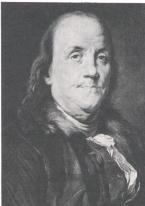
Benjamin Franklin
1706-1790
Born:
January 17, 1706 in Boston, Massachusetts, the 15th of 17 children.Education:
Taught at home by his father,Occupation:
Printmaker, writer, inventor, public official, candlemaker, soapmaker.Family Life:
Took Deborah Read as his common-law wife in 1730. They had two children -- a son who died in infancy and a daughter, Sarah (1744-1808). Franklin also had a son outside his relationship with Deborah Read, William (1731-1813), who grew up in Franklin's household and served as his father's diplomatic assistant. William became the royal governor of New Jersey in 1763 and remained loyal to the crown in the American Revolution.Political Career:
Helped to organize the first police force and fire company in the colonies. Franklin was Philadelphia's first postmaster. Franklin was a member of the Continental Congress and later an American agent to France 1778-81. Served as President of the Supreme Executive Council of Pennsylvania. Became a delegate to the Constitutional Convention in 1787.Highlights of His Career:
The only person whose name appears on all four of the great documents connected with the founding of the United States: the Declaration of Independence, the treaty of alliance with France, the Treaty of Paris that ended the war with Great Britain, and the U.S. Constitution. Author of Poor Richard's Almanack from 1732 until 1757. Pioneer in the study of electricity and invented the lightning rod. Invented a new type of heating stove called the Franklin Stove. Invented bifocal eyeglasses.Appearance:
Died:
April 17, 1790 at the age of 84.Buried:
|
The Body of Benjamin Franklin Printer (Like the Cover of an Old Book Its Contents Torn Out And Stript of Its Lettering and Gilding) Lies Here, Food for Worms. But the Work Shall Not be Lost For it Will (As he Believed) Appear Once More In a New and More Elegant Edition Revised and Corrected By The Author ~ Epitaph written by himself |
Famous Words:
"Never leave that till tomorrow which you can do today."" . . . in this world nothing is certain but death and taxes." From a letter to M. Leroy