A Great American
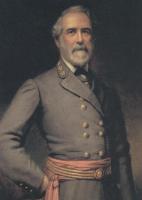
Robert E. Lee
Confederate General
Born:
January 19, 1807, at "Stratford" in Westmoreland County, Virginia.Education:
Graduated second in his class from the United States Military Academy at West Point in 1829.Occupation:
Soldier, educator, and public servant.Religion:
Family Life:
Robert E. Lee was the son of Henry Lee, also known as "Light-Horse Harry" Lee, who was a Revolutionary War hero and former governor of Virginia. Lee grew up in Alexandria, Virginia. Lee married Mary Ann Randolph Custis (a great-granddaughter of Mrs. George Washington) in 1831. His wife inherited an estate on the Potomac River in Virginia called Arlington which became the Lee's home. Today, the land of his estate is the site of Arlington National Cemetery and the home is a memorial to Lee.Political Career:
Lee avoided politics, but urged Southerners to accept defeat and work towards rebuilding the South.Highlights of His Career:
A United States and Confederate Army officer, commanding general for the Confederate Army of Northern Virginia, Lee is considered among the master military commanders of history. Lee was an Army Engineer then served in the Mexican War 1846-48, where General Winfield Scott referred to him as "the best American soldier" he had ever seen. Lee was named superintendent at West Point in 1852. Lee captured John Brown and his raiding party at the rescue of Harper's Ferry, Virginia in 1859. Appointed principal military advisor and general to Confederate President Jefferson Davis. Lee's troops scored a major victory over the Union forces under General John Pope in the second battle of Bull Run in August 1862. Lee scored his greatest triumph when his 60,000 troops held off 100,000 troops under General Joseph Hooker at Chancellorsvile, Virginia in May 1863. However, Lee was defeated in the Battle of Gettysburg by troops led by General Ulysses S. Grant. Lee surrendered to Grant at Appomattox Court House on April 9, 1865. Lee became president of Washington College at Lexington, Virginia in 1865.Lee was deprived of certain rights of citizenship after the civil War, but in a symbolic gesture, Congress restored his citizenship in 1975.
After his death, Lee was elected to the Hall of Fame for Great Americans in 1900.
Appearance:
Lee was admired because he was considered both a handsome man as well as a man of great dignity and high moral principles.Died:
October 12, 1870Buried:
Entombed in the chapel of Washington and Lee University in Lexington, Virginia.Famous Words:
"I cannot raise my hand against my birthplace, my home, my children." ~ 1861