The Cache
Of The Man Of Bells
By
Sandy Cline
JULY1983
During the 17th and 18th century, the backbone of North American
economy was the furtrade. The abundant availability of furs in
the New World created a new fashion in France and spread to the
rest of Europe. The competition between the various trading nations
created a sellers market for the man who trapped the animals.
The main supplier of furs was the Indian.
The Indian culture was not attuned to the acquisition of coin
and notes as personal wealth. The Indian dis-played his wealth
on his person as weapons and jewelry.
A wealthy Indian would carry a musket, sword and axe. His clothes
were festooned with brooches and beads Braidholders, headbands
adorned his hair. Bands of silver or brass encircled his arms
and fingers. From his ears and nose hung earrings, some-times
a foot long. The sunlight would turn him into a glittering display
of wealth.
The demand for silver to use as trade items was great. The scarcity
of post revolutionary silver coinage can be attributed to fur
trade. Often these coins are recovered in Indian village sites,
holed, as to be worn as ornaments. Silver plate was cut into
small pieces to be traded. The touchmark of the original silversmith
will some-times be found on a small piece of silver that was
used as an earring.
Touchmarks are small designs stamped into a piece of silverware
to denote the maker, his hometown, the date of manufacture and
the verification that it is silver. A lion, one paw raised, was
the equivalent of the modern, "Sterling." A letter
was used to represent the date. The style of the letter was changed
when the sequence of the alphabet had terminated.
These marks can help to date a site. For those wishing to obtain
a book that may help them in this aspect, I would recommend A
Dictionary of Marks by Margaret Macdonald-Taylor.
The various expeditions against the Indian tribes by the white
man resulted in much of the personal wealth of the Indians to
be hidden or buried. Often the villages were destroyed and its
inhabitants scattered or killed. Many of these caches were never
recovered.
This knowledge has led me to search the areas of historic Indian
villages. Every spring will find me tramping through plowed fields,
metal detector in hand, looking for a poten-tial site. I feel
fortunate that every year I manage to turn up one good discovery.
This year it was what I call, "The man with bells."
A good friend and I had been hunt-ing in a plowed field that
had pro-duced several small pieces of trade brass and numerous
musketballs. We had been hunting this field for five days. On
a hunch, we decided to spend what was left of the day detecting
the adjoining woods.
Within a short time we recovered a broken trade axe, several
musket-balls, pieces of trade brass and a tinkl-er. A tinkler
is a brass or copper thim-ble that the Indian would punch a hole
in the closed end and hang on his clothes. Several of these thimbles
would result in a tinkling sound as the person moved.
Tom and I separated to locate a concentration of artifacts. Every-thing
I found was broken. Feeling discouraged, I decided to rejoin
Tom.
There was no sign of him in the area that I had left him searching,
so I called his name. He replied from a short distance to my
right. "I think I found something," he remarked. Beside
him lay two green spheres. He emerged from the area a clump of
dirt in hand. As the dirt fell away, I saw he had a stone pipe
about six inches in length.
I needed no encouragement to join him in searching the area for
more finds. As we worked, he explained that he had gotten a very
slight tone change that at first he thought was a ground reading.
He had gone on a short distance and thought about it. He knew
that his Daytona GBD did not read the ground and decided to go
back and probe a hole. He probed and the reading was still there.
He found the first bell. The green spheres I had noticed were
large round bells.
Bells appeared to be the name of the game. Large bells, small
bells, round bells, domed bells, and one after another emerged
from the hole. Each bell recovered was carefully checked for
anything unusual. They appeared to have been fastened with a
heavy wood fiber cord. Two bells with a mass of fiber gave us
our first clue to what the bells had been fastened. It appeared
to be a heavy woven material much like bark fiber. Later investigation
showed that the Indians of the area wore woven mantles or capes
of bark fiber. We assume that this was the type of garment to
which the bells were attached.
At this point we were sifting through the sandy soil with our
hands in fear of damaging a buried artifact with a hard probing
tool. Even with our hands we worked gently, our fingers probing
for any hard object. We were rewarded with a clay pipe followed
by a round bottom cup of low-fired clay. Exuberant probing with
a metal dig-ging tool would have badly damaged these items. When
later dated, the pipe was determined to have been made around
1720.
I felt a corroded object that was long and flat. It seemed small
for a gun barrel. If you are a knowledgeable relic hunter, you
never try and pull a relic out of the ground. As I cleared the
earth from around the rusted object, I realized that it was a
sword. Careful recovery resulted in a whole sword, whereas prying
would have produced two pieces of a sword. Later research indicated
it as being a hunting sword of European manufacture about 1720-1740.
Careful cleaning resulted in portions of the maker's name being
found on the blade. What we have at the present is as follows;
Side 1, A_TIA _ _ _R, Side 2, Il_TOL_ _
If you are interested in cryptograms you may wish to work on
ours. I suspect that the sword may have been made in Toledo,
Spain.
A few more bells and a trade axe completed the large metal signals
our detectors indicated. The smaller items began to appear. When
we left for the day, the list of items recovered stood as:
33 Round bells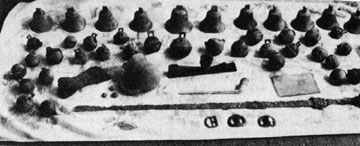
11 domed bells
I European Hunting Sword
1 Trade axe
I Stone pipe
1 Clay pipe
6 musketballs
4 Silver earrings
1 3" x 4" Piece of Glass
I Touchstone
3 Brass buckles
I Low-fired clay cup
4 French style brass buttons
4 Gunflints
When we returned the following day, Tom went directly to yesterday's
site to recheck the dirt and refill the hole properly. He was
able to locate another half dozen buttons. These buttons were
changing into a mineral state and were very difficult to detect.
Jay and I spread out to check other potential areas. My luck
was still holding, all bad. The only thing that I could find
was poison ivy.
When I located Jay and Tom, the former had uncovered a broken
sword with a brass handle and a trade axe. The earth they had
been lying in was abundant with glass beads. Jay was filling
a bucket with the earth to later pan out the beads. The sword
was an English Hanger, circa 1690-1710. It has a simple knuckle
bow that divides to join an oval counterguard having raised cherub
and floral patterns.
A short distance from Jay I got a signal that turned out to be
a tinkler. Further detecting the area produced another tinkler
and I proceeded in that direction. My concentration was broken
by a shout behind me. Jay had uncovered a silver armband three
feet from where I had found the first tinkler. The armband was
three inches wide a touchmark that designated as being sterling,
made in London, England in 1720. With it were numerous glass
and silver beads. Jay set out for the van to get another bucket
to contain the dirt. The armband had only been two inches deep.
The armband turned out to be the last major find of the week.
The following week the farmers were seeding the fields ending
our hunting until next spring.
|