RELICS FROM A
REVOLUTIONARY CAMP
By
Sandy Cline
EASTERN & WESTERN TREASURES
October 1983
This was the second time I had traveled the fifty odd miles
to detect what I hoped was a Revolutionary camp. The previous
time was in late summer when the weeds and grass had been waist
deep. It had been almost impossible to get the coil within detecting
distance of the ground. Now it was spring. The heavy snows of
winter had flattened the grasses to within inches of the ground.
There was no indication that this area was any different than
any other part of the surrounding countryside. From the research
I had done, I was pretty sure I was close. Research can be described
as working on a jigsaw puzzle with most of the pieces missing.
The pieces in this case had been found in old reports and reminiscences
that I had picked up through various historical societies.
 Originally I had come across
several references to a camp in Upper New York used by the loyalists.
It had been used as a staging area for the loyalist militia foraging
into Pennsylvania and a refuge for loyalist families attempting
to reach Fort Niagara. The reports gave a description of the
location placing it on a creek. The creek was not named. Originally I had come across
several references to a camp in Upper New York used by the loyalists.
It had been used as a staging area for the loyalist militia foraging
into Pennsylvania and a refuge for loyalist families attempting
to reach Fort Niagara. The reports gave a description of the
location placing it on a creek. The creek was not named.
It was later in Williamsport, Pennsylvania; while reading
reports on the activities of General Sullivan during his campaign
of 1779 I found another piece. It mentioned a camp used by Butlers
Rangers on Gennesee Creek. On the assumption that this was the
same camp I began to track it down. I picked up topo maps for
the area I assumed the camp was in. Any reference to a camp in
that area was collected from reports at the Canadian Archives
and reminiscences of soldiers and loyalists of the period. Finally
I felt that I had located the site on the topo map and set out
to look at the area first hand.
The journey led to the farmhouse of Mr. Collins. I explained
the reasons for my visit and showed him the area on my topo map
that I was intending to search. My candid explanations allayed
his former suspicions. He was able to give me directions to the
area I was looking for and expressed a desire to see the results
of my search. I found the area covered with a dense summer growth
of weeds. I tried to detect in the heavy grasses for an hour
fore I was exhausted and had not picked up one signal.
Returning the following spring, I was unable to drive to the
area due to wet ground. I walked the remaining mile carrying
detector, shovel and provisions for the day. I was using a Garrett
Deepseeker with a ten and inch coil, which I find, appropriate
relic hunting.
 Giving the detector a final check
and tuning, I began the initial line of pattern I have developed
to pin point the productive areas of a site. In fifteen minutes
I had my first signal. I dug a deep plug and flipped it At the
bottom of the hole, about eight inches deep, lay a musket ball,
as I retrieved the ball from its resting place, ground water
began running into the hole. Giving the detector a final check
and tuning, I began the initial line of pattern I have developed
to pin point the productive areas of a site. In fifteen minutes
I had my first signal. I dug a deep plug and flipped it At the
bottom of the hole, about eight inches deep, lay a musket ball,
as I retrieved the ball from its resting place, ground water
began running into the hole.
Water tables can often be a problem during spring relic hunting.
The ground retained the water from the melting snow. Sponge-like,
the water seeps 1 the ground at every step. When a hole is made,
it rapidly fills with water under these conditions, I prefer
to remove the dirt from the hole rather have to feel for relics
at the bottom of a cold, waterfilled hole.
After marking the location of the find, I continued the pattern.
Soon I had marked several other finds, four musket balls and
a knee buckle. I felt that this had given me an area that I could
concentrate my search within. Six dropped musket balls were found
within a three foot area.
The first button was pewter designated by a "5"
within a broken circle. This is a type similar to the Connecticut
regimental buttons of the Revolutionary period. This was a curious
relic to turn up in a British site. One small area near the creek
produced a dozen or more buttons. There was an abundance of rusted
iron and pottery in this area as well. I assume that this may
have been the dumping area for the camp.
 I have found that colonial camps
and forts often disposed of their refuse on the riverbanks. Most
of the buttons were of the plain face variety. Two of the brass
buttons were deteriorated to the point of making positive identification
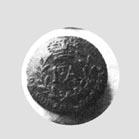
impossible. One showed a crown with three script letters beneath.
The other may be a New York regiment. The wet, acid soils of
New York seem to have a detrimental effect on brass buttons while
preserving the pewter buttons. I have found that colonial camps
and forts often disposed of their refuse on the riverbanks. Most
of the buttons were of the plain face variety. Two of the brass
buttons were deteriorated to the point of making positive identification
impossible. One showed a crown with three script letters beneath.
The other may be a New York regiment. The wet, acid soils of
New York seem to have a detrimental effect on brass buttons while
preserving the pewter buttons.
There were two buttons from Butlers Rangers and one from the
Queens Rangers. One piece, pewter buttons that at one time had
a steel eye. The "Queens Rangers" was formed in 1757
under Robert Rogers of Rogers Rangers fame. As leader of all
rangers during the French and Indian Wars he had perfected techniques
similar to tactics used by commandos in modern warfare. He did
not invent the concept of ranger companies operating with hit
and run tactics. These had been used earlier along the frontiers.
He evolved the techniques to a fine art, imitating the Indian
way of making war and improving his methods as he gained experience.
In 1760, the main body of rangers, including Queens Rangers wintered
at Fort Niagara at the mouth of the Niagara River.
During the winter of 1776-77 Rogers either relinquished or
was relieved of his command and the force passed to Captain John
Graves Simcoe. Elements of this corps saw action in most every
major battle of the Revolutionary War. In 1 779 the rangers were
given royal stasis as a regular force of the British army with
the designation of First American Regiment. After the end of
the War the Queens Rangers replaced the British regular garrisoning
the border forts. About 1796 they were disbanded.
The most active and successful regiment of provincial troops
was Butlers Rangers. The rangers did range over a vast area-from
the Kentucky Valley, to the boundary of New Jersey, along the
frontiers of New York and Pennsylvania and westward into the
Ohio Valley. Regular and Provincial regiments went into winter
quarters when the weather turned cold and vicious.
Rangers were expected to operate all year round. When unable
to travel by canoe, they would revert to sleighs, skates or snowshoes.
Their key to success was mobility, traveling with a minimum of
equipment. Ranger camps were always in a spot that gave the sentries
a cleat view of the surrounding countryside and approaches to
the camp. The area that I was detecting definitely fell into
this category. The river made a sharp turn around the rise of
land giving a good view up and down the river.
Col. John Butler formed the regiment in 1777 and during the
war nearly 900 men officially served with the regiment. Losses
in action were higher than any other corps. Butler's rangers
continued their activities in the field after hostilities had
ceased in June of 1782.
By the style of the Queens Rangers button, the site could
be dated as being occupied after the regiment had been given
royal status, possibly 1780-82. 1 had high hopes that I might
find some very good relics, per-haps a cross belt plate. As I
worked my way towards the high ground, I encountered less water.
Now I could explore my holes without them turning into a swimming
hole. The brass items, such as the waist belt buckle and mouth
harp that I found had a green patina, but not the deterioration
that had been evident with the relics found in the low, wet areas.
The British regulars and colonials had used mouth harps as a
mode of entertainment. They were also used as trade items for
the Indians.
The high ground was also a better growing area for small trees
and bushes. It was a struggle to locate a signal that lay under
a thick tree root. The root was about two or three inches thick
with smaller roots forming a net around it. I removed a large
quantity of dirt while working around the roots, but could not
locate the object that my detector was reading. Suddenly the
signal disappeared. I checked the pile of dirt and the hole without
success. I spread the dirt and probed more in the hole, checking
with the detector continually. After ten minutes of messing around,
I picked up a signal a foot away from the area that I had been
searching. The object must have flown off my shovel while I was
transferring the dirt from hole to pile. I picked the button
out of the grass and wiped off some of the dirt. It was silver.
I dipped it into an ever-convenient pool of water and washed
it off. A date of 1763 showed clearly at the bottom of the disc.
A good cleaning revealed a Spanish 'one real" coin of the
pillar variety. I was ecstatic. This was the oldest coin that
I had ever found.
I managed to recover a few more buttons before the fading
light forced me to pack my treasure and start my journey home.
A curious find was a silver plated British Navy button, possibly
an officer's. I often wonder what was a naval officer doing in
the middle of Western New York.
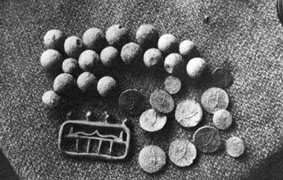
I felt that I had a very good accumulation of relics for the
nine hours that I had been able to detect. There were 39 musket
balls, 17 buttons, and a mouth harp, a belt buckle, a knee buckle
and a Spanish reale. I often planned to return to the site, but
every spring finds me with something else to do. Unless a real
estate development should emerge upon the campsite, it will remain
there until my return.
|