|
By Sandy Cline 1981 SILVER & GOLD ANNUAL Joe Eager, born again prospector had attained a new milestone
in his hobby of treasure hunting. A retired pensioner had told
him stories of a very productive silver mine he had worked in
at the turn of the century. After a 200-mile drive, he arrived
at the washed out road that led to the mine. Detector in hand,
he walked up the road.
Opening one of the bags allowed the rock within to spill across
the floor. A large plate of silver protruded from one of the
rocks. Enthusiastically he sorted through several bags filling
his knapsack with silver. The rest of the afternoon was spent
transferring the silver from the mine to his car. This was his
third mistake. In the seclusion of his basement workshop, he gleefully applied the heat of the acetylene torch to the broken rock, watching the silver flow into a mold he had constructed. This was almost his last mistake. Rather than kill off our hero, we will leave him in his hospital bed recuperating from the poisonous gases incurred when smelting silver. Failing to do thorough research on a subject can sometimes be fatal. His first and last mistakes were a lack of knowledge of the geology and properties of silver. The other mistakes were trespass and theft, which on occasion I have suspected to be fatal. Often the "KEEP OUT" signs are to prevent sightseers from falling down open mine shafts. These have not been sealed with a concrete plug because the owners intend to reopen the operation. Other mines are one or two man operations being worked on weekends and vacations. Many of the so-called "abandoned mines" are still under patent claims. It would be advisable to obtain a copy of your state or provincial mining regulations and a recent claims map of the area you intend to prospect. If you desire to fill your safety deposit box with little bars of silver you had best know how to recognize it in its native state and convert it into the negotiable state.
This diverse description may sound very confusing to the novice prospector so I will introduce this rule of thumb. No other white malleable metal, soluble in acid is likely to be encountered. Lead is softer and grayer; platinum is harder and insoluble; cobalt and arsenopyrite are brittle. Although widely distributed, native silver is not the most important ore of silver. Silver ores as a rule; tend not to show the individual silver minerals to which they owe their value. Often the novice will fail to recognize their silver content discounting them as just another hot rock. Detecting a silver mine will likely produce several different silver minerals. Argentite, "silver glance," is a silver sulfide dark lead-grey in color, usually tarnishing dull black. It can be easily cut with a knife. This form of silver is found at Leadville, Colorado and Butte, Montana. Polybasite is a compound of silver, sulfur and antimony, iron-black in colour but can be distinguished by its cherry-red color in small silvers. This form of silver is found in Pitkin county, Colorado, Marysville, Montana and Esmeralda County, Nevada. Stephanite, "brittle silver," much resembles Polybasite in composition but opaque in thin slivers. It is usually massive and disseminated through the rock. This form of diver is found in Grass Valley, Nevada county, California and Virginia City, Nevada. Proustite, "light ruby silver is a compound of silver with arsenic and sulphur. It has a rich scarlet colour end. This form is found in San Juan county, Colorado arid Owyhee county, Idaho. Pyrargyrite is purple grey to greyish-black with a composition similar to Polybasite. It is found at the Comstock Lode in Nevada and at Cobalt, Ontario. Cerargyrite, "horn silver", is a chloride of silver. It is very soft and can be cut into shavings with a knife. In its natural state it is colorless, white or grey but when exposed to light it darkens to a violet-brown. It is usually found in arid, silver producing areas of Arizona, California. Colorado, Idaho, Nevada and New Mexico. Embolite is a compound of silver with chlorine and bromine. Although similar in appearance to Cerargyrite and similar properties, It is greenish or yellowish, darkening on exposure to light.
The investigation of abandoned copper or lead mines could
prove a profitable source of silver. Some of the states where
silver has been recovered as a secondary mineral am; Connecticut,
New Jersey, Tennessee, Missouri, Kansas, Oklahoma and Utah. I will assume that we know what we are looking for and continue on our silver hunting expedition. The types of silver producing areas that we will contend with for this article are operational, non-operational, abandoned and prospect. An operational mine is one that has mining in progress. They may or may not be fenced in. Ask permission to search for silver specimens in the abandoned tailings. Limit yourself to the tailings and do not try to encroach into the working areas. The more inconspicuous you are, the more tolerant the employees will be to your presence. A non-operational mine is one where mining has ceased for the present The head frame and buildings will still be standing though usually weathered I would advise you to contain your search to areas outside these buildings. The local police or watchmen employed by the owners make periodic checks of the property. The authorities tolerate Rock hounds looking for specimens. Vandalism or breaking and entering will likely get you a night in a cold, hard cell. An abandoned mine although likely under a patent claim, has virtually ceased to exist. The mine buildings have been removed or deteriorated to a pile of rubble. Vertical shafts have been covered or plugged with concrete. You are able to detect at your plenum, but do it with caution. This type of mine holds more potential dangers than any other. Deteriorated buildings can become deadfall traps. The once sturdy, wooden mine-shaft covers have rotted to a delicate crust over a treacherous pit. Then we must not forget the many venomous critters that thrive in this type of habitat. A prospect is an area where silver has been found in small quantities but never a major vein that warranted mining. When traveling in these localities, it would he advisable to keep a sharp eye for the weathered forms of silver. Curiosity and luck have located many silver veins. Be sure and check the streams and washes that pass through a silver bearing area for placer deposits. Much has been writ ten on methods of detecting silver with
a metal detector by such notables as Roy Lagal and Charles Garrett.
The basics can be found in many books dealing with metal detecting.
Each individual develops his own method and style of checking
for silver. Each location will usually demand a different method
of operation. Standing on the site of an abandoned mine, where do you begin? A haphazard search may turn up the odd piece of silver, but the best pickings are often concentrated in certain areas. The silver ore and host rock, removed to gain access to the silver bearing veins, were carried from the mine in ore cars running on a narrow gauge track. Shortly after leaving the mouth of the mine, the track divided. One track ran out on the tailings to dispose of the waste rock. As the tailings grew, the track would be extended. The other track carried the silver ore to a loading area, to be put in trucks or wagons and carted to the smelter. During periods of high productivity, the smelters were unable to keep up with the supply of ore available. During these periods, the mine would stockpile the silver ore until it could be smelted. My favorite area to detect is where the ore had been stockpiled.
A single crevice in the rock will produce 5 to 10 ounces of small
silver nuggets. It may also lie advisable to collect the dirt
from these crevices and pan it for the fine silver it contains. As you can see, I am basically a very lazy fellow, who intends
to continue accumulating silver for a long time. For this reason,
I seldom venture into mine shafts to try my luck. Mine-shafts,
even when regularly inspected, have a tendency to collapse. If
I did find a pocket of silver that was missed, it would have
to be removed with pick and chisel. The host rock does not give
up its treasures easily; I have learned in the past. I will leave
this aspect to the more venturesome and arduous treasure hunter. The fumes given off during this process are poisonous and
can be lethal. The use of an exhaust fan in a well-ventilated
area is essential. Prospecting for silver may not be as easy as finding silver coins, but it is definitely more profitable. I have never returned from a silver trip with less than $300 in silver, which is better, I think than coin shooting. All it takes is research, patience and a detector. Additional Reading |
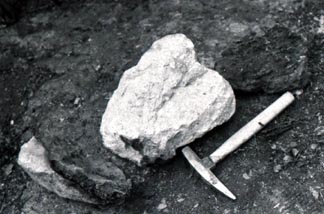 The building contained a very
large winch, covered with grease, whose steel cables stretched
up to the top of the head frame, then down into the mine shaft.
A number of burlap bags filled with rock drew his attention.
The building contained a very
large winch, covered with grease, whose steel cables stretched
up to the top of the head frame, then down into the mine shaft.
A number of burlap bags filled with rock drew his attention.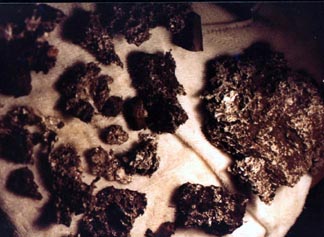 Native silver does not often
resemble those shiny bars you desire. It is apt to have a rough
surface. When you rub your thumb across a piece of silver hearing
rock, the silver tends to grab on to the skin like a burr. Usually
there is a tarnish, which varies from a reddish bronze, almost
like copper, to a golden yellow, sometimes to a dull black. If
the tarnish is removed by rubbing the high points will acquire
a white metallic luster. Silver can be found as masses, plates,
leaves, or scales. Wire silver is frequently found as slender
or stout threads.
Native silver does not often
resemble those shiny bars you desire. It is apt to have a rough
surface. When you rub your thumb across a piece of silver hearing
rock, the silver tends to grab on to the skin like a burr. Usually
there is a tarnish, which varies from a reddish bronze, almost
like copper, to a golden yellow, sometimes to a dull black. If
the tarnish is removed by rubbing the high points will acquire
a white metallic luster. Silver can be found as masses, plates,
leaves, or scales. Wire silver is frequently found as slender
or stout threads.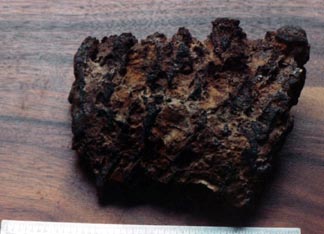 About a third of the world's
silver comes from deposits mined predominantly for silver. The
balance is recovered as a secondary mineral when mining the ores
of copper and lead.
About a third of the world's
silver comes from deposits mined predominantly for silver. The
balance is recovered as a secondary mineral when mining the ores
of copper and lead.