A TOUR OF THE
COBALT
SILVER MINES
By
Sandy Cline
1982 SILVER & GOLD ANNUAL
I have written several articles on the silver of the Cobalt
Camp in the past. This has led me inundated with requests for
more information on Cobalt. To facilitate those treasure hunters,
who desire to embark on an adventure into the past, may I guide
you on a tour of some of the mines of the Cobalt Camp?
Silver was discovered in the Cobalt area in 1903. James McKinley
and Ernest Darragh filed the first recorded claim on land at
the south end of Long Lake. A blacksmith, Fred LaRose, filed
on land near his forge at the north end of the lake. The provincial
geologist was asked to investigate the deposits and his report
in 1904 produced a rush of prospectors, claim jumpers, fortune
hunters and eager novices, eager to make their fortune. The railway
station beside Long Lake became Cobalt.
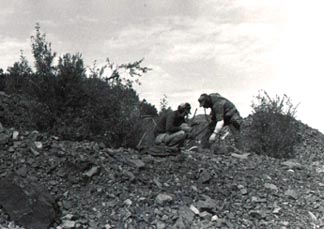 The town grew around the railway station
unplanned. Wherever a flat outcrop of rock, big enough to support
a building could be found, appeared a miner's home. The present
town still maintains this haphazard appearance of growth, the
main street zigzagging through the town. Cobalt was a poor man's
mining camp. Most of the rich, silver bearing veins lay close
to the surface and could be mined cheaply. This ultimately led
to the town's demise. By 1929 most of the mines had shut down.
There was a slight flurry of activity in 1950-51 with the discovery
of new veins and another in the 60s with the rising price of
silver. By 1973 there were only three operating mines in the
area. The town grew around the railway station
unplanned. Wherever a flat outcrop of rock, big enough to support
a building could be found, appeared a miner's home. The present
town still maintains this haphazard appearance of growth, the
main street zigzagging through the town. Cobalt was a poor man's
mining camp. Most of the rich, silver bearing veins lay close
to the surface and could be mined cheaply. This ultimately led
to the town's demise. By 1929 most of the mines had shut down.
There was a slight flurry of activity in 1950-51 with the discovery
of new veins and another in the 60s with the rising price of
silver. By 1973 there were only three operating mines in the
area.
Every August, the town returns to its days of glory with the
Miners Festival. This features special events, tours and competitions
relating to the historic mining period of the area. It would
be an asset to acquire a topo map of the area before setting
out to metal detect the inoperative mines and tailings of the
Cobalt Camp. The map number is 31 MI SE, Cobalt and can be obtained
from;
Public Service Centre,
Ministry of Natural Resources
Room 1640, Whitney Block,
Queens Park, Toronto,
Ontario, Canada M7A 1W3
If you have not obtained the topo map before reaching Cobalt,
you can check the Highway Bookshop at Cobalt. They maintain a
large selection of topo maps of the area but the Cobalt map is
often out of stock.
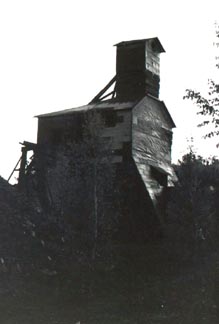 Specimens of silver can be collected
from the dumps of numerous inoperative mines in the vicinity
of Cobalt. The intrusion of collectors on the tailings of the
mines still operating is severely frowned upon. Specimens of silver can be collected
from the dumps of numerous inoperative mines in the vicinity
of Cobalt. The intrusion of collectors on the tailings of the
mines still operating is severely frowned upon.
Cobalt is four miles off Highway 11 on the secondary road
11B. Head frames of past productive mines border the road as
you enter the town. It would be an asset to begin your explorations
at the Mining Museum. This is on the main street in the center
of town. The head frame of Shaft No.4, of the Coniagas, now a
part of the main street shops, stands up the street from the
museum. The museum contains a display of types of silver found
in the Cobalt area that have been donated by the various mines
that have existed in Cobalt's past. This can give you a visual
aid in identifying silver when you find it. The various rooms
contain information pictures arid relics dealing with Cobalt's
mining past. Some of the items give a personal atmosphere to
the era a set of snowshoes for a one-legged man, stocks from
defunked mines and early editions of the Cobalt news-paper, The
Nugget.
Leaving the museum, proceed north on II B to the Coniagas
head frame. This has been used as a confectionery store and a
florist shop in the past and was used as the information center
for the Miner's Festival in 1983. Leave the main road and proceed
past the head frame, about 100 feet down this road is a junction.
Turn right onto the road to Sasaginaga Lake. Drive 0.2 miles
to the mine on the right side of the road. There are several
shafts on this property that were once the Coniagas mine. It
was discovered in 1904 and closed in 1943 yielding close to 34
million ounces of silver.
The Trethewey mine was just north of the Coniagas. It operated
during the same period and produced 64 million ounces of silver.
Returning to 11 B at the railway station, turn left of the
Bank of Commerce for 0.2 miles. Turn left and drive 0.05 miles
to a junction. Shaft 80 of the Nippising tube is to the left
of the junction straight ahead up the ridge is another part of
the Coniagas mine. The area within a quarter mile is dotted with
many shafts. These shafts were the most prolific producers of
silver in the Cobalt area until their demise in 1932.
Continue north on 11B to St. Theresa School on the right and
the Cobalt-Brady Lake road. Turn right (east), crossing the Larose
bridge over the railway. The rusty head frame at the railway
tracks to the south is Shaft No.2 of the Right of Way mine. The
Agnico Concentrator to the north of the road sits on the tailings
of the Larose mine. The historic black-smith's forge and cabin
still stand at the side of the road.
For this excursion I will give a road log beginning at Hwy.
11B (Mile 0)
Mile
0.25 Road on right to Nipissing 401 Mine
0.4 Road on right to O'Brien shaft #33
0.5 Road on left to O'Brien mine
0.75 Junction of Cross Lake Road on right
0.9 Road on left to Colonial mine
1.5 Nova Scotia nine to left of road
Road on left to Crown Reserve tailings
2.4 Junction of Glen Lake road on right
2.5 Road on left to Crown Reserve mine
2.55 Junction of road to Foster and University mines
2.65 Silver Sidewalk site
3.0 Road on left to Drummond mine
3.9 Road on right to Rochester mine
4.1 Junction. Follow road to right
4.1 5 Lumsden mine on right
4.25 Silver Miller mill on left
4.45 Road on right leads to Silver Miller mine
4.6 Cobalt Lode mine on left
5.5 Road on right to Victory mine
Road ends at Mayfair mine.
The Nipissing 401 mine was operated until 1932 and was one
of their most productive claims. There are two shafts on the
property, 0.1 and 0.25 miles south of the Brady Lake road on
the right of the access road.
The O'Brien mine was the longest continuously operated mine
in the Cobalt area. Between 1905 and 1967 it produced 40 million
ounces of silver. The underground workings have so undermined
the area that several cave-ins have occurred and are now fenced
of to the general public. The head frame and mine buildings are
still standing, allowing the visitors to experience the magnitude
of a mine operation. The Colonial Mine produced about ten million
ounces of silver between 1907 and 1936. The workings consist
of several open cuts, adits and shafts, with the adits are the
most productive. The Nova Scotia mine began with a surface vein
showing silver for 60 to 75 feet. Leaf silver was commonly encountered
during the mining operations between 1906 and 1912. About a million
ounces of silver was recovered. The Juno mine yielded 46,000
ounces of silver. For several years "No Trespassing"
signs have graced the entrances and mine tailings.
The Crown Reserve mine produced 20 million ounces of silver
in the period l908-l948. The veins lay beneath Kern Lake, which
was drained to allow mining. The majority of tailings now lay
beneath the waters of Kerr Lake. Crown Reserve. Kerr Lake, Lawson,
Foster and University properties are presently under lease to
Canadaka Mines and they are not allowing treasure hunters to
detect these properties.
The Drummond mine consisted of an open pit with several open
cuts and shafts. Between 1904-17 it produced nearly four million
ounces of silver. It was common to find sheets of silver during
the mining operations.
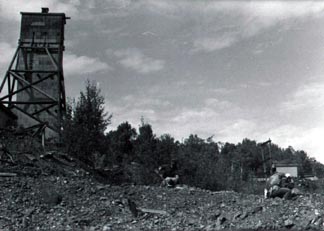 The Rochester mine produced 15,000
ounces of silver before it was abandoned as being unprofitable. The Rochester mine produced 15,000
ounces of silver before it was abandoned as being unprofitable.
The Beaver, Temiskaming and Cochrane mines are currently in
production by Agnico Mines and are not accessible to treasure
hunters.
The Lumsden mine, despite its low production (20,000 ounces
of silver), is an excellent area for the novice treasure hunter.
The area has been actively detected but still produces small
plates of silver. The high mineral content of the tailings dampens
the field of the detector so the average detector has a very
low depth penetration. I usually remove a couple inches of surface
rock from the area I am searching to obtain greater depth with
my detector.
The Silver Miller mine came into existence with discovery
of silver veins under Brady Lake in 1947. For a time ore was
mined from the Lumsden property until the Silver Miller shaft
was sunk. This shaft continued operation until 1957, yielding
7.3 million ounces of silver.
The Christopher and Cobalt Lode mine prospered from 1954-66
yielding 1½ and 4~/2 million ounces respectively. The
Victory, Ophir and Mayfair mines were very low producers.
There are many other mines that I have not listed specifically,
but treasure hunters may find interesting. The Deerhorn mine
where dendritic silver is found in pink calcite and greatly prized
by rock hounds and the Nipissing property where the hill was
hydraulically washed of all earth and vegetation to expose the
veins of silver are points of interest.
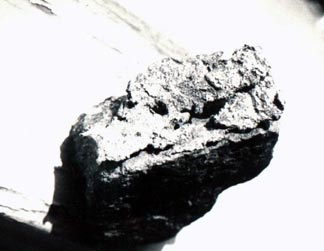 The silver is not confined to
the mines that I have noted. The tailings of abandoned mines
were used as fill for roadbeds and foundations. Pieces of silver
rich ore fell from trucks and sleds as it was being transported
to the mill. In 1906, a resident of North Bay walked around the
various mining properties picking up silver nuggets to the value
of $l5, 000. That was when silver was 51.50 an ounce. In the
1950s I was able to still walk the mining properties picking
up silver by sight. The advent of the metal detector has greatly
reduced the easy pickings. These days it is essential to locate
the areas that other treasure hunters have not searched. I dig
a bit deeper into the tailings or find tailings away from the
main shaft. The silver is there, but you have to pass your coil
over it to detect it. The silver is not confined to
the mines that I have noted. The tailings of abandoned mines
were used as fill for roadbeds and foundations. Pieces of silver
rich ore fell from trucks and sleds as it was being transported
to the mill. In 1906, a resident of North Bay walked around the
various mining properties picking up silver nuggets to the value
of $l5, 000. That was when silver was 51.50 an ounce. In the
1950s I was able to still walk the mining properties picking
up silver by sight. The advent of the metal detector has greatly
reduced the easy pickings. These days it is essential to locate
the areas that other treasure hunters have not searched. I dig
a bit deeper into the tailings or find tailings away from the
main shaft. The silver is there, but you have to pass your coil
over it to detect it.
There are three other items that I think that you should consider
hi planning a silver-hunting trip. Develop a practical knowledge
of silver in its various forms. Consider the time of year that
you plan to make your trip and make arrangements to be sure that
you will return.
Silver is not the only metal/mineral that you will read with
your detector. The area contains various iron ores, cobalt and
nickel. The only mineral that you will find difficult to discriminate
is the nickel. It will read at high discrimination. In many cases
the silver will be found in association with one of these minerals.
A ready visual aid to determining the difference is by their
oxidation through weathering. Cobalt oxidizes pink, nickel green
and iron-rust. For an in-depth identification, consult a rock
and mineral guide.
Weather is of prime importance in planning when the trip is
to be made. The snow starts around the end of October and lingers
into May. Last April when I made a trip with Cliff Williams and
John Payne we found a foot and a half of snow on the ground with
drifts six to eight feet around the tailings. The good weather
brings out the black flies and mosquitoes. The black fly is a
tiny insect with the appetite of a piranha. They are more numerous
during the milder weather. The mosquito thrives during July and
August when they literally line up to get a drink. Needless to
say insect repellent is a must.
I cannot stress the possibility of getting lost. I search
well off the usual area for my silver. In the past year, several
of the treasure hunters lost. Fortunately they were a part of
a group and were found. Each of the lost never believed that
it could happen to them.
Carry a compass and a topo map of the area and never venture
into the bush alone without letting someone know where you are
going.
A trip to the Cobalt Camp is an adventure with the potential
of finding enough silver to make it very profitable. I continue
to make several trips a year and always cover my expenses.
If you come across a little guy with a big beard detecting the
dumps of Cobalt while you are there, stop and say "Hello".
I can show you much more in person than I can write in article.
Many professional treasure hunters never run any discrimination.
They dig everything because they know that even sometimes, tiny
amounts of discrimination will cause good samples to be rejected.
Just set the discriminator to eliminate the very tiny items like
small nails and other rusted iron objects.
Whenever you locate a piece junk be sure to keep it and discard
it in a trash receptacle. Do not put it back down. Some day you
may be in the same area again or at lea there is a good chance
that some low treasure hunter will be there
It makes no sense to dig a piece junk time and time again. Let's
I each other to be productive.
There are vast quantities of silver in the Cobalt region.
There are quantities of gold in Australia. There are vast quantities
of silver and in Mexico and in the Western States you can find
your share if you use the right detector, learn how use it and
be persistent. The reward will be yours.
|