Classical Education, Volume II: Dragon
Gordon J. Davis Jr
Welcome to the second installment of
Classical Education, the series of articles intended to familiarize the
unfamiliar with the decks and theories of the online Eternal format Classic. In
my previous article, I covered the basics of the Classic format. I discussed
what it was and what it wasn't, along with some of the theories behind Classic.
And I even managed to define the different archetypes of decks used in Classic
(which is common to all the main line formats). And, as promised, now that I
have the "boring" stuff out of the way, I can proceed to discussing the fun and
entertaining stuff.
Decks.
In this article, I'm going to let everyone
realize their worst fears about the format and then show you why your fears are
unwarranted. You see, Classic already has an undeserving reputation as the
format of degenerate Combo decks and disgusting turn 2 wins. While that is
certainly possible, it's the exception - not the rule. In this article, I'm
going to cover a deck that has been my baby since my Vintage days - shortly
following the release of Judgment and a card that would become infamous among
the Vintage and (now) the Classic community (following the release of Visions).
The card I'm talking about redefined the
term "crap rare" in the Limited, Block, Standard, and Extended environments of
the time. However, in Vintage and Legacy - it was a bomb. It even went so far as
to be banned in Legacy for power concerns. What card is this that I speak of, a
card so powerful it was banned in an Eternal format and yet scorned in the most
played formats of Magic?
|
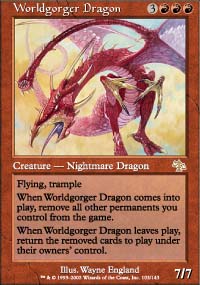
Worldgorger Dragon
Judgment Rare
3RRR
Creature - Nightmare Dragon
7/7
Flying, Trample
When
Worldgorger Dragon comes into play, remove all other permanents you
control from the game.
When
Worldgorger Dragon leaves play, return the removed cards to play
under their owners' control.
Now...how exactly was a card this
bad a bomb in the two Eternal formats? That's a good question, and the
answer will surprise you.
Enchantments.
You see, the other formats didn't
possess any permanent-based reanimation, in particular Enchantments.
Vintage and Legacy, however, possessed three - Animate Dead (Alpha,
Beta, Unlimited, Revised, 4th Edition, and 5th Edition), Dance of the
Dead (Ice Age), and
Necromancy
(Visions). Because of the unintentional interaction between
Worldgorger Dragon and those three Enchantments, Vintage and Legacy
suddenly had a fast and reliable "infinite" mana engine.
|
|
How does this apply to Classic? Well, for
a while - it didn't. It didn't even apply to the original Open format and later
Freeform. It didn't even apply to Classic at it's inception. You see, Classic
had the Engine for the combo...but it was lacking the Enabler. However, this
problem would be soon solved when Wizards of the Coast began to re-release old
out-of-print sets for use on MTGO. Mirage began it, but it wasn't until Visions
was released that the Combo would be available on MTGO (in a much clumsier
version than it's Vintage counterpart). And even after the release of Visions,
it took a while for the Combo to catch on. In fact, Dragon has only recently
become a well-known deck among the Classic community.
Now, I've rambled quite long enough about
the history and basic idea of this deck. Let's get into the good stuff.
So that is the deck list. Doesn't look all
that frightening at first glance, does it? No big flashy creatures (besides the
infamous
Worldgorger Dragon), no fearsome artifacts like
Umezawa's
Jitte, and none of the ever popular burn like
Lightning
Helix or
Fireblast. So let's take a look inside, and break it down to it's basic
components.
At the most basic levels, every Combo has
three parts to it - an Engine, an Enabler, and a Kill. All three parts are
required for the deck to function properly.
|
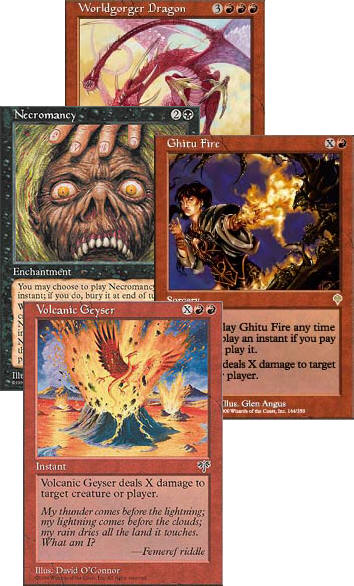
Combo Engine: The Engine is
Worldgorger Dragon. Without this card, the deck doesn't work. This
is the card with the required ability that, in turn, generates your
"infinite" mana by removing all your lands and the Enabler from the
game, and then dying from the loss of the Enabler and returning all your
lands to play untapped along with the Enabler to continue the cycle. |
 |
|
Combo Enabler: The Enabler
is
Necromancy. Without this card either, the deck doesn't work. This is
the card that reanimates the
Worldgorger Dragon initially, and continues to reanimate it each
cycle of the Combo when it comes back into play from the Removed from
Game zone. |
|
Combo Kill: This version of
Dragon runs two Kills. Both function at Instant-speed, but only one is
truly an Instant.
Ghitu Fire
is the main decked kill and is officially a Sorcery, but can be cast as
an Instant for an additional 2 mana. The second win condition is in your
sideboard and is
Volcanic Geyser. And since that is a true Instant, it's also
(conveniently enough) a Wish target with
Cunning
Wish. |
And now, here are the rest of the parts of
Dragon and a rough idea of what they do.
|
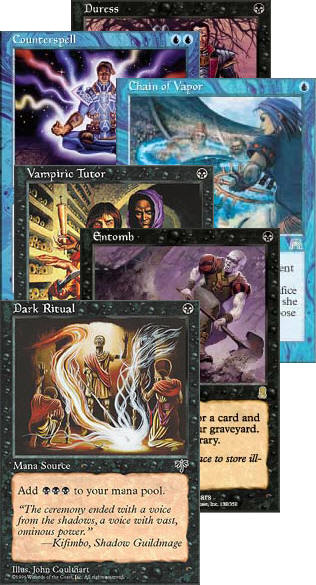 |
Control Elements: Dragon is
a Combo/Control deck, and as such has elements of Control in it's main
deck and sideboard. The most obvious pieces of this deck that are from
the Control model are the
Duresses
and the
Counterspells. In the sideboard, the
Blazing Archon could also be considered Control. And split between
the main deck and sideboard are five pieces of bounce - 4
Chain
of Vapor (1 main deck, 3 sideboard) and 1
Echoing Truth. |
|
Tutoring: Thanks to
Classic's lack of a Restricted List, Dragon is able to run four
Vampiric Tutors, with three of them in the main deck and the fourth
in the sideboard. The only downside to this card is that it puts the
card you Tutor for on top of your library instead of in your hand. And
don't forget...you can cast spells on your Upkeep and it happens before
your Draw phase. |
|
Combo Acceleration: Since
this Combo is hinged upon the
Worldgorger Dragon getting tossed in the graveyard, this deck has
three Entombs
in the main deck with a fourth in the sideboard. Also doubling as card
drawing and
Worldgorger Dragon ditching (from your hand) are four
Careful
Studies. |
|
Mana Acceleration: Not much
in the way of Mana Acceleration in Dragon, but even so it's a fast and
reliable deck (by Classic's standards). The four
Dark
Rituals make a noticeable difference in how this deck runs, but not
a big enough difference to consider
Cabal
Rituals as supplements. |
|
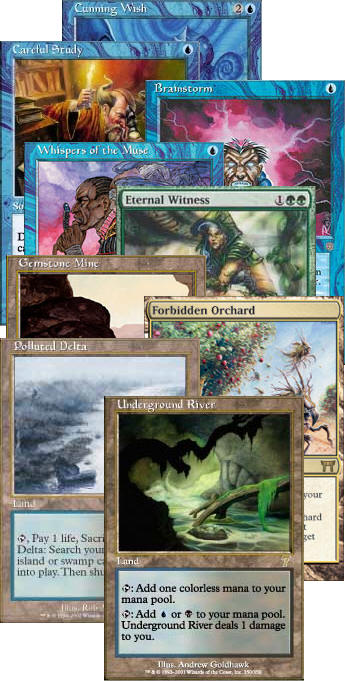
Toolbox Sideboard: The
Toolbox Sideboard idea is using Wishes in your main deck and putting one
copy of each of your most needed 4-ofs and some situational 1-ofs in
your sideboard as Wish targets, and then use the appropriate Wish. In
the case of Dragon, I went with
Cunning
Wishes and an Instant-based Toolbox Sideboard.
Whispers of the Muse,
Entomb,
and
Vampiric Tutor all ended up as Wish targets, with three in the main
deck and one in the sideboard. Also added in was an
Echoing Truth for when you have to bounce multiple targets of the
same name, and my secondary win condition of
Volcanic Geyser. |
 |
|
Card Drawing and Recursion:
Card drawing and recursion is achieved through four different cards,
with one of them also fulfilling an additional role of protecting my
Combo pieces in my hand. The first is
Careful
Study, which draws me two cards and forces me to discard two cards.
Often times, I'll save this spell for when I got a
Worldgorger Dragon in hand. Next is
Brainstorm, which allows me to draw three cards and then put two
cards from my hand back on top of my library in any order. This achieves
two things. First, it allows me to cast
Brainstorm in response to a
Duress and
hide my Entombs,
or Necromancies, or
Vampiric Tutors from the
Duress.
Second, it allows me to put unneeded cards on top of my library, and
then if followed by a
Polluted Delta use or a
Vampiric Tutor...I can shuffle the unneeded cards into the library
and not see them again so soon. After
Brainstorm we have
Whispers of the Muse. This is the card I choose to replace Read the
Runes in Dragon, which has generated a small argument between myself and
my Clan Captain in MTGO. I decided on
Whispers of the Muse because it has no discard/sacrifice clause in
it, and if my
Ghitu Fire,
Volcanic Geyser, or
Cunning
Wish gets countered...I can begin drawing again with
Whispers of the Muse and Buyback. The final card is my limited
recursion, and comes in the form of
Eternal Witness. If you cast this card and resolve it, or cast two
Necromancies - one on
Worldgorger Dragon and one on
Eternal Witness, you'll be a Control deck's worst nightmare because
you can "infinitely" recur your win condition spell since the
Eternal Witness will trigger every time she comes back into play
from the Removed from Game zone. |
|
Mana Base: This was the
hardest part of the deck for me to design and refine through my play
testing. Since my deck is, clearly, of the black and blue variety, it
would appear easy to build a mana base. Except that one of my two win
conditions requires XRR to cast and the
Eternal Witness, if I want to hard cast her for some reason, costs
1GG. To satisfy my deck's need for off-colored mana, I have included
eight five-color lands, using the two with the least drawbacks for the
deck. Those are
Forbidden Orchard and
Gemstone Mine. Neither of which has any drawback when I begin my
Combo loop, and has the least drawbacks before the loop begins. The
other two non-Basics I used are
Polluted Delta (to fetch one of my six Basics, thin the deck a
little, and shuffle the library) and
Underground River, both as 3-ofs. Originally, this deck had Watery
Grave instead of
Underground River since the Watery Grave appeared to be a superior
choice (and in almost any other deck, the RGD Shock Lands are superior
to the 7E/AP/9E Pain Lands). However, during the Combo loop, the Watery
Grave was unusable because of it's comes-into-play trigger of me paying
two life for it to be untapped. |
Sideboard:
1x
Blazing
Archon: This card is in this deck as an anti-Aggro measure. If I'm playing
against a very fast Aggro deck, in games 2 and 3 I'll sideboard in the
Blazing
Archon and make my primary concern getting this into the graveyard and
reanimated to stop decks like Goblin Bidding and Ravager Affinity from running
over me so fast.
3x
Chain of
Vapor: This card is in this deck as a turn 1 answer to the turn 0
uncounterable card that makes Dragon and any other graveyard-based Combo or
Aggro deck usually roll over and die. The card I'm talking about is
Leyline
of the Void, a black Enchantment with a casting cost of 2BB that also can be
played before the game starts by any deck for no mana investment - all it asks
is to be in your opening hand or a hand you've mulliganed for. Usually I'll
sideboard these three cards directly when I know or suspect I'll be facing a
Leyline
of the Void in games 2 and 3.
1x
Echoing Truth:
This card is in this deck as a way to bounce multiple non-land permanents at
once with the same name. Be it multiple
Leyline
of the Void, or a couple of
Meddling Mages,
or some
Pithing Needles...it doesn't matter.
Echoing Truth
will get rid of one, two, three, or four at once. All for the same 1U
investment.
1x
Whispers of the Muse: This is my single copy of
Whispers of the Muse I took from the main deck and placed in the sideboard
as a Wish target copy of my more constantly used spells.
1x
Entomb: This is my
single copy of Entomb
I took from the main deck and placed in the sideboard as a Wish target copy of
my more constantly used spells.
1x
Vampiric Tutor:
This is my single copy of
Vampiric Tutor
I took from the main deck and placed in the sideboard as a Wish target copy of
my more constantly used spells.
1x
Volcanic
Geyser: This is my secondary win condition, used either when my
Ghitu Fire is
countered or if I decide to "go off" with my Combo while holding a
Cunning Wish
instead of a
Whispers of the Muse or
Ghitu Fire, or
if I draw a
Cunning Wish before
Ghitu Fire
when I'm chain casting
Whispers of the Muse with Buyback.
4x
Xantid Swarm:
This card is in this deck as a hard castable anti-Control measure. All it needs
to do is attack on the turn I decide to go off, and Control will just sit there
while you win - even if they have a thousand
Islands and five
hundred
Counterspells in their hand. That is because as soon as
Xantid Swarm
attacks, it's triggered ability goes on the stack and the opposing player can't
cast any spells the rest of the turn. So unless they're holding a
Stifle or
Trickbind,
it's as good as game.
2x
Pithing
Needle: This card is in this deck as an answer to some of the more annoying
cards in the format. Cards like
Withered
Wretch,
Tormod's Crypt, and
Scrabbling
Claws that pick apart your graveyard. Or you can name any of the Onslaught
fetch lands such as
Bloodstained Mire and prevent your opponent from using them to fetch a land
and thin and then shuffle their deck.
Now that I've explained what the deck is
and have given you a rough idea of why each card is in the deck, let's talk
about how it functions, why it functions, and which rules it uses from the
published Comprehensive Rules of Magic the Gathering. As stated earlier, Dragon
is a Combo/Control deck, meaning it has elements of both a Combo deck and a
Control deck inside of it's sixty cards. This makes it a bit slower than a
dedicated Combo deck since I've diluted it with Control aspects, but at the same
time improves the deck's resiliency against some of it's worse match ups while
giving it some protection for when
Necromancy is
cast and the Combo loop has begun or is being maintained.
The Combo loop itself is surprisingly
simply. Once you have
Worldgorger Dragon in the graveyard (often by casting
Entomb or
discarding it with
Careful Study),
you cast
Necromancy - which doesn't target the
Worldgorger Dragon just yet. Once
Necromancy
resolves, it's triggered comes-into-play ability goes on the stack and it asks
you what to target. You select
Worldgorger Dragon. At this time, you'd tap all your remaining lands for
mana.
Once the trigger resolves, the
Worldgorger Dragon comes into play and
Necromancy
attaches itself to the
Worldgorger Dragon. Now the
Worldgorger Dragon's comes-into-play triggered ability goes on the stack.
When it resolves, all your permanents except the
Worldgorger Dragon get placed in the Removed from Game zone - including
Necromancy.
This causes
Necromancy's leaving play triggered ability to go on the stack and destroy
the
Worldgorger Dragon.
Worldgorger Dragon returns to the graveyard and his leaving play triggered
ability goes on the stack. Once it resolves, all your permanents are returned to
play from the Removed from Game zone. The lands return untapped and
Necromancy
returns as well and it's coming-into-play triggered ability is ready to be put
on the stack once more.
Rinse, wash, and repeat until you have
enough mana to win. This is done either by chain casting
Whispers of the Muse with Buyback for 5U until you draw
Ghitu Fire or
Cunning Wish,
and then sending either a 20+ point
Ghitu Fire to
your opponents head for the cost of 22R (Ghitu
Fire normally being an XR Sorcery, but it can be played as an Instant for
X2R) or Wishing for
Volcanic
Geyser and sending a 20+ point
Volcanic
Geyser to your opponents head for the combined cost of 22URR (2U for
Cunning Wish
and 20RR for
Volcanic Geyser).
Just be warned though - Dragon is a
dangerous deck to play in Timed tournament matches, regardless of whether or not
it's a PRE (Player Run Event) or one of those 8-man Constructed Classic events.
This is because MTGO doesn't have Rule 102.4b or Rule 421 programmed into it's
code. Those rules are as follows (directly taken from the
MagicCompRules061001.rtf file you can download from the official Magic the
Gathering homepage):
102.4b If the game somehow enters a
"loop," repeating a sequence of events with no way to stop, the game is a draw.
Loops that contain an optional action don't result in a draw.
MTGO will recognize and register a draw in
one situation. That situation is if you have exactly ONE
Worldgorger Dragon in your graveyard and nothing else (no
Eternal
Witness or
Blazing
Archon) and your opponent has NO creatures in his or her graveyard. In that
situation, if both players hit F6, the loop will repeat at high speed until the
game crashes. MTGO will register a draw, and essentially ignore that result. I
noticed this during the UnCon Classic PRE event when I drew two games and won
the third in the match and MTGO tried to go on to a game 4, despite it being a
Best 2 of 3 match.
A draw also results, but MTGO won't
enforce, if you have BOTH
Worldgorger Dragons in your graveyard and nothing else (no
Eternal
Witness or
Blazing
Archon) and your opponent has NO creatures in his or her graveyard. While
that situation meets the requirements for a draw as per Rule 421, MTGO will not
award a draw. Instead, your opponent will eventually win after you time out from
MTGO endlessly forcing you to pick which
Worldgorger Dragon to animate in your graveyard. You still have no choice
(you pick a
Worldgorger Dragon either way), and neither you nor your opponent can stop
the loop...but your opponent will end up winning despite the game being a draw
according to the Comprehensive Rules because of a portion of the rules being
left out of MTGO's code.
421. Handling “Infinite” Loops
421.1. Occasionally the game can get into a state in which a set
of actions could be repeated forever. These rules (sometimes called the
“infinity rules”) govern how to break such loops.
421.2. If the loop contains one or more optional actions and one
player controls them all, that player chooses a number. The loop is treated as
repeating that many times or until another player intervenes, whichever comes
first.
421.3. If a loop contains optional actions
controlled by two players and actions by both of those players are required to
continue the loop, the first player (or the first involved player after the
active player in turn order) chooses a number. The other player then has two
choices. He or she can choose a lower number, in which case the loop continues
that number of times plus whatever fraction is necessary for the active player
to “have the last word.” Or he or she can agree to the number the first player
chose, in which case the loop continues that number of times plus whatever
fraction is necessary for the second player to “have the last word.” (Note that
either fraction may be zero.) This sequence of choices is extended to all
applicable players if there are more than two players involved.
Example: In a two-player game, one
player controls a creature with the ability “{0}: [This creature] gains flying,”
and another player controls a permanent with the ability “{0}: Target creature
loses flying.” The “infinity rule” ensures that regardless of which player
initiated the gain/lose flying ability, the nonactive player will always have
the final choice and therefore be able to determine whether the creature has
flying. (Note that this assumes that the first player attempted to give the
creature flying at least once.)
421.4. If the loop contains only mandatory actions, the game ends
in a draw. (See rule 102.4b.)
421.5. If the loop contains optional actions controlled by
different players and these actions don’t depend on one another, the active
player chooses a number. In APNAP order, the nonactive players can each either
agree to that number or choose a higher number. Note that this rule applies even
if the actions could exist in separate loops rather than in a single loop.
Rule 421 clearly explains how "Infinite" loops operate and how
they're supposed to be handled. Once again, MTGO's code does not have Rule 421.2
or Rule 421.4 in it, and as such MTGO forces you to play out every cycle of the
loop to generate the mana - even though by the Comprehensive Rules and Penalty
Guidelines, that is considered stalling nor will it register a draw if the only
two creatures in your graveyard are
Worldgorger Dragons and your opponent has no creatures
in their graveyard.
The weakness of this deck is, obviously, the fact that graveyard
hate can stop it cold. Some of the major pains are as follows (graveyard hate
and otherwise), and how to deal with them.
Leyline
of the Void. I've taken up getting this card
Restricted in Classic as my personal crusade. No card has unbalanced Classic as
much as this card and it's very effective, and likely inadvertent, result of
hating Combo out of the Classic metagame. In fact, during the Classic UnCon
event we drew an unprecedented 112 players to our PRE. And out of those one
hundred and twelve decks...exactly two were Combo. One copy of Dragon (piloted
by me) and one copy of ShallowHulk. Neither of which even placed in the Top 8.
In fact, one of the Top 4 decks was a Mono Green Aggro deck with four Leylines
in the sideboard, although in his defense - he could cast them with
Birds of
Paradise or
Chrome Mox. To deal with this card, I have the
Chain of
Vapor in the main deck and three more in the sideboard
for games 2 and 3. But it's still hit and miss - depending on the deck running
Leyline
of the Void, even a turn 1
Chain of
Vapor on the Leyline may be too slow to win the match
for me.
Cremate. Cremate
is easier to deal with, since it actually has to be cast. You can use the
Control aspects of Dragon to deal with it, either before it's cast with
Duress
or while it's being cast with
Counterspell.
Or, if you've already got
Worldgorger Dragon in the graveyard and are holding
Necromancy...you
can just win in response to
Cremate, since
the entire loop is preformed at Instant-speed.
Coffin Purge.
Coffin Purge
is almost identical to
Cremate, except
it has Flashback and as such can be played a total of eight times from the four
slots given over to it. And also makes
Duressing
it almost a non-issue, since they can just play it again from the graveyard. And
the same applies to
Counterspell.
But also, like
Cremate, if you're holding
Necromancy
when they use
Coffin Purge, you can just win in response.
Withered
Wretch.
Withered
Wretch is basically a reusable
Coffin Purge
or Cremate on
legs. And like
Cremate, it can be
Duressed
before it's played or hit with
Counterspell
on it's way in. And above and beyond that,
Pithing
Needle can be used to prevent your opponent from using
the Wretch's activated ability and stripping your graveyard bare. Unfortunately,
because the activation is colorless and so cheap - it's very hard to just win in
response to
Withered
Wretch unless your opponent taps out to activate it.
Tormod's Crypt.
Same as
Withered
Wretch.
Tormod's Crypt
is a major hassle, but it has all the same weaknesses as
Withered
Wretch without the strong point of an activation cost.
You can hit the Crypt with
Duress
while it's in hand or
Counterspell
when it's on it's way down. Plus,
Pithing
Needle shuts down this card and makes it into a fancy
paper weight. And, since it's activation cost is it's sacrifice, you can just
win at Instant-speed in response if you're holding
Necromancy.
Scrabbling
Claws. Same as
Tormod's Crypt,
on all accounts except it's scope of ability when it's sacrifices. You can
Duress
this and hit it with
Counterspell.
Pithing
Needle stops it from using either of it's activated
abilities. It's first activated ability lets you choose the card to put into the
Removed from Game zone. It's second activated ability requires it to be
sacrificed for your opponent to pick a card to put in the Removed from Game
zone. And, like
Tormod's Crypt,
Coffin Purge,
and Cremate -
you can just win in response by casting
Necromancy
if you have your set up ready.
Swords
to Plowshares. This is one of the biggest worries you have from white,
except perhaps
Disenchant (which may or may not regain favor since it's inclusion with Time
Spiral as a Timeshifted card).
Swords
to Plowshares, if timed properly by your opponent, is game over. This card
is an absolute must-Counter if played or must-Duress
if seen in your opponent's hand.
Disenchant. This is one of the three biggest problems white gives you (not
counting Orim's
Chant, given it's low circulation and prohibitive cost to acquire for most
players). Just like
Swords
to Plowshares, if this card is timed right it's game over for you. And just
like
Swords to Plowshares, this is a must-Counter or must-Duress
if seen in your opponent's hand.
Naturalize. Same as
Disenchant,
except it's green. Treat this card exactly like
Disenchant if
it's played or seen in your opponent's hand.
Unsummon. This is your biggest concern from blue, except maybe
Wipe Away. And
just like
Disenchant,
Naturalize, or
Swords
to Plowshares - this spell is an absolute game over if your opponent times
it properly and must be Countered or discarded with
Duress
when seen.
Sudden
Spoiling. One of the new, and annoying, Split Second cards. Right now, there
is no answer for this except
Duress
and forcing your opponent to discard it or using
Xantid Swarm
in games 2 and 3.
Sudden
Spoiling, in particular, strips away the
Worldgorger Dragon's abilities (except for the
comes-into-play ability if
Sudden
Spoiling is played after the Dragon resolves) and leaves you with nothing
but an 0/2 until end of turn, when it reverts to a 7/7 Flying Trampler. While
this is not (normally) game over right away, it can end up being game over on
your opponent's next turn or a major tempo hit.
Trickbind.
Another one of the new, and annoying, Split Second cards. Right now, there is no
answer of this except
Duress
and forcing your opponent to discard it or using
Xantid Swarm
in games 2 and 3.
Trickbind,
in particular, acts as an uncounterable
Stifle
to prevent either the
Worldgorger Dragon's comes-into-play ability or it's
leaving play ability and thus stops the Combo in it's tracks in that manner. And
like
Swords to Plowshares,
Disenchant,
Naturalize,
or Unsummon - if
this spell is timed right, it will leave you with nothing on your side of the
board.
Wipe Away. Another one of the new, and annoying, Split Second cards. Right
now, there is no answer of this except
Duress
and forcing your opponent to discard it or using
Xantid Swarm
in games 2 and 3.
Wipe Away is, for all intents and purposes, an uncounterable
Unsummon or
Boomerang. A very dangerous card against Dragon, and fast enough to be an issue
(like the rest of the Split Second cards I've mentioned or will mention).
Krosan Grip. Another one of the new, and annoying, Split Second cards. Right
now, there is no answer of this except
Duress
and forcing your opponent to discard it or using
Xantid Swarm
in games 2 and 3.
Krosan Grip
is the uncounterable version of
Naturalize,
and is more dangerous because of it's Split Second ability. All the precautions
surrounding
Disenchant,
Naturalize,
Swords
to Plowshares,
Unsummon, and a lot of other spells mentioned apply here. If you see it,
Duress
it. And if your opponent times it properly - they win because you'll be left
with nothing in play.
Angel's Grace. Another one of the new, and annoying, Split Second cards.
Right now, there is no answer of this except
Duress
and forcing your opponent to discard it or using
Xantid Swarm
in games 2 and 3. Although using
Xantid Swarm
against Angel's
Grace is risky. They can always play
Angel's Grace
in response to the trigger ability of
Xantid Swarm
and prevent you from winning should you go off. So if you know you're facing a
deck with
Angel's Grace and are siding in
Xantid Swarms,
be sure to attack with the
Xantid Swarm
on every turn so they either have to use it and lose it or hold on to it on the
off chance that you are bluffing with the
Xantid Swarm
attack.
That should just about cover everything you need to know about
Dragon on MTGO. It's history, the idea of the deck, how the loop functions, it's
weaknesses, and how to combat it's weaknesses. I know my previous article was
more than a little dry, but I felt the need to lay the ground work of what
Classic was before I began to break down decks and explain them. Soon, I'll have
another deck article ready and available. Until then.
Solaran_X on MTGO, MTGO Official Forums, and MTGOTraders Forums