
4. The Martyrdom of Sri Guru Tegh Bahadur Sahib Ji
The tyrant Emperor then issued his final orders that Sri Guru Tegh Bahadur Sahib should be beheaded in Chandni Chowk, the central market place of Delhi. Next morning, a large crowd gathered at Chandni Chowk to see the unique sacrifice of a Pir, whom all Hindus acknowledged to be their spiritual leader. Guru ji took His bath in a nearby well and recited the holy hymns. The Guru was then seated on a platform which had been erected for this occasion under a banyan tree, Qazi Abul Wahhab Borah then read the "fatwa."
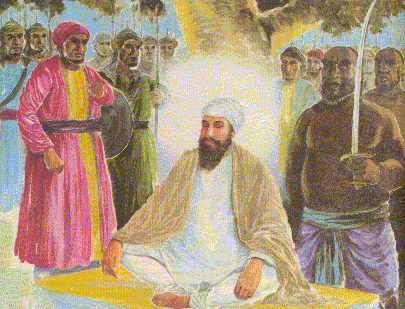
The Guru requested, the executioner- Jalaluddin to strike the blow when He had finished the recitation of Japji Sahib and when He bowed in reverence at the end. Accordingly, Jalaluddin struck the blow. The holy head flew into the lap of Bhai Jaita, who was standing nearby. He moved away swiftly towards Anandpur Sahib.
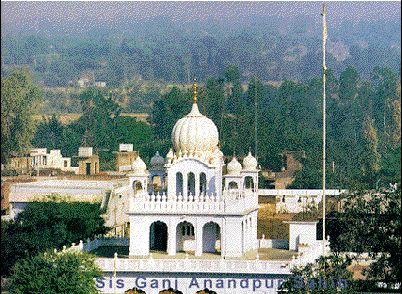
The World had seen a miracle and the Mastery of the Sword at Delhi the like of which they had never seen before. The Guru performed this "supremely heroic act to uphold righteousness" on Thursday, the eleventh day of Novembcr 1675 A.D. or 1732 Bikrami a few minutes after the clock had struck nine. At the place where Guru ji was martyred there now stands the magnificent shrine Gurdwara Sis Ganj Sahib.
The Emperor had it announced that the headless body of the "Pir of the Hindus" lies in Chandni Chowk." He who wishes to cremate it may come forward and do so." At the same time he imposed a heavy guard around that area so that no Sikh or Hindu may come near it.
On that unhappy day heavy clouds moved over Delhi and soon heavy dust storms and rain followed. It looked as though even nature had gone into mourning. Under such weather conditions, most of the guards had now dispersed, and those who were there became ineffective. In the afternoon Lakhi Shah—a Sikh of the "Vanjarah" tribe moved towards Chandni Chowk at a great speed. Lakhi Shah was a devotee of Guru Tegh Bahadur ji. He at once lifted the holy body and wrapped it under the bales of cotton that he was carrying. He then dashed towards his residence at Rakabganj. Lakhi Shah reached there at about midnight. He knew that he did not have much time at his disposal since the Imperial forces would soon be after him. So, he asked his family and neighbours to move out of their huts quickly. He then set fire to the whole village so that it appeared as if the whole place was on fire and not as though one body was being cremated: Next morning Lakhi Shah had the ashes of Guru ji put into two urns and buried at the same place where His body had been cremated. At this place now stands the historic shrine of Rakabganj Sahib.
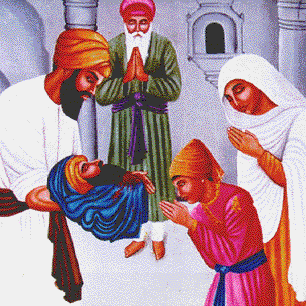
The holy head of the Guru was carried to Anandpur Sahib. Just before Bhai Jaita reached Anandpur Sahib, a whole procession of Sikhs led by Guru Gobind Rai came towards him. Bhai Jaita then presented before Him the holy head of His Father-Guru.
Guru Gobind Rai then had a pyre of Sandalwood prepared and after reciting the preamble to Japji Sahib and Sohilla set fire to it. At the place where the head of Guru Tegh Bahadur ji was cremated there now stands the historic shrine of Gurdwara Sis Ganj Sahib.
Aurangzeb, the Emperor, had become very unsettled ever since the day of Martyrdom of Guru Tegh Bahadur ji; his soul having been shaken by this heinous sin. It is said that he saw before him the spirit of Bhai Matidas every night and that he became extremely frightened of it. Soon the time came for the Emperor to die a miserable death at Aurangabad. Note, that just as the two parts of the body of Sri Guru Tegh Bahadur Ji were cremated separately at two different places, so too were two graves made to commemorate the death of Aurangzeb, one at Ahmed Nagar and one at Aurangabad. The difference is that while thousands daily, pay homage at the shrines of Guru Ji, only dogs and owls aquaint the tombs of Aurangzeb.