
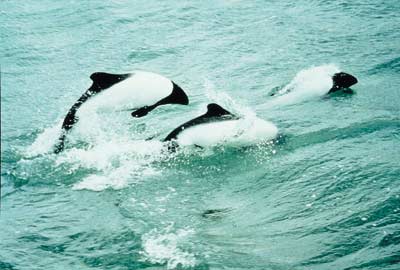
Common Name: Commerson's Dolphin
Species: Cephalorynchus commersonii
Adult Weight: 35-60kg (75-130lbs)
Birth Weight: 6kg (13lbs)
Adult Length: 1.3-1.7m (4 1/4-5 1/4ft)
Habitat: Inshore
Status: Locally Common
Diet: Crustaceans, Fish and Squid
Description: This is a striking animal and is relatively easy to indentify at sea. Its small stocky body is more similier to that of a porpoise than a dolphin, but its conspicious behaviour is unmistakably dolphin-like. At birth, it is grey, black and brown; as it ages, it develops a subdued black and grey coloration, which turns starkly black and white when it is adult. There is a considerable variation in apperance from one individual to another, particulary in the extent of black and white. It is possible to tell the sexes apart by the black patch on the underside, which is shaped like a raindrop in males and like a horseshoe in females. The population around Kerquelen Island, in the Indian Ocean, is geographically isolated, and may form a separate subspecies; most individuals are larger than the Southern American animals and are black, grey and white.
Behaviour: Fast swimmer and often active on or above the surface. Breaches frequently, often several times in a row. Sometimes seen swimming upside-down and spinning underwater on its logitudial axis; may surf in heavy swell and even in breakers close to the shore. Often bowrides, and will swim alongside or behind vessels. Sometimes found with Peales' and Black Dolphins and Burmeisters porpoises. Some populations may keep close to well-defined territories. Probably forages on or close to the sea bed.
Distribution: Distribution appears to be continuous along the coast of South America from Peninisula Valdes, Argentina, to Tierra del Fuego. Also occurs in Chilean waters and around the Falkland Islands and Kerguelen Island, and there are scattered records from waters south of Tierra del Fuego. Appears to be most common in southern Tierra del Fuego, around the Falkland Islands (espescially near harbours and natural protected areas), and in the Straits of Magellan. Most sightings are close to shore, in water less than 100m (325ft) deep. Found along the open coasts and in fjords, bays and river mouths; known to enter rivers. Seems to prefer areas with large tidal range. Often near kelp beds.
