
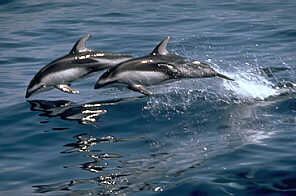
Common Name: Pacific White-Sided Dolphin
Species: Lagenorhynchus obliquidens
Adult Weight: 85-150kg (185-330lbs)
Birth Weight: 15kg (35lbs)
Adult Length: 1.7-2.4m (5 1/4-8ft)
Birth Length: 80com-1.2m (32in-4ft)
Habitat: Inshore and Offshore
Status: Common
Diet: Fish and Squid
Description: The Pacific White-Sided Dolphin is particularly lively. Large schools make so much disturbance in the water that their splashes can often be seen long before the animals themselves. The body pattern varies greatly between individuals, and tends to be less distinctive in younger animals. It looks remarkably similer to the Dusky Dolphin, but there is no overlap in range. When swimming fast, the Pacific White-sided Dolphin may produce a spray of water known as a 'rooster tail', and so at a distance could be mistaken for a Dall's Porpoise. Confusion is most likely with the Common Dolphin, but the Pacific White-sided Dolphin has a shorter beak and no hourglass pattern on its sides.
Behaviour: Very active and demonstrative, creating lots of splashes. Frequently breaches, sometimes spinning in mid-air or turning a complete somersault and landing on its side or belly. Fast, powerful swimmer; several may porpoise in unison. Enjoys surfing on ocean waves or wake-riding, and is an avid bow-rider, often seeming to appear from nowhere. Sometimes swims very close to the surface, with only its dorsal fin visible, like a shark. Large schools may split into smaller groups when feeding, but re-assemble when resting. Often associates with other cetaceans; may also be seen with seals and sea lions. It is extremely inquisitive and may even approach stationary boats.
Distribution: Tends to remain south of colder waters, influenced by Artic currents, and stays north of the tropics. Although common in the Gulf of Alaska and also around the southern Kamchatka Peninsula, it is absent from the Bering Sea. Mainly found offshore, as far as the edge of the continental shelf, but does come closer to the shore where there is deep water, such as over submarine canyons. May be north-south or inshore-offshore movements with the seasons (may move inshore or southwards in the winter), but some populations are probably resident year-round.
