This factfile was written by me! (K)
Sheep are my favourite animals because they are like really cute and they are really helpful and so on. They help us by providing us with wool which we use for loads of things that you might take for granted, like carpets. And they don't even have to die to give us these things!
But anyway, here is the more interesting stuff:
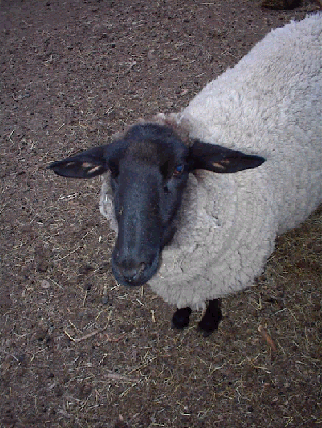
Breeds: Black, Suffolk,
Weight: Can weigh up to 160kg
Feed on: mainly grass
Climates: Sheep can live in either hot or cold climates.
Here I have decided to focus on one particular breed of sheep: the American Bighorn Sheep.
Description: a stocky sheep with very large horns living in the mountains of North America. The males stage impressive fights each year, and have extra-thick skulls to prevent brain damage during clashes.
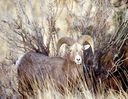
They also have a short, crimped coat. In the summer they are a rich brown with large white patches on the buttocks, but they fade to grey in the winter. The males have very large, curved horns weighing up to 14kg, whilst the females' are much smaller and less curved. The skull is double-layered to absorb the impact of fighting blows, and there is a strong tendon running from the skull down the neck to help protect the neck during twisting movements.
Average life span: on average, 9 years, but up to 24.
Statistics: 168-186cm long, standing 94-110cm at the shoulder and weighing 57-140kg (females slightly smaller, weighing 56-80kg).
Areas where they live: from South-western Canada to Western USA and North Mexico.
Habitat: Alpine to dry desert.
Feed on: grass and other plants, etc.
Behaviour: males and females live in separate herd, usually forming small groups of 8-10 individuals, but sometimes congregating into much larger herds. Female lambs tend to stay in their mothers' herd whilst males leave. They range over quite large areas, and move from sheltered valleys in the winter onto the upland areas during the summer. They are very agile on rocky surfaces and narrow ledges and are good swimmers.
Conservation: listed as 'Lower risk - Conservation Dependant'.
Sounds: bleating and snorting, although generally quieter than many sheep.
Background: