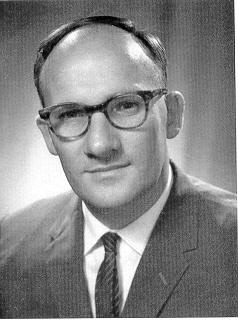
Kevin M.K. Cairns MHR

JOHN SMITH MURDOCH, BRISBANE, A WOODEN LEG, SYMBOLIC SIGNS,
AND THE OPH BUILDING
OPH was constructed during 1923-1927, at a cost of £640,000 and was designed by a Glaswegian John Smith Murdoch who also designed the Hotel Canberra, the Power Station at Kingston (A.C.T.)* and many other government buildings, including the State and Commonwealth Office Blocks adjoining Anzac Park in Brisbane. While located in Queensland he also designed "many custom houses, court houses and post offices throughout central and northern Queensland" as one of Queensland's district architects (David Rowe, "Building Federation, An Architectural Perspective", Constitutional Centenary, December 1994, 4-5.)
* For more information on the Kingston Power Station and its association with OPH, go to "The Division Bells and the Time of Day" on this website.
Murdoch had been appointed Chief (Commonwealth) Architect in 1919 and in 1922 was given the task of designing a Provisional Parliament House in Canberra. The building was finally opened in May 1927 by the Duke and Duchess of York.
When I was Senator Vince Gair's secretary I used to work in Smith Murdoch's Commonwealth Offices in Brisbane. The nearby Anzac Park was a restful place where Brisbane office workers would sit and eat their lunch. The windows from the Commonwealth Parliament Offices provided good views of any demonstrations taking place in the Park. At the top, near the railway station, was a memorial for those who had been killed in action.
We shared the building with several other Commonwealth agencies, including the Bankruptcy people. Somehow they found out I was on the third floor and so when people needed signatures witnessed they sent them down to see me - the only Commissioner for Affidavits within cooee. Family historians of the future are going to find my monniker permeating years of Brisbane bankruptcy papers - a bit like the names of midwives on the goldfields: the same witnesses were present at everyone's birth.
In the sixties and the seventies the Parliamentary staff in Brisbane were a friendly group, particularly to me as a "Southener", who had migrated to Queensland from NSW. Jack, Des, Marg, Carmel, Jess, Bernie, Merle and the car drivers Jack and Cliff mixed freely with the MPs and Senators from all parties. I think it was Carmel from a Labor MHR's office who passed on a message to the Police that a parcel bomb had allegedly been sent to our office. Crackpots didn't differentiate, if they wern't knocking on your door today they were annoying staff at some other MP's office.
I don't remember anything special about Smith Murdoch's Brisbane buildings although I spent a great deal of time in the offices, even Saturday night one time when I was rushing to assemble a policy speech. I had no hole-punch to pierce 20 roneod foolscap pages so I obtained a hammer and nail and used the office dictionary as a base. It worked. The nightwatchman wondered what the racket was all about.
The room I worked in was previously occupied by a former Parliamentary War veteran who lost his leg in WW I. One day a young Senate Official, Tom Wharton, told me how he was cleaning out a retired Senator's office in OPH in Canberra and came across a wooden leg in a cupboard - it was thought to belong to the Veteran whose room I later occupied. How do you misplace your wooden leg? Then, on the other hand, I once viewed a set of false teeth belonging to a former MHR which were filed among his manuscripts in an archival repository! As was a funeral urn containing the ashes of another former MHR, once convicted of murder!
I can recall that there was a narrow driveway on the park-side of the building and space for several cars. Naturally enough, first choice for a parking spot went to the resident MP's. The late Kevin Cairns MHR used to park an elderly Morris Minor there and sometimes he would give me a lift home. Occasionally the car would not start and that was how I paid for my lift home - I had to give it a push start so that Kevin could get the motor to tick over. Getting Brisbane office workers to stand clear of the driveway while Kevin got up enough speed to launch the car onto Adelaide Street was an interesting sight. Later, Kevin became Minister for Housing and was entitled to an official driver and car. It never had battery problems.
Kevin M.K. Cairns MHR |
|
|
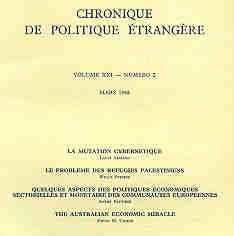
Kevin Cairns was a Brisbane Dentist and Liberal MHR for Lilley who developed an interest in economics. In 1968 he was invited to contribute an article to an academic journal in Brussels about "The Australian Economic Miracle". He was quite chuffed about that and proudly presented me with a copy. Did Australia have an "economic miracle" in 1968, or was that simply Kevin's catchy title? |
Back to John Smith Murdoch. Recently I was conducting a tour group around OPH and I mentioned Smith Murdoch's architectural work in Canberra and Brisbane. One of the tour group from Brisbane then told me that there are now plans to convert Murdoch's Brisbane State Government offices into city accommodation units. Hopefully, that fate will not befall OPH.
Let me tell you an interesting story about OPH and John Smith Murdoch. Murdoch was a member of the Masonic order. This is well known, it is not a secret. It appears that he integrated some of the symbolism of his craft into the design of OPH. For example, if you stand in front of the statue of King George V in King's Hall and raise your eyes towards the ceiling you will notice a square design within the row of windows. It has what appears to be three tassles hanging down on each side and some say that this represents a Mason's ceremonial apron.
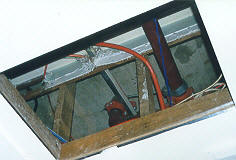
In 1999 workmen were renovating the inner support structures of the Old Parliament House and they came across a roughly scratched drawing of three intertwined fish on a previously inaccessible concrete column dating from 1927. This is a well-known Christian symbol for the Trinity and has given rise to a theory that some of the workmen employed during 1923-27 were not happy at the symbolism that Smith Murdoch had incorporated. They regarded Masons as anti-Christian and this was a silent form of protest, which remained hidden for 72 years. We are unlikely to ever know the true story, those early workmen are now either dead or in their nineties.
 |
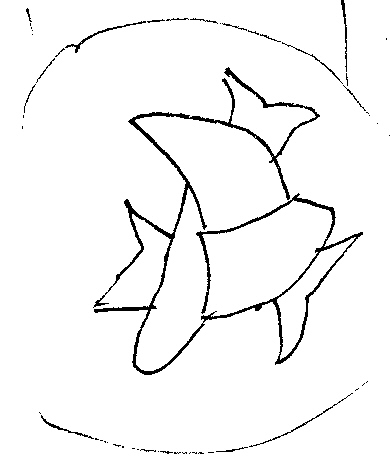 A sketch of the the three intertwined fish. |
|
| The above is a hole cut in the ceiling on the lower level of Old Parliament House. It is covered with perspex and somewhere up there on a concrete column is the rough sketch of three intertwined fish (see my drawing on right). Nothing much is visible at this stage but hopefully the authorities will install a spotlight to illuminate the drawing. | ||
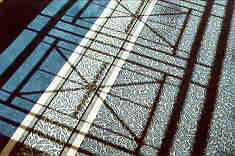
| This photo was taken one afternoon in
the enclosed corridor leading from Kings Hall to the
Members' Dining Room. The pattern of the railing has been
projected onto the carpet by the afternoon sun. I had thought that John Smith Murdoch was responsibel for the design because it contains plenty of 90 degree angles and squares but the well-known entertainer Jeanne Little says that her mother Katie Mitchell was responsible for the design, which symbolises a flag. It can also be seen on buildings in and around Sydney. Katie Mitchell had a successful business designing and manufacturing ornamental ironwork. (Article in Sunday Life section of Sun-Herald, 7 May 2000.) |
 |
Click on this button to return to the Contents
Page 
This is part of the Unofficial Website for Old Parliament House, Canberra, which is maintained by Denis Strangman.