Japan
Stats & Facts Physical Economy History
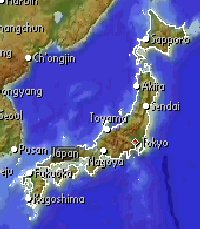
Lonely Planet - Map of Japan
Japan (in Japanese, Nihon or Nippon), is a country occupying an archipelago off the coast of east Asia. It stretches about 2,400 km (1,500 miles) from Hokkaido in the north-east through Honshu, Shikoku, and Kyushu to the Ryukyu Islands in the south-west. Japan is separated from China to the south-west by the East China Sea, from Siberia and Korea to the west by the Sea of Japan, and from the islands of Sakhalin and the Kuriles to the north and north-east by the Sea of Okhotsk and the Nemuro Strait.
Statistics & Facts
Capital : Tokyo
Area : 377,835 km2 (145,883 sq. mi.)
Population : 125.362 million (1995)
Currency : Yen
Religions : Joint adherents of Shinto and Buddhism 80.0%; Christian 1.2%
Ethnicity : Japanese 99.4%; Korean 0.5%; Chinese and other 0.1%
Languages : Japanese (official)
International Organizations : OECD; UN; Colombo Plan
Physical
The deeply indented coastlines are surrounded by many smaller islands, with the
Inland Sea forming an important constituent of the country. The islands curve
along the edge of the Eurasian plate, one of the Earth's geologically most active
zones, creating almost perpetual earthquake and much volcanic activity. Mountains
cover two-thirds of Japan's surface, and the rivers are generally unsuited for
navigation. Generally the climate varies from the long Hokkaido winter of deep
snow to subtropical conditions of the south, influenced by the Kuroshio and the
Tsushima Currents. During the seasonal periods of heavy rainfall and typhoons,
flooding becomes a major problem.
Economy
The Japanese economy is the second largest in the world and is still growing
rapidly. Economic growth has been built on a huge level of exports, and Japan
has export surpluses with all its major trading partners, which include
developed economies such as the USA and Germany, as well as the developing
economies of its neighbours such as China and the ASEAN states of South-east
Asia. Japan leads the world in the manufacture of electrical appliances and
electronic equipment, which, along with motor vehicles, iron, and steel, make
up most of the country's exports. The shipping and chemicals industries are
also important. Japan is under pressure to facilitate access to its domestic
markets for imports of foreign manufactured goods. Japan is a leading
financial market, and the Tokyo stock market is one of the world's foremost
financial centres. There are gas fields around the main island of Honshu,
but Japan is short of mineral and energy resources, being the world's largest
importer of oil. It has a substantial nuclear energy capacity, which with
hydroelectric plants provide much of the country's energy. Only one-sixth of
Japan's land can be farmed or is habitable; agriculture is dominated by rice
cultivation, and a quarter of food needs must be met by imports. With the
rise in the value of the yen since the mid-1980s, Japan has invested heavily
overseas, and contributed increasing amounts of aid, often in the form of
Japanese goods and services, to developing countries.
History
[Click on the links for a little more depth into the names and terms used.}
Originally inhabited by native Ainu, the Japanese themselves are thought to be
descendants of people who migrated from various areas of mainland Asia. By the
5th century AD the
Yamato
clan loosely controlled much of Japan and began to
establish imperial rule. The developing state was much influenced by Chinese
culture. Buddhism was introduced in the 6th century and, after a brief
conflict, coexisted with the Japanese religion,
Shinto.
In the 7th century Prince
Shotoku
was partially successful in establishing an administrative
system based on that of
Sui China.
However, by the 9th century the
Fujiwara
family had gained control over the imperial court and its power was undermined.
The growing strength of feudal lords and of Buddhist monasteries resulted in civil war for most of the 12th century, the ultimate victor being Minamoto Yoritomo, who in 1192 became the first shogun and established a military administration. From then effective power lay with the shogun rather than the emperor. Yoritomo's Kamakura shogunate was replaced in 1333 by the Ashikaga shogunate, but its rule was one of prolonged civil strife. In the late 16th century three warriors, Oda Nobunaga, Hideyoshi, and Tokugawa Ieyasu broke the power of the feudal lords (daimyo), and Ieyasu's Tokugawa shogunate provided stable but repressive rule until the restoration of the emperor in 1868.
Europeans had begun to trade with Japan in 1542 and Catholic missionaries, including Matteo Ricci, made numerous converts. The Tokugawa shogunate excluded all foreigners in 1639, except for a few Dutch and Chinese at Nagasaki, and proscribed Christianity. During the 18th and 19th centuries the wealth and power of merchants began to increase and Japan extended its influence over the northern island of Hokkaido.
In the first half of the 19th century Tokugawa power was gradually undermined by economic problems, insurrection, and the arrival of Western trading and naval expeditions, most notably those of the American Commodore Perry (1853-4). The shogunate's failure to resist foreign penetration served as the catalyst for armed opposition, which in 1868 finally succeeded in replacing the shogunate with a new regime led formally by the emperor Meiji ( Meiji Restoration). In the succeeding decades feudalism was dismantled and a centralized state created which was dedicated to the rapid modernization of society and industrialization. Japan's new strength brought victory in the Sino-Japanese War (1894-5) and the Russo-Japanese War (1904-5), and established it as the dominant power in north-east Asia. Japan fought on the Allied side in World War I, but thereafter its expansionist tendencies led to a deterioration in its diplomatic position, most notably vis-a-vis the United States. In the inter-war period, expansionist-militarist interests gradually gained power within the country, and, after the occupation of Manchuria (1931) and the creation of Manchukuo (1932), full-scale war with China was only a matter of time. The Sino-Japanese War finally broke out in 1937, and, having already allied itself with Germany and Italy in the Anti-Comintern Pact, Japan finally entered World War II with a surprise attack on the US fleet at Pearl Harbor in December 1941. Initially overrunning the colonial empires of south-east Asia at great speed, Japanese forces were eventually held and gradually driven back ( Pacific Campaigns ). In September 1945, after the dropping of two atomic bombs, Japan was forced to surrender and accept occupation . A new Japanese Constitution was introduced, and full independence was formally returned in 1952. Japan embarked on another period of rapid industrial development, to become one of the major economic powers in the world. Its relations with China and south-east Asian countries improved, but the large imbalance in its favour in its trade with Western nations (particularly the USA), resulted in economic instability. The Liberal Democratic Party (LDP) held office continually throughout these years, surviving numerous financial scandals. In 1992 a further series of scandals threatened the stability of the government, led by Kiichi Miyazawa, and the future of the LDP, while Japan's economy continued to be affected by the global recession. In 1993 the government was defeated in a vote of no confidence and a general election was called in which the LDP split and lost its overall majority. The opposition formed a seven-party coalition and ejected the LDP from office for the first time since its formation in 1955. The new government, led by Morihiro Hosokawa, introduced a political reform bill proposing a system of single-seat constituencies and legislators elected by proportional representation; the measures were passed and implemented by the end of 1994. Hosokawa's resignation in the same year brought a short-lived coalition government, led by Tsutomu Hata, to power; it was replaced with a coalition of the LDP, the Social Democratic Party of Japan (SDPJ) and Sakigake, under Tomiichi Murayama. In January 1995 a large earthquake caused extensive damage to the city of Kobe, killing more than 5,000 and leaving 310,000 homeless. The instability of the coalition government became apparent as deep ideological divisions between the participating parties and divisions within the SDPJ manifested themselves. In 1995 the SPDJ announced that it was disbanding and in 1996 the LDP's Ryutaro Hashimoto became Prime Minister of a new coalition. That same year widespread public concern was aroused by a series of gas attacks on public transport carried out by a religious sect, Aum Shinrikyo, whose leader was arrested and charged in May. To mark the 50th anniversary of the end of the Pacific War, the government agreed to issue an official apology for Japan's actions during the conflict. A large economic stimulation package was also unveiled by the government in an attempt to bring the Japanese economy out of its longest recession since 1945. Friction between the USA and Japan over trade issues--particularly Japan's trade surplus with the USA--which had long dominated US-Japanese relations, eased slightly in the early 1990s as a series of trade agreements were reached improving access to Japan's markets. However, talks to end the dispute over the valuable sector of cars and components failed and a trade war was narrowly avoided in 1995. Following the inconclusive general election of October 1996 Hashimoto formed a minority LDP government.