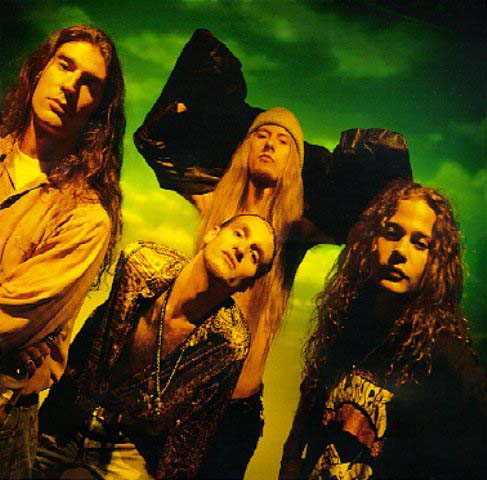
 Past/Other Members: Mike Starr
Combining the gloom of grunge with the crunch of metal, Alice in Chains sprang from the much-publicized Seattle rock movement of the late eighties and early nineties to become one of alternative rock's most successful groups. Propelled by the bleak, drug-and-death-addled vision of singer Layne Staley, and the plodding, subtly shifting metal chords of guitarist Jerry Cantrell, Alice in Chains quickly rose to prominence with aggressive marketing and a doom-struck sound that matched the uncompromising power of Metallica with the hipper sound of modern rock. Staley formed "Alice N' Chains" while still
in high school, but it wasn't until 1987, when he met Cantrell at the Seattle
warehouse rehearsal space known as the Music Bank, that the two changed
the name to Alice in Chains and began to search for a distinctive sound.
To help them, the pair recruited friends Sean Kinney on drums and Mike
Starr on bass; they signed with Columbia Records in 1989. For the next
year, the band toured extensively, opening for acts as disparate as Iggy
Pop and Poison, and released a promotional-only EP entitled We Die Young.
It wasn't until the 1990 release of Facelift--with its harsh, contemporary
take on the drop-tuned (tuning the stings lower than standard) sound of
Black Sabbath--that the band's vision began to take real shape. The album
got off to a slow start (it didn't enter the Billboard charts for eight
months), but eventually went gold and earned a Grammy nomination for the
single "Man in the Box." In November of 1991, the band followed up its
debut with the four-song EP Sap.
In 1994, the group scored again with Jar
of Flies, an acoustic EP that became the first such mini-album to reach
the top of the Billboard album chart. Not only did the EP prove that the
decibel-intense band had an interest in a quieter, more intricate mode
of expression, it also confirmed that the boys could play; Cantrell, in
particular, was seen as the emerging guitar hero from all the Seattle bands.
In late 1995, the quartet released the self-titled Alice in Chains, a record
that refined their slow, taut approach to mining a groove to an art form,
best characterized by the lead track "Grind." Though the album was well
received, it failed to be the blockbuster many had hoped for. Within a
year, the band, in uncharacteristically rapid fashion, released a follow-up,
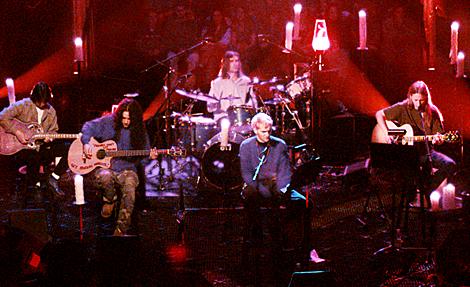
an entire album of "unplugged" material drawn from an acoustic performance
filmed by MTV. To celebrate the event, Alice in Chains plugged back in,
albeit briefly, to serve as the opening act for the first four shows of
KISS's reunion tour in June of 1996.
 |