

The musical parts (the text behind the lyrics)
Scenes speaks of transcendence, the way nature has, and gives us, of making our race perpetuate itself, making our inheritance (genetic, cultural etc.) remains as a presence on our descension, giving this race a character of permanence - and even immanence, perhaps - which would make us eternal, in a certain way.
Another of the human manifestations that can concede eternity is art, once properly registered, produced, distributed and disseminated - something that is issued on the air through radio waves just once, for example, travels eternally through the stars, freed of physical limitations.
The only limitation is non-creation, the fear to dare, the lack of initiative, an art that does not make itself present in the contemporary context of its existence (it might even be discovered, later on, but then the creating artist would hold no more responsibility for the issuing of his product).
Part 1: A Son to Live On
One chance is given to persons about to procriate: to become better human beings. Because of that, life presents renewed opportunities for spritual growth all the time, chances to turn lose practices that bring no good, devious signs on a road from nothing onto nowhere.
The ideal path to be trodden by future parents would necessarily be a virtuous one.
When, with all the will to succeed, parents meet the sweeteness of his child, they start to wonder about what destiny would be created by them for the little one, given to him as inheritance and shared together, as closest relatives.
During life, many different people and feelings will come and go. Anyway, the nature of time is to see that growth happens and that parents can follow it until a given limit - that of their lives (or their child’s, sometimes).
One of the things done by descension is to face the elder parts their coming of age - or maturity -, but if even the “experienced” show themselves as yet ignorant about how to drive their lives onward, sometimes, that’s equall part of the ongoing proccess of mutual learning.
There would not be one single way to deal with bringing up a child, and only close attention to the dialectic of the proccess could prepare parents to deal with fatherhood, for one day their child will proceed alone to pursue an individual adventure in life. So parents should always try to capture their child’s personality in their hearts and learn to perceive it and respect whichever differences from their own selves that are shown within their child’s personal ways.
The will is written by nature: life will be the only legacy left by all parents as a gift to their own kindred, those who have inherited it. Powers such as will, power of decision and determination have also naturally been given by the child’s personal experience in the proccess of private particular education, as well as how what was taught has been perceived - all those are factors to be counted in order to make the child get to take better care and control of life when all alone.
Part II: Walk of Life (instrumental)
The rhythm of this part has a walking like attitude, with ups and downs, disconected encounters, little trips and stumbles, falls and comebacks, all culminating in a dramatic introduction to the next part.
Part III: Chase from Death (instrumental)
This part is characterized by a certain degree of acceleration of a repeated motive, translating anxiety in dealing with an inextricable common fate - like repeated round trips trying to avoid coming to one single and inevitable destiny while going in circles.
Part IV: Final Rest
The final destiny, translated in complete peace and quietness.
Part V: A Doubt to Live in
While at the same time it concedes us the fruition of life while it occurs, time measures the extension of the interval in which all succeeds.
Eternal as an universal entity, it wraps us in itself, ceases to exist for us and still remains immutable in its infinite span, not having in it a single element that points to our immediate objective perception any possible modification in it.
Time ignores us completely, only awaiting to see life transformed into death, like a bird of prey.
Prayers are made so the time we are conceded can be further extended, but it is known that this will not go beyond the point where we can no longer follow its passing - and, thus, this same passing does not affect us at all, anymore. Why praying, then?
There is a reasonable doubt about the continuity of life after death, or eternal life, this eternity being a presumption that within pure reason cannot be considered as more than wishful thinking. Nevertheless, this extension is all one thinks about when seen on the brink of life (or the whole time, perhaps, because we are never allowed to know when exactly we’ll be struck down).
In the end, when life is faced to death, all that has occurred while it lasted vanishes in the blink of an eye to make part of an unmade registry, abbandoned beyond time and matter. Beyond the human maya.
IV - SCENES OF WONDERING BEYOND
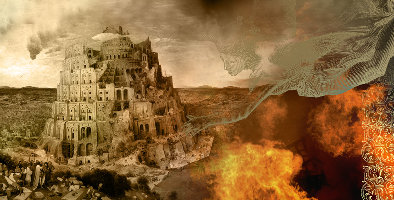
Babel Tower, such as The Gate, has two conotations: One social, and another phylosophical. For the social vision we can take two situations: The conventional biblical vision and the modern social one. No matter which one, if any, of those “guidelines” better suits the listener, the musical discourse tries to represent the tensions, doubts, searches, meetings and partings, renewed encounters, the individual and social living, the evolution of the social and individual process.
The musical parts: The text behind the music
Part 1: Questions?
The individual questionings. The loneliness of the One within the Group. The search for a means for expression and comprehension to and fro. The self search. The search for peers / pairs. The attempt for understanding: Unchangeable Law or Eternal Cycle of Individual Evolution?
Part 2: Thounsand Minded Dark City
The questionings of the group, of society. The loneliness of the Whole in the Group. The tensions and social pressures. The social Tower of Babel. If each one has his own language, how to integrate? How to understand the “language” of the whole?
Part 3: Human Abstraction
The human being and the eternal meeting renewed. The search and the understanding of Eternal Truths. The abstraction of individuality.
V - BABEL TOWER

This suite has been conceived by putting together five parts, of which the first one and the last one (beginning and ending) faithfuly follow the score of A Nigh On Bal Mountain by Modest Mussorgsky, who based himself on a popular tale about a special night of the year when all witches, gnomes, gobblins and nightly creatures would gather on a Mountain (Bald Mountain) to realize an enormous sabbath. The musical idea represents a confrontation between Good and Evil, in all its fury, that nevertheless with the break of Day (part 5), that invades all in a placid yet definitive way, dissolves all miasms left by the terrible sabbath, shies away all shadows left by darkness to make Life come to fruit from the ashes of Death.
Parts 2 and 4, Night Tale e Night Tale Reprise, are compositions by Jim Cuomo, from Fire Ballet, Canadian progressive rock band from the 70’s, who has gently authorized us to perform it.
It is perhaps a narrative of a Crusader who evokes the mystical powers granted to the soldiers from Camelot with the aid a wizard, before his travel to perform the sacred duty trusted upon him, which is accepted and honored, so that he goes to the distance only be engaged in many a fight, until one clad seems him defeated and killed by his moorish enemy.
Part 3, The Engulfed Cathedral by Claude Debussy, also used by Cuomo between both parts of Night Tale, could maybe look different from the others at first sight, was it not for the powerful concepts of plasmation and transmutation presented in its musical structure. Phylosophically, the clads between Darkness and Light bring these two elements before all else. The way it is presented by Cuomo in Night Tale is suggestive that maybe the soul of the dead warrior finds its rest during the piece.
VI - A NIGHT ON BALD MOUNTAIN
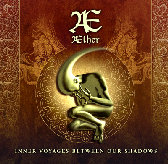
A SINTHESIS: INNER VOYAGES BETWEEN OUR SHADOWS
What might look at first sight like a record with many independent tittles is actually a conceptual CD, with the values explored within it evolving from track to track and musically viewed under many perspectives.
And those perspectives would be some inner voyages between our shadows.
Shadows from the past, of a life that has been.
At the same time, shadows of the present, shadows emerged by the light of a peaking sun, which are present but cannot be perceived by who is lightened by full light.
Shadows under which we hide ourselves when we sought for the somber side of our self. Eventual shadows under which the masks of the Babel of life fall and we meet amidst, I search of fraternity and friendship, of comprehension and understanding.
Shadows of knowledge, where the doubts that linger over our hearts and minds make us continuously adventure ourselves through the unknown in search for answers and explanations for all that is unnusual.
Shadows left by each one and by all, undelible signs of our presence, in all that surrounds us, and that stay for long after our presence, through our generations and deeds.
And, of course, those all fugacious shadows of unique moments, light and brisk, captured by us from the ethereal mater (aether) which we try to be able to illustrate and eternalize on this record we have made.
1 - Prayer for a New Meeting - 14:00
2 - The Gate - 9:15
3 - Forgiveness - 11:36
4 - Scenes of Wondering Beyond - 12:06
5 - Babel Tower - 7:26
6 - A Night on Bald Mountain - 19:29
INNER VOYAGES BETWEEN OUR SHADOWS - A LIBRETTO