Melody Maker |
BUDGIE BEAT |
|||||
WITH THE
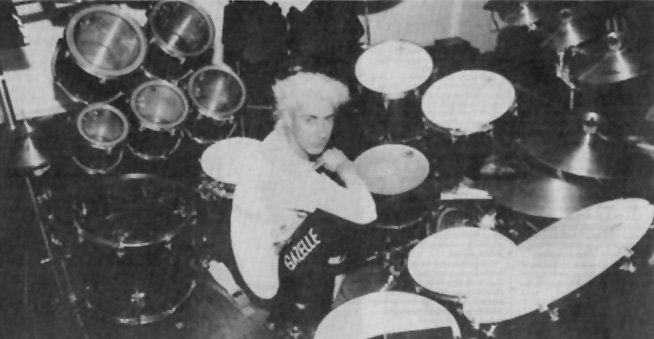
BANSHEES AND Bands led by drummers don't exactly have the greatest reputation as musical innovators. Not for nothing do mentions of the likes of The Dave Clark Five, Cozy Powell's Hammer and John Coghlan's Diesel meet with hoots of derisive laughter in 'muso' corners. Not for nothing was the joke "What do you call a guy who hangs out with musicians? "Answer: "A drummer" conceived and circulated amongst those who chose to twang strings and stroke keys instead of beat skins. But occasionally, the drumming world does throw up a winner. Not just a man who learnt to hit things faster than the next man, or a man who managed to twist a stick through a 360 degree circle between every back beat, but a man who broke new ground, who found new sounds, who stirred up new ideas. One such man is Budgie, full time member of Siouxsie And The Banshees, and driving force behind The Creatures, who since 1981 have been trying to write, play and release material featuring little more than a drummer and vocalist, Siouxsie Sioux. Of course, Creatures material isn't exclusively drums and voice; Budgie plays a range of tuned percussion, a little guitar and has been known to rope in the odd brass section here and there too, most noticeably on their summer of '83 hit, "Right Now". The power behind The Creatures' sound, however, is and always will be the massive kit Budgie has pieced together over the years. He's been through Pearl, Gretch and Sonor, and for recent Banshees material and the new Creatures album, "Boomerang", he's been flailing wildly over his latest flame, a Tama with more than a few Budgie innovations. "They just said to me, 'What do you want?', so I said, 'Whatever you've got'. We put some sizes together, power toms basically the same size as I was already using, but using lighter heads. Right at the beginning I inherited the Banshee kit. It was a Pearl kit with Remo CS heads on it, and quite thuddy. I lightened the whole thing up, and the notes started to come from that. When I got the Tama kit, I got a big gong drum on one side, which I always wanted, and lots of little drums on the left hand side, which is sort of like the Chinese side. The gong gets tuned to a low C approximately, though I don't get a tuner out every day, and the little drums are tuned to C, D and F. I found that when we started doing the beginning of "Standing There" (the new single) they were the notes that we pulled out later. There's been a conscious effort to not strangle the drums and let them sing a bit more. When you play, live drummers tend to tune the drums tighter and tighter because maybe it helps you to play a bit faster when you're tired." Tuning drums is definitely one of Budgie's fortes, and he sticks to proven methods when tuning his double-headed toms. "I think there's something to be said about hitting the drums on their own first without any head on them at all. See what natural note just comes out of it. I found that when the Tama kit arrived all the serial numbers were consecutive; they were made and packed and sent over to me. It wasn't that they'd taken drums from here and there, which definitely helps when tuning it as a kit. "I usually put the bottom head quite loose, get a little tension in it first, and get the tension slowly up until I hear the harmonic overtone of the drum. If the gong drum's a low C, the first rack tom will be a high C, and I tune the sets of toms in octaves. I put the top head on and try and get the play between the two heads. I'd been using Ambassadors for ages, top and bottom, and I changed over recently to a thinner head on the bottom, and Evans resonant head, which is specially made not to be a hit. On this recent recording we changed over to Evans Cadcam 750 guage on the top, and we started playing around with different colour heads for different types of tone. |
So I get the two heads to almost the same tension, and then just lower the bottom head until it allows the harmonic to come through. If you really want to pull the note out, you hit the rim as well." Sometimes Budgie will go as far as changing the tom heads after every two takes, and on recent recordings he's had particular problems with snare heads. "We got hold of a batch of faulty Premier heads and the central dot on their all-weather head kept moving. I'd be left with a patch of glue in the middle, so I tried a whole load of things. In the end I used these Evans Cadcams in black, all different guages and weights, for the recording. I use a couple of snare drums, the Sonorphonics I got with the Sonor kit. They're about 6 1/2 inches deep, with a very heavy thick ply. I just tune it till it sounds good, mainly cross tuning and holding onto the lug so I know where I am. If it's got a mike on for live you tune it to the mircrophone. "With the bass drum, on the Tama I'm using a 20 inch, because the toms were an extra two inches deep and at the height I'm used to playing at the clearance over the bass drum vanished. And I find the tone a lot more punchier, a lot tighter, and not lacking in any kind of response and warmth and depth of punch. We had almost a full front head on at first, then we pulled it back until a microphone would fit in And not too much padding in there, apart from one of those Remo Muff'1 dampers (which secure themselves to the head via the rim). The head's a Remo Pinstripe with one of those self-adhesive leather pads on it. I don't like those click pads at all, because you get double hits sometimes and they get sticky. And if you use those Ambassador heads you push holes in the skin." |
"I
do things like trigger brass samples off the Akai S900. With 'Peek-a-boo' I had the three different brass stabs. I don't put the Simmons up if I'm not specifically using them. When I'm not using them I put my two trusted Pearltimbales back up. Tama made some red wood ones, but I found them too dull." Most of Budgie's kit is mounted on the Tama rack, though he fels a little safer with the 16-inch and 18-inch floor toms actually on the floor - "I like to lean on them, and the little clip tends to slip on the rack when you do that" - with the gong drum suspended above them. "The gong drum is like a single headed bass drum, and the lugs let you put 22-inch heads on a 20-inch drum. It sort of pulls the head down the side of the drum and out. It's very clean as nothing's touching the head. Lots of people use it with a very flappy sort of sound, like a flam, but I use it with an Ambassador, and I like to get a note out of it, like a low C. It's kind of my way of playing the bass at the same time. And it's good if you've done a roll and you don't want to finish on a cymbal crash. You can finish on the gong drum instead." Not that cymbals don't get a look in on the Budgie set-up. A quick look at the picture will show you he's a Zildjian endorsee. “I was using Paste Rude because I found regular cymbals too thin, and then Zildjian approached me - I guess it must have been the year they were taking on more drummers - and it was great to go down there and try them all out. It was amazing how different one size cymbal can be, all in the same series and size. I picked up a lot of effects cymbals, and I think I use them more than the regular size cymbals. I do use a 16-inch and 18-inch crash, and I pulled out an earth ride cymbal, which is left un-machined, raw metal, and it’s a very metallic sound. It just sounds like tin in a way, very pure. I thought it sounded odd enough for me to use as a ride on this record. |
Ideas
greow out of the song that suggest something to you, and you try and find some way of enhancing that idea." "The Spain sessions were also recorded on 16-track, and because of the lack of inputs it was impossible to mike each drum individually, which forced them to re-think the recording method." "We used a PZM in a parabolic reflector set up above my head. So we did away with regular overheads and just put key microphones on the individual drums I was about to use in the song. It was pretty straightforward really. We found that with the bigger drums just one microphone between the three would suffice, the drums are just so loud. The room we were playing in had a stone floor and stone walls, and just empty space. The desk was in the same room with no separation. I think on some tracks it works, but on others we could have done with more control over the kit.” Once on tape, Budgie's not afraid to experiment further still with the sounds, even to the extent of playing the tape backwards, as on the Banshees' "Peek-a-boo". "That came from a drum track from the previous album, and the idea for the melody in the chorus came from the brass part that was on the song reversed." And more recently, rather than getting into drum machines, (apart from dabbling with the 808) Budgie's been experimenting with a combination of real drums re-manipulated using a Fairlight. "We put all the drums into a Fairlight, quantised it all and took sections to re-create a different drum part. I find that really exciting and it changes the whole approach to it. It also means you can loop it and take good parts without worrying about tempo fluctuation." Budgie rarely plays to click tracks, unless he's working on cross-rhythms against the 808, and despises practise. "I just can't do it, I can't. What I do now is keep fit. One of the problems in the past was warming yourself up and getting yourself into a physical condition where you can actually start to do the things you can hear in your head. Co-ordination is the main thing and I do a lot of gym work. I think speed and agility comes through keeping your brain in touch with the periphery of your little fingers." In fact practise has never been a part of Budgie's drum life, paradiddles taking a back seat to actually playing. "I can't even play paradiddles. I never learnt. I used to see this guy doing them and I couldn't begin to see how he was doing it. I know what one is, and I can do it in a way now, but in a way that suits me. I think what I've always tried to do is undo myself - try and stop my limbs from doing what they would naturally do, to make my limbs completely independent. I'm doing that all the time, on tables or whatever, always driving people mad. "It still embarrasses me that I can't do paradiddles and two stroke rolls, but I just never thought it was going to get in my way, I think the best thing is to master basic rhythm keeping, and not cluttering up, and helping out, keeping everybody else in time. Give support where it's needed and listen like crazy. Be aware of the arrangement of the whole song and not just wrapped up in your own little world." Budgie's always got plenty to say about almost every aspect of drumming: with sticks he's found that certain woods create different tones, especially on cymbals, and he opts for prime hickory; on gear he thinks you should always keep trying different things because "if you get settled with something you must be missing out on something else"; with hand-care he'd spoken to Simon Phillips who had been told that rubbing chocolate and lemon juice into your hands keeps them tough. It didn't work, but as Simon told him, it tasted really good! At the end of the day, a little white spirit helps to harden the callouses. And most unusually, the interminably long gear set-up problem drummers suffer from is, perversely, one of his joys. "I've been setting my kit up myself, mainly because we've not been on the road with The Banshees and The Creatures we don't want loads of roadies handing about, and I love it. To begin with I didn't even know how to set the big Tama up, so I had to get my roadie to show me, and I took loads of polaroids of it. "One of the reasons I started to play drums in the first place was because you get so much stuff. There's so many nuts and bolts. That was the big drawof it. You can't physically do it when you're going from town to town on the road, but when you're not I love to do it. Absolutely love it." So maybe if you know The Creatures or The Banshees aren't too busy, and you're looking for a conscientious drum roadie that'll be happy in his work to take care of the hardware, you could think of Budgie. But whatever you do, don't ask if he's going cheap. |
|||
| "It still embarrasses me that I can't do paradiddles and two stroke rolls, but I just never thought it was going to get in my way."
|
||||||
Secured to the bass is one of Tama's double bass |
“Anyway, the effects cymbals are great, just like |
|||||