$25,000 Pyramid
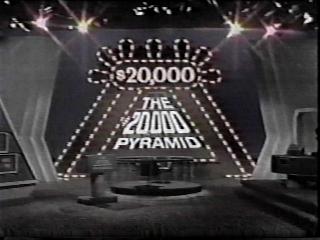

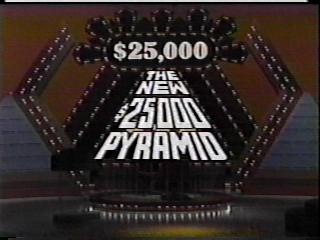
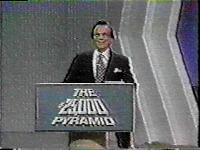
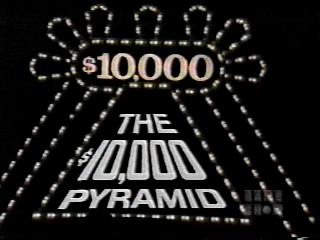
Originally, this
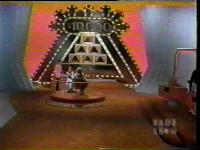
show was known as the $10,000 Pyramid in 1973. In 1976, inflation
hit and the show became the $20,000 Pyramid on ABC daytime, and
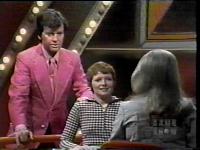
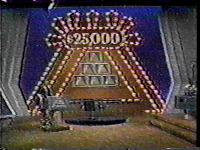
Bill Cullen hosted the nighttime version, the $25,000 Pyramid,
which aired weekly in syndication. ABC canceled the show in 1980
and the show went into syndication in 1981 as the $50,000
Pyramid, which only lasted five months. In 1982, CBS revived the
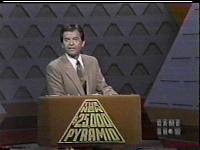
show as the $25,000 Pyramid on its daytime schedule. Dick Clark,
who hosted the previous daytime versions of the Pyramid, returned
to host the show. In 1985, the show went syndicated with the
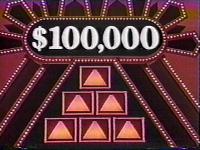
$100,000 Pyramid with Dick Clark hosting both the daytime and
nighttime versions. $100,000 went off the air in 1987 along with
the daytime version. The $25,000 Pyramid was replaced by a new
CBS daytime game show, Blackout, hosted by Bob Goen. 13 weeks
later, Blackout was canceled an was replaced by the show it
replaced, the $25,000 Pyramid, which ran for 13 more weeks until
it was gone for good in July 1988. Family Feud took over the next
Monday.
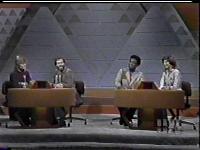
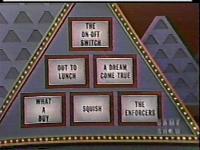
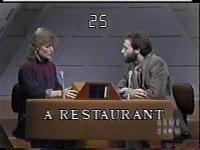
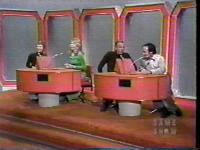
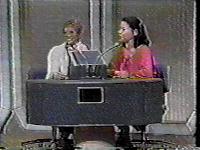
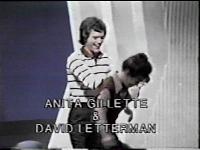
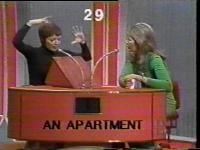
There were two contestants paired up with a celebrity partner.
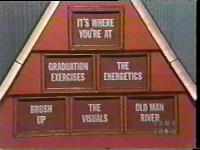
There were six categories on the board and the person giving the
clues picked the category. The contestant would then have to
describe seven words that came up on a screen in 30 seconds
relating to that subject. A contestant could use jestures and
could describe it however he/she wanted to without actually
saying the word or saying a form of the word that may be
contained in the word. (i.e. You cannot describe lightning by
saying "Its the streak of light in the sky during a
thunderstorm." because light is contained in the word
lightning and that would be an illegal clue.) If a contestant
gave an illegal clue, the word would automatically be skiped and
the total possible amount of points a contestant could earn out
of seven would be six. Contestants played three rounds per game
and the team that had the most points at the end of the game, won
the game and went the Winner's Circle for a chance at $10,000.
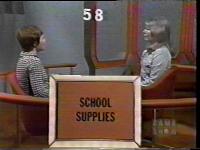

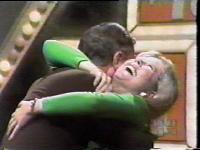
In the Winner's Circle, a contestant or celebrity would describe
the six categories on the board by giving a list of clues. A clue
that is too discriptive would be an illegal clue, and the
contestant would have to give up the chance at the $10,000.
However, each category won was worth money so the contestant
could still earn more money.
Example of legal game play for describing "Parts of a
Car": "The tires, the hood, the engine, the turn
signal," etc.
Example of illegal game play for describing "Parts of a
Car": "You drive it, you use a steering wheel to direct
it," etc.
If all six categories were correctly guessed in 60 seconds or
less, the contestant would win $10,000 on his/her first try or
$25,000 on his/her second try.
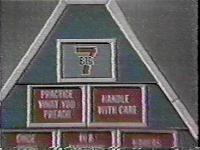
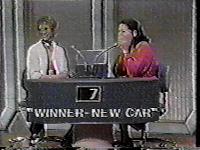
In the first game, there was a "7-11" hidden behind one of the categories during the game play. If a contestant found the "7-11" and could successfully describe to his/her partner the seven subjects that fit the category the "7-11" was hidden behind, he/she would win $1,100 in bonus money. In the second game there was a "Mystery 7" hidden behind one of the categories. If a contestant found the "Mystery 7" he/she would decribe to his/her partner seven subjects that fit in the "Mystery Category" in 30 seconds. If successful, the contestant would win a bonus prize not effecting the score of the game. In the 1970's for the $20,000 Pyramid and the $25,000 Pyramid, the "BIG 7" was hidden behind one of the six categories and if chosen, the contestant had a chance to win a special prize if he/she got all 7 clues in 30 seconds or less. On the night time edition of the Pyramid ($25,000 Pyramid), the "BIG 7" was often played for a car.
In 1991, the $100,000 Pyramid
was revised with John Davidson as the host and it ran until 1992.
Donnie Osmond will host a new revival of the $100,000 Pyramid in
the fall of 2002.
(PICTURES OF PYRAMID THOUGHOUT THE YEARS)