The Sphinx Through History
By
Fr\ wnsm
Introduction
— What's In a Name?
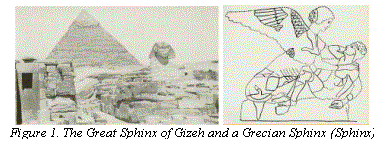 "Man." The answer is "man." The question, of
course, is the classic riddle of the Sphinx, that great wild beast pouncing all
over history. Its two most commonly recognized forms are those of the Great
Sphinx on the Gizeh Plateau and that of a vicious, riddling monster in the
Greek legends of Oedipus [fig. 1]. Throughout its history, it has taken on four
primary symbolic meanings, representing the sun, guardian, attacker, and
'mystery' in general. In this paper I will treat the earliest historical
appearances of the sphinx, its migration around the Mediterranean into Greece
and Rome, and some of the different interpretations that have been applied to
it in these various cultural settings as it has made this journey.
"Man." The answer is "man." The question, of
course, is the classic riddle of the Sphinx, that great wild beast pouncing all
over history. Its two most commonly recognized forms are those of the Great
Sphinx on the Gizeh Plateau and that of a vicious, riddling monster in the
Greek legends of Oedipus [fig. 1]. Throughout its history, it has taken on four
primary symbolic meanings, representing the sun, guardian, attacker, and
'mystery' in general. In this paper I will treat the earliest historical
appearances of the sphinx, its migration around the Mediterranean into Greece
and Rome, and some of the different interpretations that have been applied to
it in these various cultural settings as it has made this journey.
An etymological analysis of the word itself yields that it came from the Greek terms sphingo and sphingein, meaning to strangle and to bind tightly, respectively. In this Greek form it is also called sphix and phix, which ties it to the term asphyxiate, as is borne out by the etymological breakdown in Webster's Dictionary. It defines the word as a Greek-derived, New Latin term, literally meaning a stopping of the pulse, from the Latin negator "a-" being tied to the verb "sphyzein," meaning "to throb" (m-w.com). Regardless, the meaning of the name we use for this beast implies a creature that is capable of vanquishing any opponent. The Egyptians first use the name ruty to describe it in the Pyramid Texts, which were written in the VIth Dynasty (2625-2475 B.C.E.) (Sphinx, 129), and is also referred to by the terms hu or hur (Gods, 361). Sometime during the Middle Kingdom period, the Great Sphinx was given the title Sheshep-Ankh, meaning 'Living Statue.' The Greeks modified and adopted this appellation as the word sphinx.
Form and Substance
The form we call the sphinx has one constant: the body of a lion and wings. The head varies from that of a bird of prey, ram, or human. Considering that many tales of the Egyptian gods involve invaders from Eastern regions, I fully expected to discover eastern antecedents of the sphinx. This is, however, not the case. The first known appearance of this form is that of a gryphon (lion's body, head and wings of a bird of prey) in the Susa and Elam regions (the modem-day border between Iran and Iraq, along the north rim of the Persian Gulf) circa 3000 B.C.E. (Sphinx, 115), at the outset of the Bronze Age. This variant is considered to represent an earlier form of the creature before taking on the characteristics most commonly associated with its first appearance on a grand scale: the Great Sphinx on the Gizeh Plateau.
Selim Hassan, who organized excavations around the Great Sphinx in the mid-1930s, believes the origins of the sphinx lay in the symbol of the lion (Sphinx, 68). Here is a powerful creature, known for its strength, ferocity, and victorious nature. Hassan believes that leaders of villages began associating themselves with the strength and potency of this animal around 2800 B.C.E., near the divide in time between the First and Second Dynasties. They began to represent the local sovereign with his head upon the body of a lion. E. A. W. Budge, who headed the Assyrian and Egyptian wings of the British Museum at the beginning of the twentieth century, concurs somewhat, explaining it was "probably the product of the beliefs of a school of theologians which existed when the cult of the lion was common in the Delta or Northern Egypt, but tradition perpetuated the idea of ‘protection’ that was connected with it, and the architectural conservatism of the Egyptians caused reproductions of it to be made for all the great temples in the country in all periods of its history” (Gods, 362). In the Egyptian mythological schema, the sphinx is later attributed to being the daughter of Typhon (or Orthus) and Echidna (or Chimaera) (Gods, 361), and this, then, became the prototype for the sphinx of the Old Kingdom period.
The
Old Kingdom – 2650-2150 B.C.E.
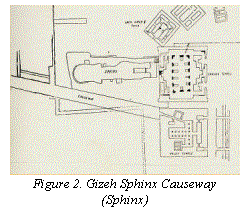 There are several theories arguing the date
of the appearance of the Gizeh Sphinx. Most date it to somewhere in the IVth
Dynasty, around 2500 B.C.E., but others date it to a much earlier period, some
as early as 10000 B.C.E. For example, Hassan’s position is that it was carved
in the period following the erection of the pyramids of Khufu and Khafra, most
likely at the end of the latter’s reign. He bases his evidence on a pit for the
drainage of rainwater located at the end of the causeway running along the
South edge of the Great Sphinx [fig. 2]. He believes this pit was plugged after
completion of the sphinx carving (Sphinx, 88-9). Hassan readily admits,
however, that there is no shred of archaeological evidence to tie the Sphinx
specifically to Khafra. Budge offers a few other suggestions, saying that it
was already old at the time of Khafra’s reign (Gods, 361). Though he
admits disfigurements of the stele between its forelegs also may date it to
Khafra, he goes on to note that an inscription found in the Temple of Isis by
Mariette in 1853 states that Khufu, not Khafra, “had the spur of rock carved
into the form of a man-headed lion” (Mummy, 32). During this period, the
Egyptians associated it with Atum, god of the setting sun, which itself
is a symbol of death. It was also known at that time to represent the three
other forms of the sun as well: midnight, dawn, and noon (Sphinx, 129).
Budge believes it was specifically intended to serve as a guardian for the
entombments in that region, and that those who constructed it believed that the
sun god would descend and dwell within the creature to provide protection for
the dead (Gods, 361).
There are several theories arguing the date
of the appearance of the Gizeh Sphinx. Most date it to somewhere in the IVth
Dynasty, around 2500 B.C.E., but others date it to a much earlier period, some
as early as 10000 B.C.E. For example, Hassan’s position is that it was carved
in the period following the erection of the pyramids of Khufu and Khafra, most
likely at the end of the latter’s reign. He bases his evidence on a pit for the
drainage of rainwater located at the end of the causeway running along the
South edge of the Great Sphinx [fig. 2]. He believes this pit was plugged after
completion of the sphinx carving (Sphinx, 88-9). Hassan readily admits,
however, that there is no shred of archaeological evidence to tie the Sphinx
specifically to Khafra. Budge offers a few other suggestions, saying that it
was already old at the time of Khafra’s reign (Gods, 361). Though he
admits disfigurements of the stele between its forelegs also may date it to
Khafra, he goes on to note that an inscription found in the Temple of Isis by
Mariette in 1853 states that Khufu, not Khafra, “had the spur of rock carved
into the form of a man-headed lion” (Mummy, 32). During this period, the
Egyptians associated it with Atum, god of the setting sun, which itself
is a symbol of death. It was also known at that time to represent the three
other forms of the sun as well: midnight, dawn, and noon (Sphinx, 129).
Budge believes it was specifically intended to serve as a guardian for the
entombments in that region, and that those who constructed it believed that the
sun god would descend and dwell within the creature to provide protection for
the dead (Gods, 361).
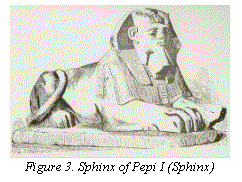 We find that by the middle of the Vith
Dynasty that the Egyptian sphinx still has the form with a human head, which
most often depicts the likeness of the local sovereign or pharaoh as a symbol
of his omnipotence. A perfect example of this, from the reign of Pepi I, is
currently housed at the Louvre [fig. 3] (Sphinx, 94).
We find that by the middle of the Vith
Dynasty that the Egyptian sphinx still has the form with a human head, which
most often depicts the likeness of the local sovereign or pharaoh as a symbol
of his omnipotence. A perfect example of this, from the reign of Pepi I, is
currently housed at the Louvre [fig. 3] (Sphinx, 94).
First
Intermediate Period/Middle Kingdom – 2134-1640 B.C.E.
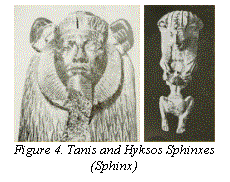 By 2000 B.C.E., the sphinx had migrated
around (via the Middle East region) and across the Mediterranean into Asia
Minor. The eagle-headed variant males its first appearance at this time in
Mycenae (Sphinx, 123), and in this period we begin to see further
variations in design. During the reign of Amenemhat III, in the XIIth Dynasty
(circa 1750 B.C.E.), a different variety of Sphinx began to appear around
Tanis. For example, earlier variants with human heads surround the face with
the Nemyss, or hood-style headdress of the king. In the Tanis examples,
the mane and ears of a lion encircle the face (Sphinx, 98), and the
Hyksos variants place and over-sized head on a tiny lion’s body [fig. 4]. Those
found at Tanis by Mariette were made in the likeness of Amenemhat (Mummy,
44-5).
By 2000 B.C.E., the sphinx had migrated
around (via the Middle East region) and across the Mediterranean into Asia
Minor. The eagle-headed variant males its first appearance at this time in
Mycenae (Sphinx, 123), and in this period we begin to see further
variations in design. During the reign of Amenemhat III, in the XIIth Dynasty
(circa 1750 B.C.E.), a different variety of Sphinx began to appear around
Tanis. For example, earlier variants with human heads surround the face with
the Nemyss, or hood-style headdress of the king. In the Tanis examples,
the mane and ears of a lion encircle the face (Sphinx, 98), and the
Hyksos variants place and over-sized head on a tiny lion’s body [fig. 4]. Those
found at Tanis by Mariette were made in the likeness of Amenemhat (Mummy,
44-5).
Second
Intermediate Period/New Kingdom – 1640-1070 B.C.E.
The XVIIIth dynasty, which began around 1580 B.C.E., Created and applied further meaning to the Great Sphinx. It was during this time that it was given a name instead of mere terms of reference. Its name was now Hrumachis, ‘Horus of the Two Horizons’ (Sphinx, 131) in Ancient Egyptian cosmogony, further emphasizing its solar symbolism.
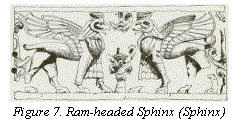
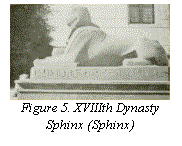 Beginning in this period, other physical
characteristics became more prominent in Egypt: the lion-body appears slimmer
and less muscular [fig. 5]. Other physical adaptations include the appearance
of human hands and forearms on some of them [fig. 6], and the first arrival of
the gryphon form (i.e. eagle-headed) occurs during the reign of Ahmes I (Sphinx,
102), right at the dawn of this dynasty. In the reign of Amenhotep III
(1411-1375 B.C.E.), the ram-headed sphinx first appears [fig. 7]. This variant
was associated directly with Amun Ra (Sphinx, 103), an earlier
representation of the sun deity, yet solar nonetheless. The Ancient Egyptians
represented the sun with dozens of deities over the centuries, each
representing different aspects of the sun. As noted earlier, some solar gods
represent the sun at different times of the day, but there are others
representing the burning sun over the desert, the sun obscured by clouds, et
cetera. The sun was obviously regarded as an important element of their
cosmogony, and these different forms of solar gods reflect this.
Beginning in this period, other physical
characteristics became more prominent in Egypt: the lion-body appears slimmer
and less muscular [fig. 5]. Other physical adaptations include the appearance
of human hands and forearms on some of them [fig. 6], and the first arrival of
the gryphon form (i.e. eagle-headed) occurs during the reign of Ahmes I (Sphinx,
102), right at the dawn of this dynasty. In the reign of Amenhotep III
(1411-1375 B.C.E.), the ram-headed sphinx first appears [fig. 7]. This variant
was associated directly with Amun Ra (Sphinx, 103), an earlier
representation of the sun deity, yet solar nonetheless. The Ancient Egyptians
represented the sun with dozens of deities over the centuries, each
representing different aspects of the sun. As noted earlier, some solar gods
represent the sun at different times of the day, but there are others
representing the burning sun over the desert, the sun obscured by clouds, et
cetera. The sun was obviously regarded as an important element of their
cosmogony, and these different forms of solar gods reflect this.
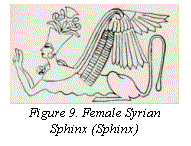
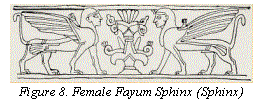
 Toward the end of the XVIIIth dynasty, during
the reign of Tutankhamun (1347-1338 B.C.E.), we find the elongated figure of
the lion or sphinx used as a symbol of protection on the ornamentation of both
beds and funerary biers. Statues of such figures were also found stationed as
guardians of temple doorways, and they also began to make their way into
jewelry and the bolts of doors (Sphinx, 66). In this period also we see
the first foreign influences on the form: female heads and raised wings, first
found in Egypt on a cup in Fayum, approximately 50 miles southwest of Gizeh
[fig. 8]. Sphinxes of classical Egyptian origin were male-headed and winged,
but the wings were always depicted as laying flat across the leonine back of
the creature (Sphinx, 105). There were three general varieties of the
female-headed sphinx (Sphinx, 109). The first appeared identical to the
male-headed variant, with nemyss headdresses, but with a beardless,
female face. The second variant featured Syrian and Canaanitish influences
[fig. 9], with elaborate headdresses and lioness bodies, alluding to the
goddess Ashtoreth, (Sphinx, 110). This worship of the moon
goddess, who began as Ishtar of Nineveh, made its way into Egypt from Syria
during the reign of Thothmes III, and was well established by the reign of
Amenhotep III (Gods, 278-9). The third variant combines elements of the
first two. The last variation on the form of the sphinx in this period, as we
prepare to move into the Iron Age, is that associated with Ramses II (1292-1225
B.C.E.). It is essentially the form seen in the latter Old Kingdom period, with
the additions of a shoulder cape and apron (Sphinx, 100).
Toward the end of the XVIIIth dynasty, during
the reign of Tutankhamun (1347-1338 B.C.E.), we find the elongated figure of
the lion or sphinx used as a symbol of protection on the ornamentation of both
beds and funerary biers. Statues of such figures were also found stationed as
guardians of temple doorways, and they also began to make their way into
jewelry and the bolts of doors (Sphinx, 66). In this period also we see
the first foreign influences on the form: female heads and raised wings, first
found in Egypt on a cup in Fayum, approximately 50 miles southwest of Gizeh
[fig. 8]. Sphinxes of classical Egyptian origin were male-headed and winged,
but the wings were always depicted as laying flat across the leonine back of
the creature (Sphinx, 105). There were three general varieties of the
female-headed sphinx (Sphinx, 109). The first appeared identical to the
male-headed variant, with nemyss headdresses, but with a beardless,
female face. The second variant featured Syrian and Canaanitish influences
[fig. 9], with elaborate headdresses and lioness bodies, alluding to the
goddess Ashtoreth, (Sphinx, 110). This worship of the moon
goddess, who began as Ishtar of Nineveh, made its way into Egypt from Syria
during the reign of Thothmes III, and was well established by the reign of
Amenhotep III (Gods, 278-9). The third variant combines elements of the
first two. The last variation on the form of the sphinx in this period, as we
prepare to move into the Iron Age, is that associated with Ramses II (1292-1225
B.C.E.). It is essentially the form seen in the latter Old Kingdom period, with
the additions of a shoulder cape and apron (Sphinx, 100).
Third Intermediate Period/Late Period - 1070-332 B.C.E.
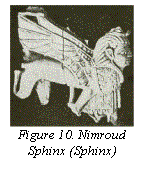
As the sphinx spread around the Mediterranean and through the Middle East into Southern Asia, it was not limited to the forms of the Old and Middle Kingdoms. For example, the raised-wing, female variant began to appear in the Assyrian region of Nimroud in the 11th Century B.C.E. [fig. 10] (Sphinx, 115). Up to this point, any mention of foreign influence would have been limited to as far east as the region now occupied by Iran and as far north as Asia Minor. From there it makes its first entrances into Greece around the 9th Century B.C.E. (Sphinx, 117).
 Moving
into the last periods before Greek and Roman occupation, we find that the
figure has continued to fulfill the same role it had since the Old Kingdom,
that of a guardian. Conversely, the Greeks viewed the creature as a vengeful
beast, attacking upon whim, without pity or quarter. I believe that since the
Egyptians had taken upon the Sphinx as a symbol of protection, other cultures
of the region may have perceived such as a symbol of threat and danger. Instead
of creating their own symbolic monsters, the Greeks envisioned a host of gods
and heroes to vanquish such predatory beasts. In the legend of Oedipus, when we
encounter the famous 'riddle of the sphinx,' the Greeks seemed to reflect some
of the symbolism attributed to the form since the Old Kingdom. The wording of
the riddle refers to three of the four sacred positions of the sun (dawn, noon,
sunset), paralleling some of the sphinx' original attributions from 2,000 years
before.
Moving
into the last periods before Greek and Roman occupation, we find that the
figure has continued to fulfill the same role it had since the Old Kingdom,
that of a guardian. Conversely, the Greeks viewed the creature as a vengeful
beast, attacking upon whim, without pity or quarter. I believe that since the
Egyptians had taken upon the Sphinx as a symbol of protection, other cultures
of the region may have perceived such as a symbol of threat and danger. Instead
of creating their own symbolic monsters, the Greeks envisioned a host of gods
and heroes to vanquish such predatory beasts. In the legend of Oedipus, when we
encounter the famous 'riddle of the sphinx,' the Greeks seemed to reflect some
of the symbolism attributed to the form since the Old Kingdom. The wording of
the riddle refers to three of the four sacred positions of the sun (dawn, noon,
sunset), paralleling some of the sphinx' original attributions from 2,000 years
before.
The Greek adaptation of the sphinx into its myths and legends suggests that its Hellenic origins were a beast searching for a form. In the variant versions of the Oedipus legends, the sphinx comes into being: by order of Hera to punish Laius for his rape of Chrysippus, by order of Dionysos, or of Hades, or of Ares. It has been known as both the daughter as well as the blood of Laius (Oedipus, 12). In the Palaephatus variant, he claims it was originally a stealthy Amazon woman who became the jilted wife of Cadmus, the man that put a price on her head. Pausanius called it a robber and thief conquered by Oedipus and his army (Oedipus, 13). Thus, the sphinx-monster as it evolved in Greece seemed more representative of the wrath of a wronged woman or a sort of divine punishment before taking on the female-headed, leonine form.
Greco-Roman
Period, Byzantine, and Beyond - 332 B.C.E.-1700 C.E.
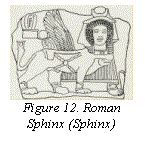
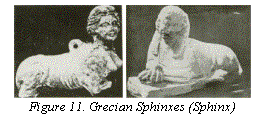 With the spread of Hellenic culture in Egypt under the
Ptolemaic pharaohs, the 'Hellenized' sphinx was reintroduced to its original
home under a new guise, and surrounded by new legends (Sphinx, 126). In
the Greek period, the sphinxes that appear are always female [fig. 11], and in
the Roman period, it became very common to see composite sphinxes, featuring
attributes of several animals not previously associated with it [fig. 12] (Sphinx,
111-2).
With the spread of Hellenic culture in Egypt under the
Ptolemaic pharaohs, the 'Hellenized' sphinx was reintroduced to its original
home under a new guise, and surrounded by new legends (Sphinx, 126). In
the Greek period, the sphinxes that appear are always female [fig. 11], and in
the Roman period, it became very common to see composite sphinxes, featuring
attributes of several animals not previously associated with it [fig. 12] (Sphinx,
111-2).
During this period, the sphinx becomes identified with yet another form of the Egyptian sun god, Horus. This time, it is Heru Behutet, the form of Horus worshipped at Edfu, usually represented as a winged disk, flanked by the twin uraei (cobras), Uatchet and Nekhebet, and this representation was used in the context of relentless pursuit of enemies. Hassan quotes Budge's Legends of the Gods, saying "...and Horus of Edfu transformed himself into a lion which had the face of a man, and which was crowned with the Triple Crown" (Sphinx, 80), a form which he takes before annihilating enemies. In this legend, Horus heads a legion of invaders from the east who arrived at the dawn of the Bronze Age, and they easily conquered the inhabitants of the region with the aid of their superior technology. According to the legend, at that time, the regional inhabitants were armed with weapons of wood and stone, and their invaders were armed with weapons of metal. This legend eventually evolved into a cult, with a priesthood that based much of their symbolic worship on the symbolism of the sun as a metal forge, and these priests went by the title of mesniu, which meant both 'metal smith' and 'priest of the sun.'
These are some of the last classical representations and symbolisms representing and represented by the form of the sphinx for nearly 1300 years. The Roman 'composite' sphinxes evolved further into creatures that neither continued to be referred to by the same term, nor symbolized the same motifs, as their predecessor. When the Roman Empire fell, succeeded by rule from Byzantium, a sort of 'non-Christian iconoclasm' came into effect, in which any symbols not in congruence with the teachings of Christianity were generally destroyed or vilified. A perfect example of this is the burning of the library at Alexandria and murder of its custodian, Hyapatia, by an army of Byzantine monks in the fifth century C.E.
This practice was repeated two hundred years later with the onset of the Arab conquest, in which Muslim devotees vilified or destroyed as much non-Islamic material as could be found, culminating in the destruction of the pagan icons at the Ka'aba, and its establishment as a Muslim holy place. Therefore, the Arabs referred to the Great Sphinx as abu-hol, which has come to be mistranslated as 'father of terror' (Sphinx, 140), but this has generally come to be viewed as a corruption of the older Egyptian term, bu hul (also bu hul, meaning 'place of "hul,"' an early name for the Gizeh sculpture. For nearly another millennium, this creature lay buried in the sand. In the case of the Great Sphinx, this was in quite a literal sense, but the form itself seemed lost in the sands of time, until it resurfaced in the most unlikely of places.
Post-Renaissance into Modernity -1700 C.E.-Present
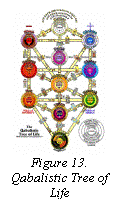
Around the year 1200 C.E., Judaic esotericists and mystics unveiled a new means of interpreting the Torah that added a new level of 'enlightened' interpretation to the Hebrew mosaic. It came to be known as Qabalah, which stems from a Hebrew term meaning tradition, implying oral traditions passed down throughout generations. It is unclear how long such interpretive practices had been utilized, but its first known appearance is dated to the dawn of the thirteenth century. Its study had been formally relegated (in the eyes of Orthodox Judaica) to males over the age of fifty, but over time, the practice attracted Gentile adherents as well, and spread from the Middle East into and across Europe. The primary symbol associated with Qabalah is the 'Tree of Life,' which is a set of ten. 'spheres,' or 'emanations,' connected by twenty-two 'paths' (each representing a letter of the Hebrew alphabet), and each 'emanation' had four attributes, the archaic elements of fire, air, earth, and water [fig. 13].
 At
the beginning of the eighteenth century, a set of pictographic mnemonic cards
started to appear, with the specific purpose of aiding the Western,
non-traditional Qabalist in its study. These became known as the tarocci,
or tarot, cards, the first full set of which is known as the 'Tarot of
Marseilles,' and appeared in 1748. The decks are split into two sections,
called the major arcana and the minor arcana (greater and lesser secrets). The
minor arcana is considered to be the antecedent to modem playing cards, four
suits (four elements) numbered ace through ten (ten emanations), and four
'court cards,' usually in some variation of king, queen, prince, and princess,
again alluding to the four elements. The major arcana consists of twenty-two
cards (twenty-two 'paths') with representations of alchemical, Rosicrucian, and
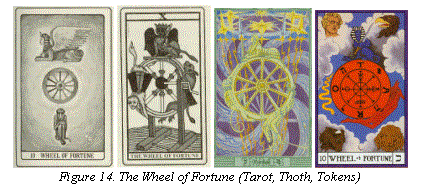
Qabalistic characters and concepts. The eleventh card in this set is called the
'Wheel of Fortune' [fig. 14] and riding this wheel are three animals: an ape,
some nondescript beast, and a sphinx, mounted at its peak. In this context, the
sphinx is a symbolic representation of the alchemical element, sulfur (Thoth,
91).
At
the beginning of the eighteenth century, a set of pictographic mnemonic cards
started to appear, with the specific purpose of aiding the Western,
non-traditional Qabalist in its study. These became known as the tarocci,
or tarot, cards, the first full set of which is known as the 'Tarot of
Marseilles,' and appeared in 1748. The decks are split into two sections,
called the major arcana and the minor arcana (greater and lesser secrets). The
minor arcana is considered to be the antecedent to modem playing cards, four
suits (four elements) numbered ace through ten (ten emanations), and four
'court cards,' usually in some variation of king, queen, prince, and princess,
again alluding to the four elements. The major arcana consists of twenty-two
cards (twenty-two 'paths') with representations of alchemical, Rosicrucian, and
Qabalistic characters and concepts. The eleventh card in this set is called the
'Wheel of Fortune' [fig. 14] and riding this wheel are three animals: an ape,
some nondescript beast, and a sphinx, mounted at its peak. In this context, the
sphinx is a symbolic representation of the alchemical element, sulfur (Thoth,
91).
 In this same period, the Masonic orders made
themselves publicly known for the first time, with the unveiling of the United
Grand Lodge of England in 1717. This order was (and, arguably, still is) a
teaching institution, incorporating an amalgam of apocryphal and heretical
European and Middle Eastern religious philosophies, as well as a bit of
Rosicrucian and Qabalistic symbolism, synthesized into an initiatic system
based on dramatic archetypal metaphors. The specific analogy employed was that
of the formula of the 'dying god,' and the sacrificial 'fool-king for a day.'
Over the next 150 years, the more esoterically-driven factions of these
organizations would adopt and adapt tarot symbolism, and conversely incorporate
Masonic symbols into the cards. They also adapted the sphinx for themselves
[fig. 15], but in a context related less to mysticism than to the classic
'riddle of the sphinx.' The first three degrees of freemasonry symbolize the
allegory of human life: the first degree represents birth and childhood, second
degree represents adulthood, and third degree represents old age and death.
Since these are the three ages represented in the riddle, the Masons saw fit to
adopt its symbolism in this manner.
In this same period, the Masonic orders made
themselves publicly known for the first time, with the unveiling of the United
Grand Lodge of England in 1717. This order was (and, arguably, still is) a
teaching institution, incorporating an amalgam of apocryphal and heretical
European and Middle Eastern religious philosophies, as well as a bit of
Rosicrucian and Qabalistic symbolism, synthesized into an initiatic system
based on dramatic archetypal metaphors. The specific analogy employed was that
of the formula of the 'dying god,' and the sacrificial 'fool-king for a day.'
Over the next 150 years, the more esoterically-driven factions of these
organizations would adopt and adapt tarot symbolism, and conversely incorporate
Masonic symbols into the cards. They also adapted the sphinx for themselves
[fig. 15], but in a context related less to mysticism than to the classic
'riddle of the sphinx.' The first three degrees of freemasonry symbolize the
allegory of human life: the first degree represents birth and childhood, second
degree represents adulthood, and third degree represents old age and death.
Since these are the three ages represented in the riddle, the Masons saw fit to
adopt its symbolism in this manner.
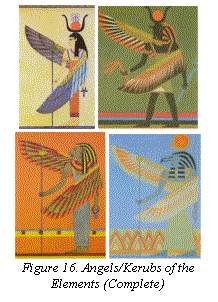
The Hermetic Order of the Golden Dawn, which appeared in the 1880s and was once headed by W. B. Yeats, was one of several groups participating in the occult and mysticism revival of late nineteenth century Europe. They blended Masonic, alchemical, and Rosicrucian symbolism into a series of Qabalistic initiations, strongly tied to tarot symbology. They further modified the sphinx symbolism, recasting it as a combination of the four elemental angels: bull, hawk, angel, and lion [fig. 16] (Complete, vol.10, p. 43), which would also associate it with the four elements, the four stations of the sun, the four cardinal directions, the four seasons, et cetera. These angels further represent virtues and aspirations called 'the four powers of the sphinx:' knowledge (man), will (bull), courage (lion), and silence (eagle) (Aleph, 152), all of which "work in conjunction as they function together as part of the same organism" (Book IV, 282). In this form and with these attributes, the sphinx has come to represent the "Holy Art of Magick" (Aleph, 151). Magick is here spelled with a 'k' to represent the definition of 'bringing about change in conformity with will,' as distinguished from legerdemain, or illusionism, and was part of an attempt by these organizations to bring about genuine change in modem religious conception, in an effort to supplant superstition and accommodate science in the process.

 By the dawn of the twentieth century, the
tarot cards began to vary in their symbolism from deck to deck. Originally, the
sphinx appeared only on the Fortune card in an alchemical context, but as these
other concepts, virtues, and powers became attributed to it, it began to spread
through the deck. The Chariot card features a chariot drawn originally by
horses, but these have been eventually replaced with sphinxes in several decks
[fig. 17]. By extension, it also appears in the form of the four elemental
angels on the Universe card, and sometimes the Hierophant card, depending upon
the deck.
By the dawn of the twentieth century, the
tarot cards began to vary in their symbolism from deck to deck. Originally, the
sphinx appeared only on the Fortune card in an alchemical context, but as these
other concepts, virtues, and powers became attributed to it, it began to spread
through the deck. The Chariot card features a chariot drawn originally by
horses, but these have been eventually replaced with sphinxes in several decks
[fig. 17]. By extension, it also appears in the form of the four elemental
angels on the Universe card, and sometimes the Hierophant card, depending upon
the deck.
Conclusion
Beginning with the Great Sphinx on the Gizeh plateau, this creature symbolized with protection. Conversely, by the time it had made its way around the Mediterranean, it had become a vengeful, attacking beast with an insatiable hunger. This dichotomy succinctly indicates how a symbol can be completely inverted or reversed over time and through different cultural contexts. The only constant symbolic element encountered through the history of this creature is its solar nature. The sun has long been worshipped as a deity itself, and was considered a principal source of life energy (along with the Nile) by the ancient Egyptians. Though they attached the specific relation to the sun at its four principal points in the day, which have also been associated with the four elements, the four seasons, and many other things, the definitive link between the Sphinx and these other attributions remained ambiguous and questionable.
Greek mythmakers maintained the solar attribute in their use of the riddle, which is the source of its symbolic usage by modem Masonic Orders. Later, when the Qabalists cemented a link between the sphinx and more esoteric philosophies, the sphinx came to represent far more than its creators had ever envisioned, as the guardian of 'sacred mystery' and 'magick.' I have no doubt that as we travel upon the level of time, future cultures and cults will arise, creating new permutations and interpretations of this great, wild beast. And who will decide these changes? "Man." The answer is "man."
Sources Cited
Budge, E.A. Wallis. The Gods of the Egyptians. New York: Dover, 1969.
Budge, E.A. Wallis. The Mummy: a Handbook of Egyptian Funerary Archaeology. Mineola: Dover, 1989.
Case, Paul Foster. The Book of Tokens. Los Angeles: Builders of the Adytum, 1989.
Crowley, Aleister. The Book of Thoth. York Beach: Weiser, 1991.
Crowley, Aleister. Liber ABA (2nd Revised Ed.). York Beach: Weiser, 1997.
Crowley, Aleister. Liber Aleph. York Beach: Weiser, 1991.
Crowley, Aleister. Thoth Tarot Cards. York Beach: US Games Systems and Samuel Weiser, 1978.
DuQuette, Lon Milo. Tarot of Ceremonial Magick. Stamford: US Games Systems, 1994.
Edmunds, Lowell. The Sphinx in the Oedipus Legends. Meisenheim: Verlag Anton Hain, 1981.
El Mahdy, Christine. Mummies, Myth, and Magic in Ancient Egypt. New York: Thames and Hudson, 1991.
Hassan, Selim. The Sphinx: Its History in the Light of Recent Excavations. Cairo: Government Press, 1949.
Regardie, Francis Isreal. The Complete Golden Dawn System of Magick. Scottsdale: New Falcon, 1990.
Wang, Robert. The Qabalistic Tarot. York Beach: Weiser, 1992.