|
Money and
Banking
Lesson 21 | |
|
| The Federal Reserve
System |
|
Federal Reserve System (Fed) -
central bank of United States
- The U.S. government created the Federal Reserve System in 1913
- European countries created central banks in the 17, 18, and 19th
centuries.
- U.S. was a late comer
- Congress, government officials, and the public did not want to
create a powerful financial institution
- The Fed has many checks and balances.
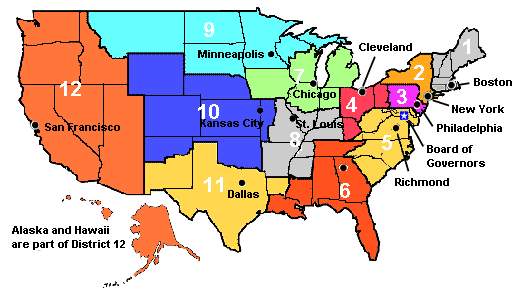
- The Fed is composed of 12 Federal Reserve regional banks.
- Each region has a Federal Reserve Bank.
- Different regions in U.S. are different
- A Federal Reserve Bank can provide services to its unique region.
- Example:
- Michigan originally manufactured all U.S. cars
- Texas and Oklahoma supplied oil and natural gas.
A regional Federal Reserve Bank:
- Manages the currency.
- The Fed issues new currency and removes old currency from the
economy through the banking system.
- Helps banks clear checks between banks in different regions or
countries.
- All banks have deposits at the Fed.
- The Fed clears a check by adjusting banks’ deposits.
- If a person write a $500 check drawn from a bank in Miami to pay
for goods in California, the Fed subtracts $500 from the Miami bank
deposit at the Fed and adds $500 to the California bank account at the
Fed.
- Regulates member commercial banks.
- Collects and publishes data for the public.
- Sets reserve requirements.
- A reserve requirement - percentage of a deposit that a commercial
bank must hold as cash or as a deposit at the Fed.
- Thus, banks have cash when depositors come to the bank to withdraw
some of their funds
- Prevent financial panics.
- A Federal Reserve Bank is a “lender of the last resort.”
- A bank having financial trouble can temporarily borrow from the
Fed.
- Example
- A bank needs money, so the bank gives a $10,000 asset to the Fed
as collateral.
- The Fed increases the bank’s reserves by $9,000 (i.e. the loan).
- The difference is called the discount, which reflects the
interest rate that the Fed charges for the loan.
- This interest rate is called the discount rate.
- The government did not create the Fed to alter the money supply,
manipulate interest and currency exchange rates, or manipulate the
financial markets to achieve economic goals.
- The Fed learned to do this during the 1920s.
Each Federal Reserve Bank is a
federally chartered corporation.
- Every national commercial bank has to purchase stock of the Federal
Reserve Bank in its district
- Stock purchase is 6% of the commercial bank’s net equity
(capital).
- National commercial banks have a carter from the U.S. government.
- Commercial banks earn dividends on their Fed bank stock.
- Each bank has stockholders, directors, and a president.
- Each Federal Reserve Bank has 9 directors.
- A combination of Federal Reserve Board and member commercial banks
elect the directors,
- 3 directors are bankers
- 3 are from business.
- The Fed appoints the last 3 directors.
- The 9 directors elect the president of the Fed district bank
- Even though the Fed district banks are privately owned, the
commercial banks have no control over the Fed banks.
- A Fed bank is not like a corporation where the stockholders can
freely elect the board of directors and vote on major corporate
policies.
- The reason the Fed has this odd structure was that Congress did
not want the Fed to be part of government or controlled by the
banks, but somewhere in between.
- The Fed is a part of government or quasigovernment.
The Federal Reserve Board - controls
the Federal Reserve System.
- The Federal Reserve Board determines monetary policy, reserve
requirements, and discount policy.
- The board consists of 7 members, who serve a 14-year term.
- A U.S. president along with Senate approval appoints the members.
- A U.S. President also appoints the chairperson and
vice-chairperson of the board.
- Originally, the Fed was decentralized and the power was dispersed
among the 12 Fed banks.
The Federal Reserve Board is independent of the U.S. federal government
- The Federal Reserve Board gets its revenue from the 12 district banks.
- The Fed does not have to go to Congress for money.
- Whoever controls the money is directly or indirectly in charge.
- The terms of the board members are staggered.
- Every two years, the U.S. President appoints one director to the
Federal Reserve Board
- 7 - members, 14 years
- Prevents a President from coming into office and appointing all
members at once, so the members would be loyal to the President.
- The government cannot completely audit the Fed.
- The less government knows, the less it can tamper with
things.
- The Comptroller of the Currency and Secretary of the Treasury cannot
be members of the board
- Prevent the government from “printing money” to cover budget
deficits.
- The Fed is completely independent!
- If the Federal Reserve angers Congress too much, Congress can
rewrite the laws that created the Fed.
The Federal Open Market Committee
(FOMC) makes decisions concerning open market operations.
- Open market operations - the
buying and selling of government securities
- Influences the money supply and interest rates
- FOMC sends a directivet to the manager at the New York City Federal
Reserve bank to actually buy and sell U.S. government securities.
- The FOMC consists of the Federal Reserve Board, plus 5 Fed district
bank presidents.
- The president of the Federal Reserve Bank of New York City is a
permanent member of the FOMC and always the FOMC vice-chairperson.
- New York City is the financial center of the U.S.
- The Fed buys and sells government securities through the New York
Fed Bank.
- The four other positions for the FOMC are rotated among the other 11
Fed district bank presidents.
- The chairperson of the Federal Reserve Board is also chairperson of the
FOMC.
The chairperson of the Fed is a powerful man.
- This person can advise the President, informs Congress of the Fed’s
actions
- Spokesperson of the whole Federal Reserve System.
- When he speaks, the financial markets listen.
- Currently the chairperson is Ben Bernanke
- He is considered the second most power man in the United States
right next to the U.S. president.
|
| Trends in the Financial
Markets |
|
The financial markets and institutions are constantly changing.
- Financial innovation - people
quickly adopt new financial products if it lowers risk, increase
liquidity, or increase information.
- Mutual funds
- A mutual fund pools together money from many people into a fund
and the fund manager invests the fund in a variety of stocks.
- Lowers investors’ risk through diversification of stocks.
- Example: You started you own mutual fund and bought 30
different corporate stock.
- Coca-Cola stock may go up one day, while IBM stock goes down
- Overall, the average of the fund’s 30 stocks will earn a
return
- Money Market Mutual Funds
(MMMF) - offered by non-bank financial institutions
- Mutual fund with check writing privileges
- Not insured by the FDIC
- Money Market Deposit Accounts
(MMDC) - offered by commercial banks
- Mutual fund with check writing privileges
- Insured by Federal Deposit Insurance Corporation (FDIC)
- If bank bankrupts, then FDIC insures account holders up to
$100,000 in total deposits
- Automated Teller Machine (ATM)
- allows bank customers to receive banking services through computer
terminals located at banks, stores, and shopping malls.
- Make deposits, withdrawals, and credit card transactions
- Consumers have access to their bank anywhere within the U.S. and
many countries around the world.
- ATMS are connected in networks
- CIRRUS - one of the largest networks
- Debit Cards - a customer uses
a card that electronically wires funds from his bank account to a
store's bank account
- Some businesses do not accept checks, but take debit cards,
because the store is certain it will get the funds from the
customer
- Globalization - savers and
borrowers are linked through international financial markets
- Example: Japanese bank transfers funds from savers in Japan to
build a new factory in China.
- What is causing globalization?
- Many countries repealed laws that restricted savers from
investing in foreign countries.
- Countries are economically growing
- More savings are channeled in international financial
markets
- Corporations are global
- Corporations produce in one country and transport to another
- Corporations need financing to build factories in foreign
countries
- Deregulation - U.S. government
is deregulating financial markets
- Banks are allowed to cross state lines and merge with other banks
- Regulations prevented banks from crossing state lines
- Commercial banks are merging with insurance companies and
investment banks
- Regulations from the 1930s separated commercial banking and
investment banking
- commercial banks - accepts deposits and makes loan
- investment banks - help corporations issue new stocks or bonds
and help government issue new bonds
- Merrill Lynch, Charles Schwab
- Many financial institutions are blending together
- U.S. banks will become larger and fewer
- Banks will offer a variety of services like investment advice
and insurance
|
| Money's Function and
Definitions |
Money eliminates many problems with barter and has four functions.
- Medium of exchange - money is
used for payments of goods and services and repayment of debts.
- Promotes efficiency
- Example - the author is an economics instructor.
- Under a barter system, the author would have to go to the market
and teach another person for goods and services that he need.
- Could have considerable search costs for people wanting
economics instruction.
- With money, the author does what he does best and teach for
money.
- Then he takes this money to the market, and buys goods and
services that he wants.
- Eliminates the problem of double coincidence of wants under a
barter system.
- Allows the specialization of labor to occur
- Unit of account - money puts a
values on goods and services
- Example: a two-liter of Coca-Cola costs $0.89 while Pepsi costs
$0.99.
- Customers can easily judge which product is cheaper.
- Extremely important for businesses.
- Businesses place values on buildings, machines, computers, and
other assets.
- Record this information in financial statements
- Investors read the financial statements and can gauge which
companies are profitable.
- Store of value -money has to
retain its value.
- Example: If a two-liter of Coca-Cola costs $0.99 today, then it
should cost $0.99 tomorrow
- Inflation erodes the “store of value” of money.
- As the price level increases, the value of money decreases,
because each unit of money buys less goods and services.
- Inflation causes consumers to lose their purchasing power over
time.
- If the inflation rate becomes too high, then money as a “medium of
exchange” breaks down too!
- People in countries with have high inflation rates use barter
more and immediately exchange their local money for more stable
money, such as Euros or U.S. dollars
- "legal tender" - Many
government laws legally require people to accept money as a means of
payment to pay off a debt or to pay taxes.
- Standard of deferred payment -
combines the “medium of exchange” and “unit of account” of money.
- Debts are stated in terms of a “unit of account,” and paid by
“medium of exchange."
- Extremely important for business transactions that will occur in
the future.
- Businesses and people can borrow or lend money based on future
transactions
A central bank can introduce two types of currency into its economy
- Commodity money - government
selects a commodity to be money
- Gold and silver
- If society did not use this commodity as money, this commodity
still has a purpose.
- Commodity money could be anything.
- Example:
- U.S. prisons, prisoners use cigarettes as money.
- In rural Russia, vodka, cigarettes, and bullets have been used
as money
- Government made a discovery about commodity money
- If the government made one-ounce gold coins
- One ounce of gold costs $800
- The face value of a coin is equal to $1,000
- The government created a value of $200 out of thin
air!
- This is a form of "printing money"
- Over the life of the ancient Roman Empire, the Roman government
“printed money” by recalling its gold and silver coins, and
re-minting them with less gold and silver.
- Towards the end of the empire, Roman coins contained specks of
gold and silver.
- Metal coins
- The face value of an one-ounce pure gold coin is $1,000
- The market price of gold is $1,500 per ounce
- People will melt down the coin and sell to the
market
- Fiat Money (or Token Money) - money used in the modern world
- 20th century invention.
- The Federal Reserve System issues U.S. dollars.
- This money cannot be used as anything else, and cannot be
exchanged for another commodity from government.
- No authority limits how much money the Federal Reserve System
can issue.
- Milton Friedman, concluded “Inflation is always and everywhere a
monetary phenomenon.”
Money needs five desirable properties for people and businesses to use
as money. The desirable properties are:
- Acceptable: The businesses and public accept it as payment for goods
and services.
- Standardized quality: The same units of money must be the same size,
quality, color, so people are certain what they are getting.
- Durable: Has to be physically durable or it may lose its value
quickly.
- Valuable relative to its weight: People can easily carry large
amounts of money and use is in transactions.
- Divisible: Money must be broken down into smaller units to purchase
low value goods and services.
All countries today use coins and paper bills as money, which has the
five desirable properties. The value of paper bills and coins is
currency.
|
| Federal Reserve's Definition of the
Money Supply |
- Two approaches to define the money supply
- Transaction approach -
emphasizes the money’s function as a medium of exchange
- Only a few assets possess this property.
- Liquidity approach - include
assets that are highly liquid
- Liquidity - an asset is
easily exchanged for goods and services without high transaction
costs
- The money supply includes all assets that have high liquidity.
- Emphasizes money’s function as a “store of value,”
- If the liquid asset retains its value and is highly liquid, it
can easily be used to purchase goods and services directly or
indirectly
- Liquidity forms a scale

- The Federal Reserve System defines money supply as M1, M2, M3, and
L.
- Many central banks in the world measure their money supply
similarly to United States.
- Which financial instruments are included differs
- Two U.S. definitions of money supply are:
- M1 is the narrowest definition
of the money supply
- Uses the transaction approach in defining what financial
instruments are included.
- Add the following 3 items together:
- Currency held by the public and in bank vaults.
- Not currency held by the government.
- All forms of checking accounts
- Does not include mutual fund checking accounts
- Traveler’s Checks that are held by people and not by the
banks
- M2 is a broader definition
than M1
- Uses the liquidity approach of defining the money supply
- Add the following items together
- Include everything from M1
- Include mutual fund checking accounts
- Include all small denomination savings deposits and time
accounts at all financial institutions.
- Small denomination in the U.S. means the account is less
than a $100,000.
- Certificates of Deposit (CDs)
- savings accounts at banks
- Which is the “Best” definition of the Money Supply?
- The monetary aggregates grow at different rates, at different
times, and even in different directions.
- Before 1981, a stable relationship existed between M1 and GDP
- With deregulation of the financial markets in the 1970s and early
1980s obscured this relationship.
- Many economists use the M2 definition of the money supply to
explain changes in the GDP and inflation.
|
| Terminology |
- Federal Reserve System
- Federal Reserve Board
- Federal Reserve Bank
- Federal Open Market Committee (FOMC)
- open market operations
- financial innovation
- money market mutual fund (MMMF)
- money market deposit account (MMDA)
- automated teller machines (ATM)
- debit cards
- globalization
- deregulation
|
- medium of exchange
- unit of account
- store of value
- legal tender
- standard of deferred payment
- commodity money
- fiat money (tolken money)
- transaction approach
- liquidity approach
- liquidity
- M1
- M2
|
|