Lesson 3 - Government Price Controls |
This lesson examines the economic impact of government regulations on the market. The government regulations are price controls, taxes, and subsidies. Moreover, students are introduced to the Laffler curve and black markets.
Economics of Price Controls
Price controls - gov. mandated prices. Gov. thinks price is too high or too low.
1. Price ceilings - a legally established maximum price that sellers may charge.
Example 1 - Some rental markets, like New York City, set a maximum price that landlords can charge for apartment rent.
| Rental Market |
|---|
| Price, Rent |
 |
| Quantity, Tenants |
- The market price is P* and quantity is Q*. Gov. thinks rent is too expensive, and sets price at P~.
- Market rent price > Rent controlled price:
- Direct effect (When P* > P~).
- Quantity demanded (Qd) > quantity supplied (Qs).
- Shortage.
- Secondary effects of price ceilings.
- Long waiting lists.
- "Under the table" payments to landlord.
- Tenants has to buy expensive furniture from landlord.
- Investors do not invest in new housing, because market rents are too low to make a profit..
- The quality of housing will deteriorate.
- Landlords lower costs by less maintenance and repairs.
 |
A very good trick question on the exam. If P~ > P*, then the price control has no effect on the market. |
2. Price Floor - a legally established minimum price that buyers
must pay.
Example 2 - Government requires employers to pay a minimum wage.
| Labor Market (Unskilled workers) |
|---|
| Price |
 |
| Quantity |
- Gov. thinks workers' wages are too low and set the wage rate to $5.30 per hour (P~).
- Employers demand workers, while employees supply labor.
- The wage is the price of labor.
- Direct effect (When P~> P*).
- Quantity supplied (Qs) > quantity demanded ( Qd).
- Surplus of labor, i.e. "unemployment."
- Secondary effects
- Employer reduces
- Health insurance.
- Job training.
- Pension plans.
- Usually hurts unskilled labor, the poor, and teenagers.
- Employer reduces
|
If P* >
P~, then the price control has no effect on the market Professional jobs tend to pay more than minimum wage. |
The Impact of a Tax
- Tax incidence - how the "economic" burden of tax is shared between buyers and sellers.
- Statutory incidence of
tax - the legal assignment of who
pays a tax
- Who sends the taxes to the gov.
- Tax incidence and statutory incidences differ.
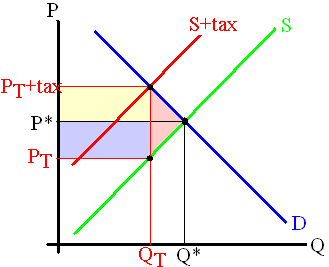
- Example: Gov. places a $1 tax on each pizza sold on pizza producers.
- Statutory incidence falls on producers.
- Tax rate - the per-unit tax
- $1 per pizza.
- Taxes are usually a percentage; this changes the slope of supply function.
- Supply curve shifts left by exactly $1.
- Market price was at P*, $10 per pizza. Pt does not equal $11.
- Price lies between $11 and $10.
- The tax changes consumer's behavior.
- Higher market price (price + tax), Pt.
- Consumers buy less, Qt.
- Tax base - the total amount of goods, which are taxed.
- The higher the tax rates, the smaller the tax base.
- Changes consumers' and producers' behavior.
- Tax revenue from pizza = Qt X $1.
- (area of a rectangle width X height)
- blue area + yellow area.
- "Yellow area" - actual tax burden on sellers.
- "Blue area"- actual tax burden on buyers.
- Deadweight loss of taxation - the red area.
- "Excess burden of taxation."
- Nobody receives this revenue.
- A loss to society, because gov. interfered with the market.
| Pizza Market |
|---|
| Price |
 |
| Quantity |
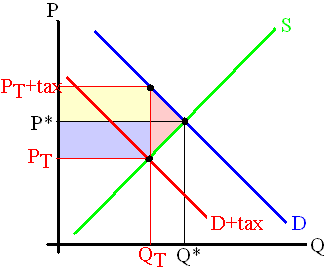
- If the $1 pizza tax was placed on the buyer.
- (switching statutory incidence from sellers to buyers).
- The buyer send the tax to the gov.
- The demand curve will shift to the left by $1, but the end result is exactly the same!
- Statutory incidence of tax changed, but the tax burden remained the same.
| Pizza Market |
|---|
| Price |
 |
| Quantity |
- Do not worry about elasticities! Using elasticities of demand and supply, economists can predict which party has the larger tax burden.
- Inelastic demand (relative to supply) - quantity demanded is not sensitive to price changes.
- Tax burden falls on consumers.
- Gov. loves to tax inelastic goods.
- Gasoline (short-run).
- Beer / liquor.
- Cigarettes.
Tax Rates, Tax Revenues, and the Laffer Curve |
1. Average tax rate = tax liability / taxable income.
Ex: Salary is $20,000 and tax liability is $5,000.
average tax rate = $5,000 / $20,000 X 100% = 25%
- Progressive tax rate - average tax rate rises with income.
- Proportional tax
- the average tax rate stays the same across all
income levels.
- Kazakhstan - income tax is 20% of income
- Regressive tax - the average tax rate falls with income, i.e. higher income results in lower average tax rate.
Example 1 - U.S. Income taxes are progressive - low-income households pay small average tax rates, while high-income households pay higher tax rates.
Example 2 - Sales tax on food. 2 families each spend $10,000 on food per year. Sales tax is 7%, so $700 is collected from each family per year.
1st family's
income = $50,000 F
1.4%
2nd family's income
= $20,000 F
3.5%
F Sales tax tends to be a regressive tax.
2. Marginal tax rate = D tax liability / D taxable income.
Ex: If marginal tax rate = 28% and family income increases by $100, then tax liability increases by $28. The tax increase affects household decisions to work, save, leisure, etc.
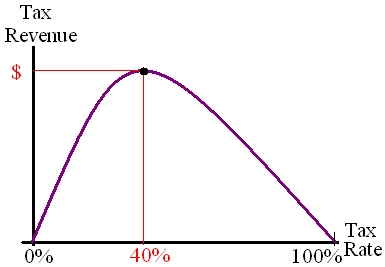
3. Laffer Curve - shows relationship between tax rates and tax revenues.
- Two points:
- 0% tax rate = 0 tax revenue
- Government has no taxes
- 100 % tax rate = 0 tax revenue
- Nobody would legally work; government takes all income
- As the tax rate increases, the tax base decreases (the activity being taxed),
- Tax changes behavior.
- Deadweight loss increases.
- Example: - Refer to Laffer Curve diagram below.
- The tax rate is 50% and the gov. wants to increase tax revenue.
- If the tax rate is increased, tax revenue declines further.
- If tax rate is lowered, then tax revenue increases!
- Nobody knows the shape of these curves!!!
- President Ronald Reagan lowered tax rates during 1980s.
- During the 1980s, the top marginal income tax rate fell from 70% to 33% (the average tax rates for the "rich" decreased).
- Between 1980 and 1990 real income tax revenue collected from the top 1 % of earners rose a whopping 51.4 %.
| Laffer Curve |
|---|
| Tax Revenue |
 |
| Tax Rate |
Government Subsidies
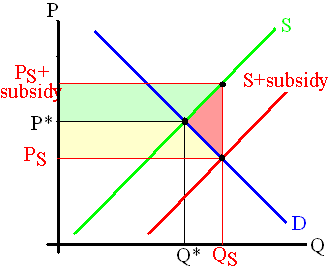
Government Subsidy - government pays suppliers to expand production
Example - Government pays dairy producers a subsidy.
| Milk Market |
|---|
| Price |
 |
| Quantity |
- The original market price is P* and Q*. Government subsidizes
diary production
- Consumers pay PS
- Producers receive PF
- Government pays PF - PS as the subsidy
- Yellow and red area is total subsidies paid to producers
- The red area is also the deadweight loss to society.
- Government interfered with market
- Subsidy helps producers and could expand employment
Black Markets
- Black Market - market that operate outside the legal system.
- Illegal products and services.
- Drugs, prostitution, gambling, smuggling, etc.
- Avoid high taxes.
- Barter - one person trades a good or service with another; no money is exchanged
- Person or business under reports income and assets, or over states
debt
- Claiming children on U.S. federal tax forms, lower taxes; some people claimed their animals as children
- Circumvent price controls.
- Avoid costly regulations.
- Labor markets are highly regulated in many countries
- Many U.S. employers hire foreigners (from Mexico) that do not have proper documents to work legally in U.S.
- Employers pay lower wages
- Labor markets are highly regulated in many countries
- Decline of civic loyalty to government
- People start to lose respect for their government institutions
- Wide spread political corruption
- Black markets have:
- More defective products.
- Higher profits.
- Higher risk:
- Arrests.
- Court fines and fees.
- Jail or prison sentence.
- Greater violence from enforcing contracts.
- Problems if there is a sizable shadow economy
- Decreases the tax base
- Leads to higher tax rates
- Government invests less in infrastructure, like roads, bridges, etc.
- Government statistics are inaccurate
- Unemployment is higher than should be
- Decreases the tax base
| Size of Hidden Economy 1990 - 1993 |
% of Real GDP |
| Nigeria | 68 to 76% |
| Mexico | 40 to 60% |
| Russia | 20 to 27% |
| Hong Kong | 13% |
| United States | 8 to 10% |
| Japan | 8 to 10% |
| Be careful of results; hard to measure |
|
Removing price controls, lowering tax rates, reducing regulations,
and fostering competition tend to decrease size of black markets and
lower corruption.
This interesting fact is the shadow economy appears to be growing in many countries including the U.S. |
References
Laffer, Arthur B. June 1, 2004. "The Laffer Curve: Past, Present, and Future." The Heritage Foundation. Available at www.heritage.org (access date: 3/23/07).
Schneider, Friedrich and Dominik H. Enste. March 2000. "Shadow Economies: Size, Causes, and Consequences." Journal of Economic Literature 38(1): 77-114.