Lesson 4 - Government Tariffs, Quotas, and Other Trade Restrictions |
This lesson examines a government's interference with international trade. This lesson has four themes. First, the lesson begins with reasons why government intervenes with free trade. Second, the supply and demand analysis is expanded to include international trade. Third, the economic impact of tariffs, quotas, and export subsidies are examined. Finally, the Asian tigers are discussed and why their economies are growing extremely fast.
Why Government Intervenes in Free Trade?
Protectionism -government introduces trade restrictions to protect producers or consumers.
Motivations for Protectionism
1. Protect an Eroding Comparative Advantage
Comparative advantage is where Country A has a relative advantage in producing and exporting a product. Country B may come along and gain the comparative advantage, taking trade away from Country A.
2. Achieve Domestic Policy Goals
Free trade can bankrupt inefficient industries, causing unemployment and lower tax collections. Government may impose trade restrictions to keep inefficient industries in business.
3. Protect National Security
Some commodities, especially natural gas and petroleum, can wreak havoc on a country, if imports were blocked. Many Asian countries, like Japan, have little energy resources and are vulnerable, if imported energy is blocked.
4. Protect "Infant Industry"
A country's industry may be relative new, and could not compete with foreign industries. Government may protect an industry, in order for the industry to become large enough to compete. When the United States became independent of England, the newly formed U.S. government applied trade restrictions to encourage the growth of U.S. industries.
Note - Most manufacturing was in Europe at that time. England wanted to manufacture all goods and sell the goods to the United States, thus causing an inflow of money into England (and creating jobs).
5. Protect National Health
Government restricts trade of a product, if the product may be harmful. For example, Europe does not import beef from the United States. Europeans claim beef contains growth hormones, which are harmful to humans. (They may be right)!
6. Protect/Retaliate Against Policies of Other Trading Countries
One country imposes a trade restriction. Other countries may retaliate against that country. For example, one country weakens its currency, in order to boost its industries. Other countries may weaken their currencies to nullify the first country.
7. Correct Foreign Exchange Rate
- Government views its currency as being either too strong or too weak. Government imposes trade restrictions to correct the currency problem.
- Usually Asian countries want their currencies to be weak. A weak currency boosts a country's exports and decreases its imports, causing its industries to expand and create jobs.
- A weak currency makes a country's exports cheap and its imports expensive.
- I have no ideal why the U.S. government pursues a strong dollar. The United States is losing industries to China and other countries.
8. Balance-of-Payment Problems
Balance of payments is the total inflow minus the total outflow of money. The problem is when more money flows out than in. Usually the central bank or government has to finance the outflow, if it is large. Government can impose trade restrictions to reduce a balance-of-payment problem.
9. Generate Revenues for the Government
Government can impose import tariffs and export taxes for revenue. A government may have better control over its ports, so it is easier to collect than income taxes
10. Prevent export of technology
Some countries ban or restrict exports of technology. These countries do not want other countries to benefit from technology and become future competitors.
 |
Government usually wants its industries to export products to
foreign countries. Its industries expand production and create
jobs, and more money flows into country than out.
Government could lie and make one of the above claims in order to protect its industries. |
Free Trade
Expand supply and demand equations to include free trade.
- Free trade
- Country imports or exports without any government restrictions
- Large country can impact trade and prices
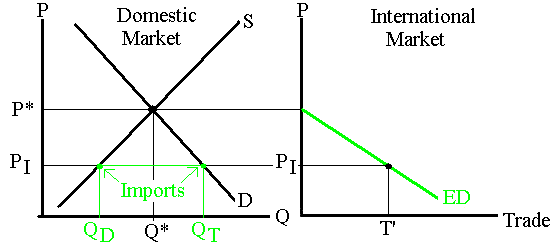
Country imports from international market
- No Trade.
- Market price and quantity are P*, Q*, and no imports.
- Free Trade
- Define Excess demand function (ED)
- Excess demand = Demand function - Supply function
- Has to be greater than or equal to zero
- Regular supply and demand are domestic market
- Excess demand is the demand in the international market
- Excess demand = Demand function - Supply function
- Country imports from international market
- Domestic consumers pay lower price, PI and consume QT
- Country imports, QT - QD, for price PI.
- The import is also T' in the international market
- Domestic industry contracts
- Lower output
- Industry employs less workers
- Money flows out of country
- Define Excess demand function (ED)
This graph appears redundant. However, this method allows for some very complicated trade restriction analysis.
| Free Trade - Imports |
|---|
| Price |
 |
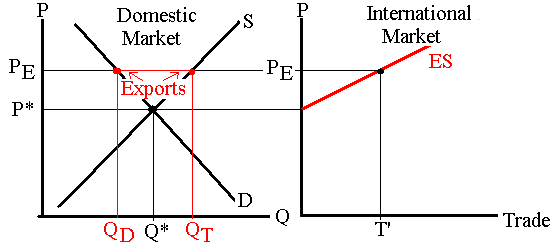
Country exports to international market
- No Trade.
- Market price and quantity are P*, Q*, and no exports.
- Free Trade
- Excess Supply (ES)
- Excess Supply = Supply function - Demand function
- Has to be greater than or equal to zero
- Regular supply and demand are domestic market
- Excess supply is the supply function in the international market
- Excess Supply = Supply function - Demand function
- Domestic consumers pay higher price, PE and consume QD
- Country exports, QT - QD, for price PE.
- The exports are T' in international market
- Domestic industry expands
- Higher output
- Hires more workers
- Money flows into country
- Excess Supply (ES)
| Free Trade - Exports |
|---|
| Price |
 |
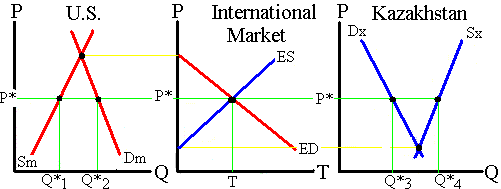
Below is free trade between Kazakhstan and United States
- Let this be the petroleum market
- United States imports Q*2 - Q*1
- U.S. domestic demand and supply are Dm and Sm
- U.S. produces Q*1 petroleum, but consumes Q*2
- Kazakhstan exports Q*4 - Q*3
- Kazakhstan domestic demand and supply are Dx and Sx.
- Kazakhstan produces Q*4, but only consumes Q*3
- International market
- Excess demand (ED) function
- Excess supply (ES) function
- Imports = Exports = T
- The petroleum price is P*
- Note - T looks larger than imports and exports; this is my mistake, because I used Microsoft paint
- United States imports Q*2 - Q*1
| Free Trade Between Kazakhstan and United States |
|---|
| Price |
 |
Government Tariffs, Quotas, and Subsidies
Government Restrictions
- Tariff - a tax on each unit imported
- Quota - government establishes the maximum amount that can be imported.
- Subsidy - government subsidies export
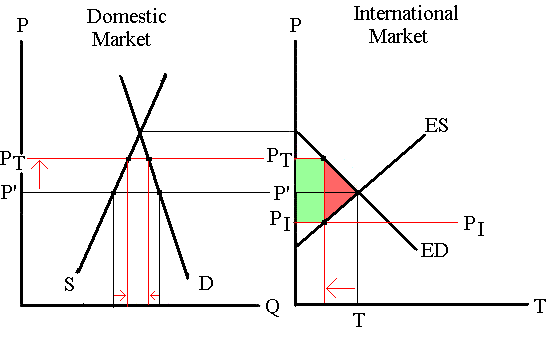
- Free Trade.
- Market price is P' and amount imported is T
- Government imposes a tariff
- Government imposes a tariff of PT - PI
- Domestic consumers pay higher price, PT and consume less.
- Domestic producers expand production.
- Expand production
- Employ more workers
- Country decreases imports for price PT.
- Foreign producers sell for PI and export less
- Government Revenue
- Green box
- Deadweight Loss
- Red triangle
- Lower social welfare
| Government Tariff |
|---|
| Price |
 |
| Quantity |
- Government quota
- If government imposes a quota
- Same impact on market
- One difference
- Government does not collect revenue
- Green area goes to foreign exports as "rent"
- Rent
- Long-run profits
- Market competition drives profits to zero
- However, rent is special term to indicate a market advantage to someone.
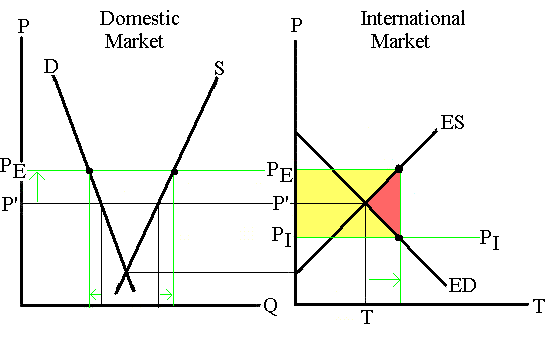
- Government Export Subsidy
- Free trade market price is P' with T quantity is exported
- Government institutes an export subsidy
- Government pays a subsidy of PE - PI per unit
- Domestic consumers pay higher price, PE and consume less
- Subsidy causes higher market price within the country
- Country exports more
- Quantity increases in international market
- Foreign producers pay a cheaper price, PI and import more
- Domestic industry expands
- Higher output
- Industry employs more workers
- Government Subsidy
- Yellow area + Red triangle
- Deadweight loss of subsidy
- Red triangle
| Government Export Subsidy |
|---|
| Price |
 |
|
|
This is also called "Beg-thy-neighbor" policy. A government imposes a trade restriction to boost its industries at the expense of exporting country. Trade restrictions tend to lower international prices, harming exporting countries. Thus, some countries will retaliate with their own trade restrictions. |
This analysis can be applied to other government trade restrictions
- Manipulate the exchange rate
- Government weakens or strengthens its currency
- Import subsides
- Export tax
- Supply reduction
- Government has programs to reduce production in domestic industries
- Increases prices and profits.
Asian Tigers
Note - Some totalitarian states can growth fast, but the high growth rate is temporary. For example, the Soviet Union grew extremely fast during the 1960s as it was expanding and adding cities and factories. However, by the 1980s, it looked like the Soviet economy stagnated. (If I am wrong, then please correct me).
Note - Currently Venezuela is growing fast under the leadership of Hugo Chavez. Venezuela is an petroleum exporting country and a member of OPEC. President Chavez is using the revenue from petroleum to finance this growth.
- Asian Tigers
- Asian countries with high growth rates of economy
- Real GDP grows around 10% per year
- Real - the effect of inflation was removed
- Hong Kong.
- Singapore.
- South Korea.
- Taiwan.
- Asian Tigers do not have abundant natural resources
- African and Latin American countries tend to have natural resources
- Two Theories
- Resource abundant countries attract foreign investment,
causing its currency to appreciate.
- Appreciating currency increases a country's imports and lowers exports.
- A government in countries without resources have limited options. Therefore, government opens economy to free markets (That is only thing they could do).
- Resource abundant countries attract foreign investment,
causing its currency to appreciate.
- Asian tigers pursue export oriented policies
- Asian country allows markets to compete internationally
- International trade is large part of economy
- Low trade protection
- Have low price distortions
- Distortion - the market has a price that is not set by the market
- Usually taxes, subsides, price controls, regulations, etc.
- Build larger factories
- Country is supplying international market
- Economies of scale
- The larger a factory, the lower is the per-unit manufacturing costs
- Have high education levels
- Emphasize vocational and technical training
- Accelerates the adoption of new technology and know how
- Tend to save more
- Deposit savings into banks and banks lend to businesses
- Businesses buy machines and equipment
- Tend to devalue (or weaken) their currencies
- Strengthens exports and weakens imports
- Asian currencies are stable (low volatility).
- There was a rapid devaluation of Asian currencies in 1997.
- Asian country allows markets to compete internationally
References
Dollar, David. 1992. "Outward-Oriented Developing Economies Really Do Grow More Rapidly: Evidence from 95 LDCs, 1976-1985." Economic Development and Cultural Change 40(3): 523-44.
Lim, David. 1994. "Explaining the Growth Performances of Asian Developing Economies." Economic Development and Cultural Change 42(4): 829-44.