 |
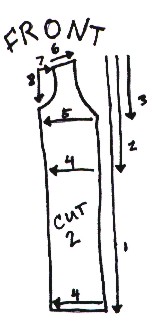
Measurements:
|
|
 |
 |
|
|  |
A Ghawazee (pronounced "GWA-zee") coat is good for dancers who want to cover a little more stomach than a choli alone. You'll see a lot of them in the SCA, although to my knowledge it's not documentable earlier than the early 19th century, but you can get away with it at an event to dance in. Sometimes I have been known to wear them, but you'll find me more often in Persian and Turkish coats, which are similar in many ways... Ghawazees are easy to make and flattering on most body types. They are also comfy to dance in.
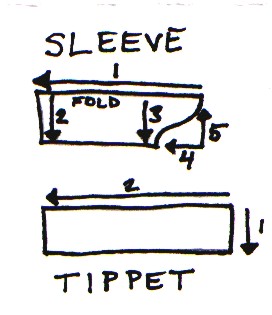
So what do they look like? In case you didn't notice in the picture on the main pattern page, it's a very simple coat based on a straight-line pattern (you've gotta love those), with a VERY tight bodice with an open front that buttons from neckline to waist or hips, tight sleeves that attach to the bodice only at the top (leaving the underarm open) reaching to the elbow with long tippets (strips of fabric that hang loose from behind the elbow), and slits up the sides. There is no slit up the back. They're very easy to make, and the only moves they restrict are belly isolations (flutters, rolls, etc), since you can't see them so great beneath the fabric. You can do them, but no one can see them really.
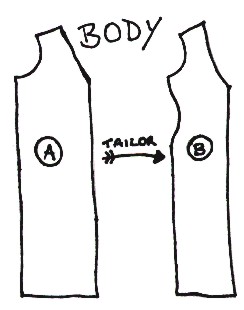
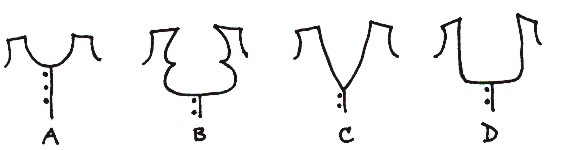
A Ghawazee is worn over a tunic which can have sleeves either (A) to your wrist, with a drawstring closure, (B) to your wrist but uncinched, (C) shaped along the lines of the Ghawazee sleeve, that is, with a long tippets hanging down, the length a few inches past the Ghawazee sleeve opening, or (D) any other shape you like. The neckline is your choice. The U-shape is the easiest to make since then the coat won't require the nice little fittings on the side of the chest which are a pain to do especially if you haven't sewn much. If you cut around the bustline, the tailoring is done all on the sides and that makes it very easy to do!
So what fabric should you choose? Well, that's really up to you, and your sewing machine's needle strength. Probably you'll want a cotton. You can also use lighter upholstery types of fabric, if you want to stay a little warmer. Cottons and cotton blends move nicer than the heavier fabrics. For colors and patterns, do a little research. As a general tip, Egyptians tend to favor stripes while Persians and Turks will go for the paisleys (that's a modern observation). Florals seem to be popular everywhere. Bright colors are fun, or jewel tones. Deep, earthy colors. Go with your personal preference. Remember we're *American* tribal dancers.
You'll need about 2 yards, depending on the width of the fabric, the length you want to make it, your size, and your preferred tippet length!
Notes for sewing: ADD SEAM ALLOWANCES! Add however much you need. You can always cut it smaller, but you can't cut it bigger. You'll want to add three or four inches to one side of the front center for an overlap. THIS IS VERY IMPORTANT! Add at LEAST three inches, preferably four. It MUST overlap in the front. Just pick a side and cut the center front out a few inches more than you need.
|
Measurements:
|
|
|
|
|
| |
You're done! You have a Ghawazee! Congratulations. :) You can leave off the sleeves if you so choose. I have a few without sleeves because I never got around to finishing them and then I liked the way they look without them.
You probably noticed that I didn't tell you exactly how to finish seams or necklines or hems and all that. And you're absolutely right. I'm not going to, either. There are endless sewing resources on the web. Go to the Costumer's Manifesto for great tips. I can't recall the address but type it in to a search engine such as Yahoo, and it should find it.