FEEDBACK HOME

WHERE TO GO ACCOMMODATION TRAVEL TIPS CONTACT


Tansen from SHREENAGAR    
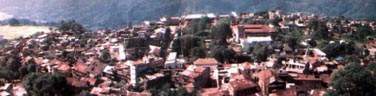
Tansen, the headquarters of Palpa district in Western Nepal is situated at a height of 1372 m. on the warm serene lap of the Shreenagar hill. The small but beautiful town Tansen is said to have been named after Tamra Sen of the Sen Dynasty who ruled the then city state. There is also another view regarding the name of Tansen. It is said that town takes its name from the Magar word "Tansing" meaning the northern settlement. The Newars from the Kathmandu valley migrated to Tansen for the sake of business and other purposes and flourished their social, economic, religious culture and traditions and way of life here, as a result, the town has remarkably duplicated Kathmandu. That's why it's often called another Kathmandu, away from Kathmandu.

[History] [Geography] [People] [Religions]


History

The name of the town "Tansen" has its origin in Magar language, meaning "northern settlement". Magars are one of the ethnic groups of Nepal having their own language, culture and history, and are assumed to be the first settlers in this area. Around 600 years ago, Nepal was divided into several small kingdoms and hill states. In this region, they were known as "Bahra Magarat", meaning the "twelve regions of Magar". The percentage of Magar population in these districts is very high till today.

During the invasion of Muslims into India, numerous kings and clans escaped from there to the northern hill areas. In the late 15th century, they entered the Himalayan region. Some of them conquered the local kings and established their own states. The former Sen - Dynasty of Palpa, founded by Rudra Sen, had its roots in those days. Under the reign of his son, Mukunda Sen (1518 - 1553), the kingdom of Palpa reached its largest expansion and Tansen became its capital.

The kingdom of Palpa spread as far as the Koshi River in the east, Gorakhpur in the south and today's Gulmi and Kaski districts in the west and north. Mukunda Sen, though unsuccessful, attacked Kathmandu valley too. After ruling thirty-five years, he resigned and spent the rest of his life as a saint.

In 1806, after a lot of political unrest, the kingdom of Palpa, which until then had been independent, was annexed into the kingdom of Nepal and was then administered by a governor, appointed from Kathmandu. Political changes in Nepal brought up changes in the administration too. Today the head of Palpa district is the CDO (Chief District Officer) and Tansen is one out of 58 Municipalities in Nepal.

Top


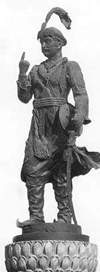
Statue of King Prithvi Narayan Shah the Great, creator of mordern Nepal


Geography

1. Land Area - 1372 sq. km. (136577 Hect)

2. Forest Area - 71170 Hect (52.11 %)
    Community Forest - 60886 Hect.
    National Forest - 10284 Hect.

3. Climate - Tropical, Sub-tropical

4. Max. Rainfall (Annual Avg) - 1903.2 ml.

5. Temperature (Avg) - Max : 23.3 c.
                               Minimum : 14.8 c.

6. Cultivated Land Area - 36599 Hect. (27%)

7. Main Agriculture Products :
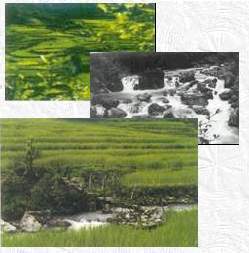
    Food Grain- Maize, paddy & Millet
    Cash Crops-Vegetable, Ginger, Coffee & Fruits.


Top


People

The People of the Valley are an almost bewildering pot-pourrrie of races, for many from the 26 ethnic groups of Nepal throng to the capital in search of elusive riches. Some of these are the Tamangs, Gurungs, Sherpas, Bhotiyas, Rais and Limbus from the middle and upper hills: the Rajputs, Majhis and Tharus from the Terai (lowlands) and the Brahmins, Chhetris and Newars of the Valley itself.

The people of the hills are of trans-Himalayan Mongoloid stock and of these the Rais, Limbus and Gurungs are famed for their service as Gurkha soldiers. Groups hailing from the lowlands boast of Aryan ancestors who were high caste Hindus from India fleeing Mogul invasions. The Brahmins and Chhetris of the Valley claim a similar ancestry. The origin of the Newars is still debated but they are considered the indigenous people of the Valley. They are of mixed Mongoloid and Aryan stock.


Top

Religions

1. Total Population - 236313
    Male - 110325
    Female - 125988

2. Population Growth Rate - 0.97%
    (National Rate) - 2.1%

3. Population Density - 172.1 per sq. km.
    (National) - 125.6 sq.km.

4. literacy Rate - 48.2 (above by sold)
    (National) - 39.6%

5. Population Classification.


Caste No. Per (%) Literacy above 6 yrs. Economy. pop. in %
Magar 136694 50.98 41.7 70.2
Brahmin 47911 20.2 64.7 56.1
Chhetri 20120 8.5 56.3 58.9
Kami 5630 6.6 34.4 69.0
Newar 8972 3.8 67.3 54.0
Sarki 6972 2.9 33.9 68.8
Kumal 5060 2.1 32.2 77.2
Damai 4807 2.0 40.0 68.2
Thakuri 2928 1.2 54.5 78.1
Others 7224 3.0 - -

Top