Raabs
Unit: Evidences
for the presence of a volcanic arc involved during
the Hercynian continental collision of the Moldanubian zone. (This
article was presented in the Conference MinPet-98, Pörtschach/Wörthersee,
Austria 22.-27. September 1998)
by
Tarek Y. Nasr, M.Sc. Institute
of Petrology, University of Vienna Thaya
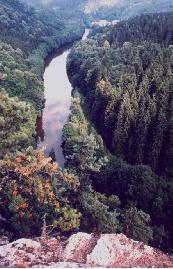
River crossing the studied area
When SUESS started to draw the so-called
Moldanubian-Moravian thrusting line, to mark the tectonic boundary
between the overthrusted high grade metamorphic Moldanubian zone and the
underthrusted lower grade Moravian zone, he could surely not have imagined
that he was opening the door to a never-ending story of research, research
that has tried to illuminate the darkness covering the complex geologic
history of the Bohemian massif. Despite the amount of research across all
earth-science disciplines, there is no agreement about many important issues;
the age-dating of magmatic and metamorphic processes, the geotectonic processes
before and during the building of this massif, and the interpretation of
metamorphic conditions. Researchers have agreed on only one issue; that
a collisional event accompanied the genetic history of the Moldanubian
zone and led to the existence of nappe structure within the Bohemian massif.
But what type of collision took
place? Where can the collisional suture be found? What do the traces of
metabasic and ultrabasic rocks within the Bohemian massif mean? Was there
a Palaeozoic ocean which closed completely during this collisional event?
There are still no clear answers to these questions.
One of the most important riddles
in the discussion about the genetic history of the Bohemian massif is the
Raabs unit; the subject of this article.
This rock series consists of different
types of high grade metamorphic rocks; mainly amphibolites of different
petrographic habits, felsic and dioritic orthogneisses with a matrix of
paragneiss crossed by metabasic bodies and localised marble and calc-silicate
lenses.
Tectonically, the Raabs unit occupies
the base of the Gföhl unit, the uppermost of the three rock units
which make up the Moldanubian zone i.e. upwards Ostrong unit, Drosendorf
unit and Gföhl unit. To avoid any terminological confusion, the term
"Raabs unit" will be used in this article to represent this rock series,
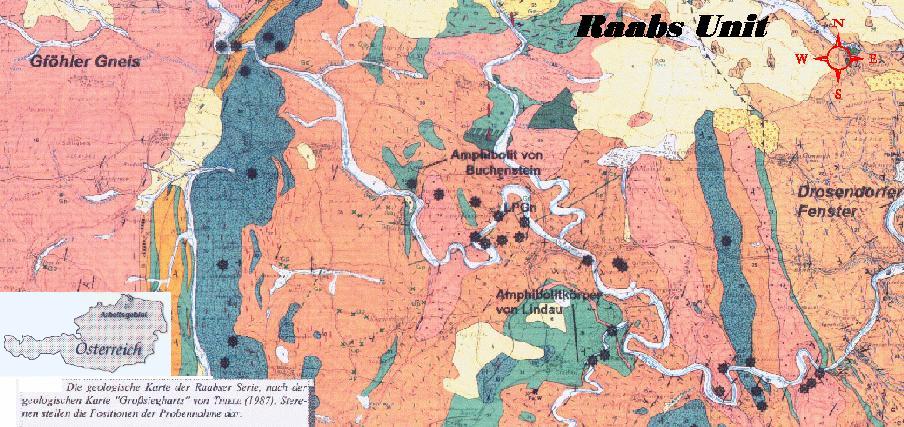
which is bounded to the east by the Drosendorfer window, to the west by
Gföhl gneiss and to the south by the Blumauer granulite (Fig.1).
Before discussing the
different models used to describe the genesis of this series, the rock
content should be examined more closely.
Amphibolites in the Raabs unit occur
in three forms; a relatively big amphibolitic body around the town of Lindau,
a small body near Buchenstein and amphibolitic lenses within the paragneisses
and (rarely) the orthogneisses (augite-gneisses). The three forms display
different petrographic characteristics. The most important outcrops exist
within the Amphibolite body of Lindau. All amphibolites have relic clino-pyroxenes
with augitic to salitic composition, which could be an indication of high
grade metamorphism for these metabasites. No amphibolites show any traces
of garnet. Each amphibolite form has different textural characteristics.
Lindau Amphibolites are well recrystallized; equilibrium textures are widely
distributed. Samples from Buchenstein have strong
alteration features like the alteration of hornblende to actinolite,
chlorite and sometimes biotite, uralitization of pyroxenes and sericitization
of plagioclase, beside the absence of any equilibrium textures. The Amphibolite
lenses in paragneisses are characterised by the alternation of amphibole-free
clinopyroxene bands with clinopyroxene-amphibolitie bands. All amphibolites
comprise relatively large amount of Ti-rich minerals like ilmenite and
rutile, but sphene is the most common Ti-mineral.
Two types of orthogneisses are found.
According to their chemical composition, they can be classified as felsic
granitic gneisses and dioritic gneisses. According to the geologic map
of the area prepared by THIELE (1987), the felsic gneiss is called Kollmitz
gneiss.
Petrography
and mineral chemistry
are
witnesses to the regional hercynian event
The first microscopic
look at the mineral content of both orthogneisses indicates that high grade
metamorphic conditions affected the rocks of Raabs unit prior to the Moldanubian
overthrusting.
Many textural and mineral features
indicate a high grade metamorphism; the homogenised garnet cores, presence
of clinopyroxene in the augite-gneiss, presence of disc sillimanite in
the granitic gneiss in addition to the wide distribution of perthitic texture
in K-feldspars.
The Kollmitz gneiss is paragenetically
and geochemically similar to the famous Gföhl gneiss, whereas the
main mineral constituents are biotite, sillimanite, perthite, plagioclase,
ilmenite/rutile and almandine-rich garnet. The texture shows blastomelonitic
habits which indicates an intensive deformational overprint represented
in features like sutured quartz boundaries, extensive undulatory extinction,
quartz bands, subcrystals in K-feldspars or quartz, and mortar texture.
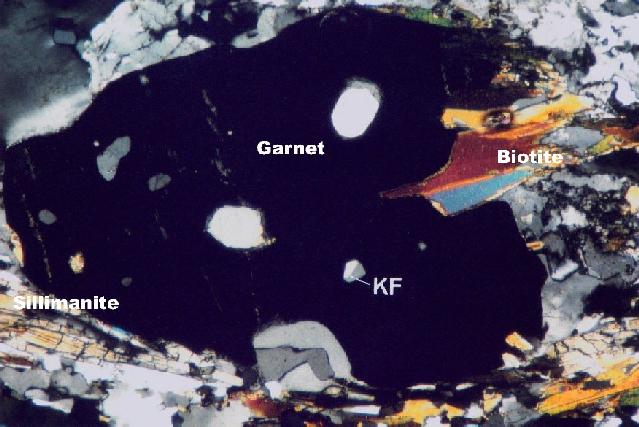
The garnet porphyroblasts are always resorbed by biotite and sillimanite
(Fig.2 and 3).
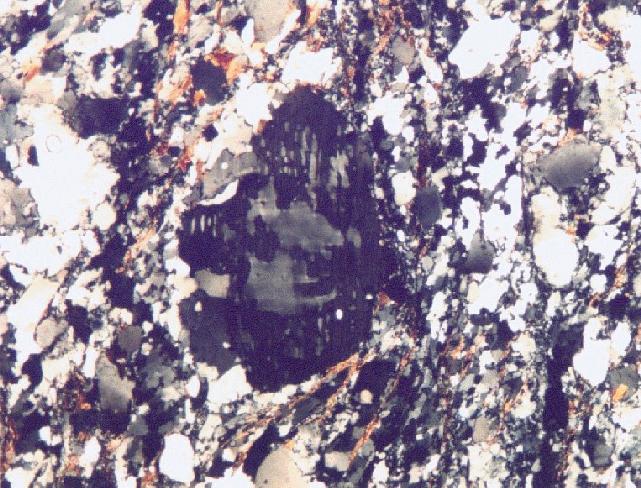
Fig.2 : Different
petrographic features displaying the different phases of metamorphism which
affected the orthogneisses of Raabs unit. upper left: Garnet prophyroblast
under XN shows the strong resorption of rim by biotite and sillimanite
and the strong deformation features in the matrix which composed mainly
of feldspars and quartz. upper right: Feldspars' porphyroblasts do form
usually with matrix mineral phases mortar structures as well as other deformational
textures like disk quartz and strong undulatory extinction which reflect
the intensive deformational event accompanied the Moldanubian - Moravian
overthrusting.
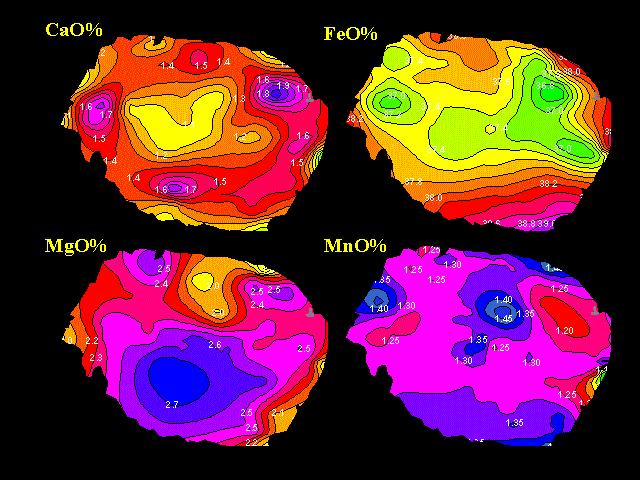
Fig.3: Chemical
countour diagram based on the main four oxydes of an almandin rich garnet
porphyroblast from Kollmiz gneiss. Variation in composition within a large
garnet porphyroblast (4mm) from Kollmitz gneiss as determined by
electron microprobe. The contours show a typical signature for a metamorphic
rock from high temperature zone with disturbed core-homogenization and
resorbed rim displaying retrograde zonation. Resorption of garnet during
uplift is accompanied by production of resorbing biotite crystals which
caused disturbance in their vicinity due to Fe-Mg exchange reactions with
garnet rim.
The dioritic gneiss
(or the augite-gneiss as described by THIELE, 1987) consists mainly of
clinopyroxenes, plagioclase and tschermakitic hornblende which consumes
the clinopyroxenes with different intensity from locality to other. In
some cases clinopyroxene crystals are almost totally replaced by hornblende;
only relicts of clinopyroxenes remain scattered within the hornblende as
seen in the attached photo (Fig.5). Garnet is rare, probably replaced by
plagioclase during decompression. Ilmenite, rutile and sphene represent
the most common accessories.
The resorbtion of garnet porphyroblasts
in both orthogneisses as well as the "amphibolization" of pyroxenes in
dioritic gneisses probably reflect the decompression phase which accompanied
the uplift of Moldanubian rocks during overthrusting on the Moravian block.
On the other hand, the widespread blastomylonitic textures in all orthogneisses
and granulites of the Moldanubian zone reflect the high ductile deformation
which accompanied the overthrusting.
An important feature noticed in
all rocks of the Raabs unit is the increase of deformation and retrograde
features toward the E-direction, actually towards the Moldanubian-Moravian
thrusting line.
The peak metamorphic conditions
could be derived from the mineral chemistry of the paragenesis: garnet,
plagioclase, biotite and ilmenite in granitic gneiss and from the paragenesis:
garnet, clinopyroxene, plagioclase and ilmenite in dioritic gneiss. Thermobarometry
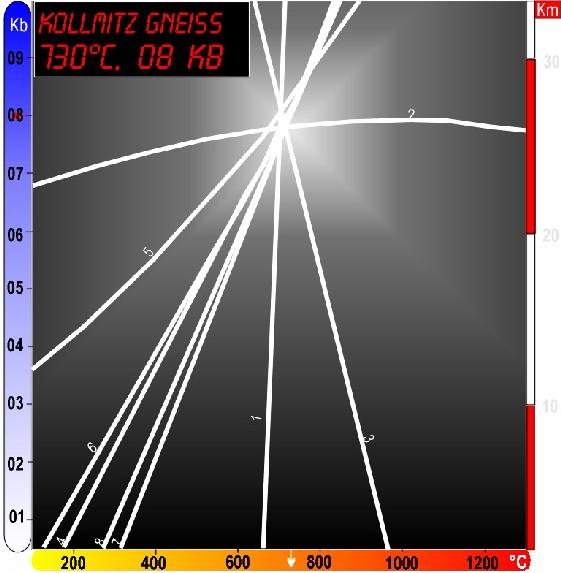
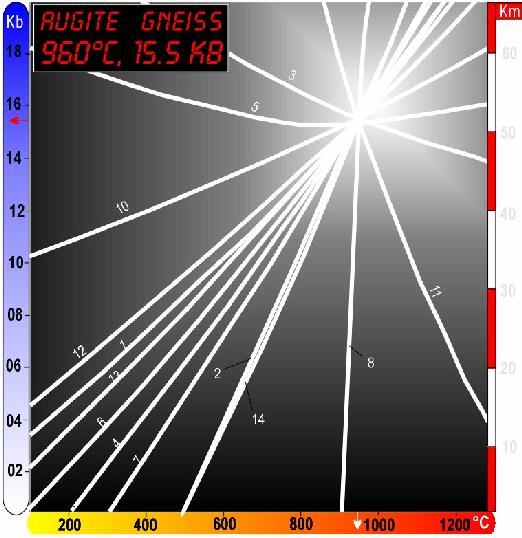
with estimation of equilibrium state (the TWEEQ method) identified high
metamorphic conditions of about 730°C/8kb for granitic gneisses, and
960°C/15.5kb for the dioritic gneisses. These high TP conditions are
comparable with a collisional event, as explained later (Fig.4).
Fig.4: PT
Diagramm calculated with TWEEQ-method (Berman 1991), for the Kollmitz
gneiss (top) using the paragenesis garnet, plagioclase, biotite, sillimanite,
imenite and quarz, and for augite gneiss (bottom) with the paragenesis
garnet, clinopyroxene, plagioclase, ilmenite and quarz. The lists of contributed
reactions include four independent reactions for Kollmitz gneiss, and three
for augite gneiss.
1.
Alm + Phl = Py + Ann
2.
6 Rt + 2 Py + Gr + 2 Ann = 3 An + 6 Ilm + 2 Phl + 3 aQz
3.
3 Rt + Py + Ann = 3 Ilm + Phl + 2 aQz + Si
4.
6 Rt + Gr + 2 Alm = 3 An + 6 Ilm + 3 aQz
5.
Alm + 3 Rt = Si + 2 aQz + 3 Ilm
6.
3 Si + 3 Rt + Py + 2 Gr + Ann = 6 An + 3 Ilm + Phl
7.
2 Si + aQz + Gr = 3 An
8.
3 Si + 3 Rt + 2 Gr + Alm = 6 An + 3 Ilm
1. Alm + Hd + 4 Rt = 3 aQz + 4
Ilm + An
2. Gr + 2 Ilm + 3 aQz = 2 Rt +
2 Hd + An
3. 4 Hd + Py + 4 Rt = 3 aQz + 4
Ilm + 3 Di + An
4. 2 Rt + Gr + Alm = 2 An + Hd
+ 2 Ilm
5. Alm + 3 Hd + 6 Rt = 6 aQz +
6 Ilm + Gr
06.6 Rt + Gr + 2 Alm = 3 An + 6
Ilm + 3 aQz
7. 3 aQz + 2 Gr + Alm = 3 An +
3 Hd
8. Alm + 3 Di = Py + 3 Hd
9. 4 Alm + 3 Di + 12 Rt = 9 aQz
+ Py + 12 Ilm + 3 An
10. 2 Rt + Py + 2 Hd + Gr = 2 An
+ 3 Di + 2 Ilm
11. 6 Rt + Py + 6 Hd = 3 Di + Gr
+ 6 Ilm + 6 aQz
12. 3 aQz + Py + 2 Gr = 3 An +
3 Di
13. 6 Rt + Py + 3 Gr + 2 Alm =
6 An + 3 Di + 6 Ilm
Geochemical
Evidences for the probable tectonic and magmatic processes
prior
to the hercynian metamorphism
The chemical composition of amphibolites
is comparable with tholeiitic to calc-alkaline basaltic rocks, but mainly
calc-alkaline, as proved by Jensen's (1976) diagram Feo+TiO2-Al2O3-MgO
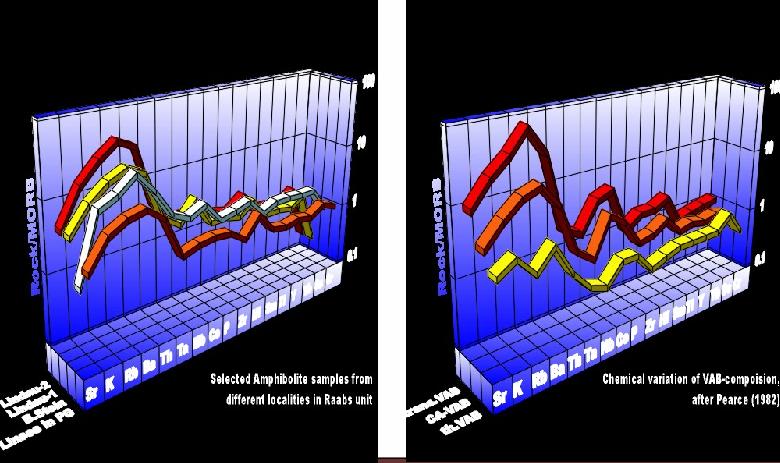
(not seen). The MORB-normalized spider diagrams for the incompatible major
and trace elements show a signature similar to that of subduction-related
calk-alkaline basalts (Fig.6), whereas there is a clear enrichment of LIL
elements Sr, K, Rb, Ba and Th with a characteristic Ba-peak, followed by
a sharp drop from Ta.Nb to Cr, but with relative enrichment for Ce, P and
Sm, as well as a variable fluctuation of Y-Yb and Sc around the unity.
This characteristic signature of subduction related basalts is mainly due
to the crustal contamination affecting the magmatism in a volcanic arc
in both ocean arcs and continental margins. This volcanic arc genesis is
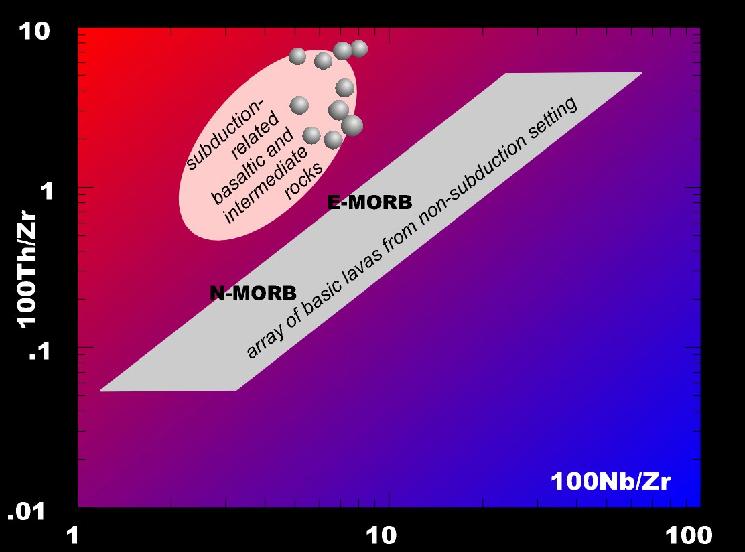
also supported by other chemical ratios, as seen in the diagram Nb/Zr
Th/Zr by Beccaluva et al (1984, Fig.7). A plot of Th against Ta after Pearce
(1982; 1983, not seen in this article), supports the subduction-related
nature. It also adds another important piece of information - that the
arc magmatism seems to be more related to continental margin than oceanic
island arcs. The clak-alkaline nature of the protolith also supports the
idea of an origin in context with a continental margin.
Fig.6:MORB-normalized
incompatible element abundance patterns for different amphibolite samples
from Raabs unit (left) and reference samples of different types of subduction-related
basalts (right) after Pearce (1982). The comparison between both diagrams
displays the similarities between the patterns of the studied amphibolites
and those of VAB especially within the region from Ba to Sm. MORB-normalizing
factors after Pearce (1982).
The chemistry of orthogneisses show
a different genesis. The augite-gneiss displays a dioritic chemical composition,
with SiO2% varying around 60%. Normative minerals show a tendency toward
qz-bearing diorite. The clear Eu anomaly is identical with that of Diorite
from other localities in the world (Eu/Eu*=0.69). Andesitic rocks do not
display this relatively high plagioclase fractionation and therefore have
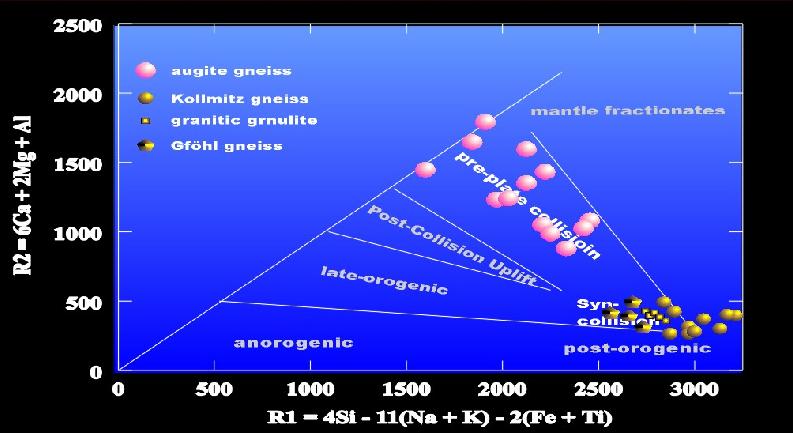
an Eu-Anomaly ratio a little under 1.0. The diagram of Batchelor and Bowden
(1985, Fig.8), as well as that of Pearce (1984, not seen), describes the
origin of augite-gneiss protolith in terms of a pre-plate collision (volcanic
arc origin).
The Kollmitzer gneiss with its high
SiO2-content (73%-78%), high K2O/Na2O ratio, high A/CNK ratio (1.55) and
extremely high Eu-anomaly (Eu/Eu* = 0.16) clearly have the geochemical
character of S-type granitic protolith. This conclusion is supported
by the Sr isotopic ratios derived
from other chemically and petrographically similar granitic gneisses and
granulites in the moldanubian zone (which show high 87Sr/86Sr of
>0.708). The origin of S-type granitic rocks is related to continental
collision - the sedimentary parts of the upper continental crust tend to
melt under the high pressures and temperatures accompanying a collisional
event. This syn-collisional genesis is displayed in the diagram of Batchelor
and Bowden (1985), which defines tectonic settings according to different
granitic compositions.
Fig.7: One
of the most important diagrams (after Beccaluva et al., 1984) which excludes
the possibility of MORB-origin for the protolithes of the studied amphibolites.
As seen here tend all samples with their high Th/Zr ratio to be restricted
within the range of subduction-related rocks. The relatively high resistence
of the elements used in this Diagram (especially Zr, and Nb) against the
secondary processes (metasomatism, metamorphism , etc..) gives this diagram
a high reliability.
Fig.8: Discrimination
diagram after Batchelor & Bowden (1985) for the different genetic modells
of grnitoid rocks. The diagram displays the possible genesis for the protolithes
of the studied orthogneisses. The diagram
definesthe genesis of the protolith of the dioritic gneiss as a subduction
related setting (pre-collision), while the Kollmitz gneiss and the other
plotted samples of granitic gneisses and granitic granulites display a
tendency toward the syn-collisional genesis (S-type granitic rocks).
An arc origin
for augite-gneiss protolith and the syn-collisional origin for the Kollmitzer-gneiss
protolith is further indicated by the element distribution in both rock-types,
which is similar to equivalent igneous rocks in ORG-normalized spiderdiagrams
(not seen in this article).
In the last few years some authors
have supported the idea that the Raabs unit represents the suture zone
remaining after the hercynian continental collision. Those authors have
justified their hypothesis by saying that geochemical evidence for MORB-equivalent
metabasites has been found in the Raabs unit; undoubtedly a strong argument
supporting their idea. Further evidence is found in the ophiolite-like
sequence, which includes the presence of coarse-grained metagabros, fine-grained
metabasaltic dykes, and also trondjemetic veins and ultramafuc remnants.
However, some authors have used the term "Raabs unit" as an equivalent
to "Raabs-Meisling unit "without making this clear. However, this article
refers to the Raabs unit s.s.
Geochemically,
the Raabs unit has
nothing
to do with the Meisling unit
It is clear that
the geochemical nature of the amphibolites reflects subduction-related
basalts as protolith, probably near or on the continental margin. So the
possible presence of a calc-alkaline volcanic arc cannot be neglected during
a discussion about the origin of the Raabs unit. The absence of andesitic
rocks within the Moldanubian zone does not mean that no arc magmatism existed.
Andesitic extrusion is not a "must" in volcanic arc origin. Many tectonic
aspects, such as angle of subduction and duration of magmatism, can control
the type, intensity and extent of magmatism in a volcanic arc. In addition,
there is no field evidence suggesting the presence of any ophiolitic rocks
in the Rabbs unit s.s. Furthermore, the syn-collisional nature of granitic
gneisses and the subduction-related nature of the dioritic gneisses point
to an environment related to that of a continental margin.
In contrast to the Raabs unit s.s,
the Meisling unit shows evidence of MORB-like metabasites which could indicate
a suture zone. But do these MORB-metabasites in the Meisling unit represent
the remnants of a real mid-oceanic-ridge basalt, or is there a possible
back arc basin accompanying the suggested volcanic arc activity?
According to all petrographic and
geochemical evidence available from the current study, there should be
a clear division between the Raabs unit and the Meisling unit. Further
studies on the geochemical nature of the metasediments in both units are
recommended to support this suggestion.
It
is suggested that the protolithes of both orthogneisses
retained
their original stratigraphic spacing
during
the hercynian metamorphism
According to geothermo-barometric measurements,
the two orthogneisses differ in their metamorphic conditions. The granitic
gneiss was metamorphosed under a minimum temperature of 730°C and depth
of about 25km, while the dioritic gneiss was metamorphosed under a very
high temperature of 960°C and high pressure equivalent to a depth of
50km. What does this mean?
To explain this situation we must
take into account the results obtained from geochemical analysis of both
rock types. Before the hercynian collision it was an arc-magmatism producing
the protolith of dioritic gneiss near the base of a continental crust segment,
accompanied by extrusive calc-alkaline basaltic volcanism over the arc.
The syn-collisional character of
the S-type granitic protolith of Kollmitzer gneiss (analogically Gföhl
gneiss and granitic granulites) suggests a stratigraphic position within
the uppermost part of a continental segment, which melted in the context
of a hercynian collision.
After the beginning of the collision,
there followed the underthrusting of a continental segment, containing
in its upper part the S-type granite and within its base the dioritic protolith,
under another continental front. This underthrusting of a continental segment
under another can take place within the same active continental margin,
and does not have to be along the suture of continental collision. With
progressive underthrusting, the underthrusted segment reached the base
of the overthrusted segment. The upper part of the underthrusted segment
(granitic gneiss) will be overloaded by the total thickness of the overthrusted
segment (˜25km and 730°C), while the base of the underthrusted
segment (diorite-gneiss) would be subjected to higher temperatures and
pressures due to the double continental thickening, i.e. through the thickness
of the underthrusted segment and that of the overthrusted one (˜50km
and 960°C).
This model represents a possible
sequence of events. Age-datings for the studied rocks, especially for the
pre-metamorphic phase, are required in order to explain the time relationship
between the subduction-related magmatism and the hercynian collisional
event.
Until such age-datings are available,
the suggested model should be considered as preliminary.