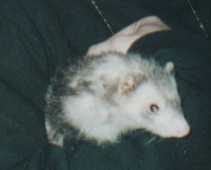
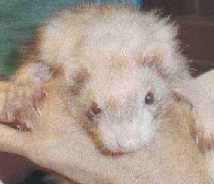
This page is dedicated to Shirley. Her entire story follows below.
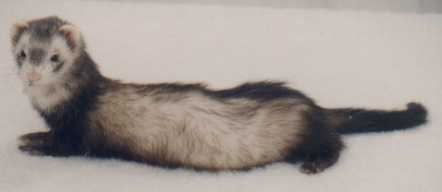
SHIRLEY’S STORY
Shirley is a 5 1/2-year old ferret who has a remarkable story to tell. I hope that you will get as much joy from her saga as we have. Here is her story:
The first time that we saw Shirley was in October of 1996 at a pet superstore. She was among the first group of ferrets that the store had received when they opened in September of 1996. At that time she was only 2 months old. Every ferret there received a new home except Shirley. Other ferrets came and went, but Shirley remained behind. Over the next several months she was purchased twice, but was returned to the store both times. The first purchaser was a teen-age girl who was not allowed to have a ferret. The second time was by a couple unfamiliar with normal ferret behavior. They said that she was very wild. So Shirley stayed at the store, and became the store mascot. Shirley’s name was chosen for her by the store clerks.
In May of 1997, we went to the store to get some pet supplies, realized that she was still there, and began to play with her. She quickly won our hearts and we decided to give her a home with our other ferrets, CoCo and Piglet. Because she was kept in a cage at the store for 8 months and not allowed to run, she was full of energy when she arrived at her new home. The first night she ran around for almost 2 hours, before settling in to her new life with our other ferrets. Shirley, now 10 months old, finally had a home.
Over the next few years, we acquired more ferrets, eventually allowing the number of ferrets to reach a high of 6 (all of our ferrets were rescue ferrets except Shirley). Also, during that time we experienced some of the medical problems that ferrets usually get, along with a few that are not so common. Some of these were: adrenal disease (both left and right adrenal glands); insulinoma; a kidney removal; fatty liver disease; helicobacter inflammation and 2 different forms of cancer. Even with all of this experience, nothing would prepare us for what was to come next.
Until June of 2001, Shirley was the healthiest of our ferrets. Her only vet visits were for her annual immunizations and checkups. At that time we noticed that she had developed a pattern of "mothering" the other ferrets, along with some marginal hair loss (although not at the base of her tail, as is so common with adrenal disease). We suspected that it was adrenal disease, so we took her to our local vet and he confirmed our fears.
When treating adrenal disease, there are 3 primary courses of treatment. The first option is to not treat the disease at all because in the majority of ferrets, adrenal disease is a cosmetic problem. A percentage (probably fewer than 10%) of male ferrets with adrenal disease will develop life-threatening prostatic problems, and an even smaller percentage (probably fewer than 1%) of males and females will develop life-threatening bone marrow or metastatic disease. The second option, Lupron injections, has been used in many ferrets, and is effective in eliminating itchiness and restoring hair growth in most cases, but in my opinion, this just covers the symptoms and does not cure the problem. The third option is to surgically remove the diseased organ(s). Because there are always risks to any surgery, all courses of treatment need to be fully explored in advance to find what seems to be the best balance for the individual pet. Having faced this problem several times in the past, and having had good success, we decided to do the same with Shirley as we had done with CoCo, Bandit and Cosmo: to have the affected gland(s) removed surgically to stop the progression of the disease. (I want to add here that at the time we made the decision for Shirley’s surgery, we were unaware of the fact that I stated above – that adrenal disease in most ferrets is just a cosmetic problem. Had we known this, our decision may have been different than what it was.)
There are risks when doing adrenal surgery in addition to the normal risks of any type of surgery. If the affected gland is the left gland, the procedure is relatively simple…the gland is located, isolated and removed completely. (According to one study, in approximately 40% of cases, the left gland is the only one affected. In about 20% of cases, both glands are diseased.) In the case of the right adrenal gland, however, the procedure is not so easy. In most cases, due to the proximity of the gland to the vena cava (the main vein that returns blood from the lower part of the body), the gland will actually grow into the vein. When this happens, the surgeon will only open the gland and remove as much of it as he can, leaving some cells in place. This procedure is called debulking. This does not completely remove all of the disease. Sometimes, if the growth has progressed sufficiently, it will block the vena cava. When this happens, the body will force the blood through some of the smaller veins in an effort to complete the return path to the heart. The amount of blockage will determine how much collateral blood flow will be necessary. It has even been found in some cases that the vena cava has been completely blocked and that the body has completely compensated for this. We were aware of these facts prior to Shirley’s surgery. However ………
On Tuesday, October 9, 2001 (just 2 days after CoCo lost her fight with cancer), Shirley underwent surgery for her adrenal disease, under the care of our local vet. He is a skilled surgeon who has performed many adrenal procedures on ferrets. Even in the best of care, there are unforeseen problems that cannot be determined prior to the surgery. What he found was the right adrenal gland growing into the vena cava. While attempting to clean it, the vein deteriorated and began to leak, and repair attempts were fruitless. In order to save her life, he was left with only 1 option: to clamp off the vein and remove the entire gland. He did this, closed her abdomen, and she went to recovery. When we arrived to take her home that evening, the vet told us of the difficulties he encountered, but he didn’t seem overly concerned with her prognosis. He did state that she would be sore, and it would take longer than usual for her to recover. We put her into her cage at home (away from the other ferrets), and she slept through the night without incident.
On Wednesday morning, she was slow to wake, and she didn’t want to eat. Our ferrets are let out of their cages for at least 1 hour every morning, but Shirley wanted no part of her playtime. We still were not overly worried though, even later that day or that evening, in light of what she had been through. On Thursday morning, she did not seem to be making any progress in her recovery, so I dropped her off at the local vet’s office and asked him to check her over, in case some other problem had arisen since her surgery. The vet said that she was just very sore, so he put her on some pain medication, again not overly worried about her, and sent her home. By Friday morning, however, we were now starting to get concerned about what was happening to her, because she didn’t seem to be improving. She would just go from her cage to one of the critter beds, and just rest. This just was not Shirley. In comparison, all of the other ferrets that had surgery would show signs of recovery by the second day.
As I had mentioned, CoCo passed away from cancer on the Sunday prior to Shirley’s surgery. Prior to her passing, she was being treated by Dr. Evelyn Ivey, DVM, who is a member of the Special Species group at The University of Pennsylvania School of Veterinary Medicine in Philadelphia, Pennsylvania. We previously had scheduled an appointment with her for Friday at noon to discuss CoCo’s necropsy (autopsy). My wife insisted that we bring Shirley along with us to that meeting because she wanted to get a second opinion from Dr. Ivey. This decision was probably the single most important event in Shirley’s life. Dr. Ivey quickly examined her, took her up to the exotics ward, and within an hour came back to us with the startling news that Shirley was suffering from acute KIDNEY FAILURE !!
A million questions went through our heads at that point. How could such a thing have happened? Did the surgeon check her kidney values prior to her surgery? Was it a result of the surgery? How did the surgeon miss this diagnosis? And most importantly, what was her prognosis? Many of these would be answered in the days that followed.
Shirley was immediately taken to the intensive care unit and put on intravenous fluids. She received an abdominal sonogram and extensive blood testing. Her diet was modified to one low in phosphorous. She was given medications to prevent excess stomach acid (to prevent ulcers from forming), and around-the-clock monitoring for any signs of deterioration of her organs. Over the next several days, she was closely monitored as a treatment plan was being developed for her. During this time, no one was able to tell whether Shirley would even survive this ordeal. Each day, Dr. Ivey would call us to keep us updated with Shirley’s condition. Shirley’s blood values were very high: BUN of 139– normal is below 40, creatinine of 5.5 – normal is below 0.8, and phosphorous of 12.7 – normal is below 8. The higher the numbers, the more danger she would be in. If left unchecked, the toxins could slowly cause her to die. When kidney values get too high in humans, they undergo dialysis. At some facilities, dialysis may be performed for pet dogs and cats as well. Dialysis has not been attempted in pet ferrets due to the large volume of blood that would be needed to prime the dialysis machine, so ferrets must use an alternative treatment: fluid therapy. The cleansing of the toxins from the blood is done by infusing large amounts of fluids into the body. This will help the kidneys to work better. However, there is a limit to the amount of fluids that can be given before other problems arise, so monitoring is essential. For Shirley, this treatment was done with intravenous fluids.
We discussed the possible causes for what had happened, and the most logical answer was this: as I mentioned above, it is possible to clamp off the vena cava and the body will compensate for this. The problem is that at the time of the clamping, Shirley’s vena cava was only partially blocked. Until the smaller veins can expand, the blood being pumped from the heart is "trapped" in the lower half of the body, resulting in a higher than normal blood pressure in the lower half of the body. We suspect that this caused swelling and hypertension in her kidneys and subsequent damage to the renal tissue. The sonogram also demonstrated a large infarct (an area where blood flow was much reduced) in the left kidney. The infarct was suspected to have been due to renal hypertension. (There have been cases where the gland completely blocked the vena cava prior to surgery and there was no problem from higher blood pressure because the blockage was done over a long period of time and the smaller veins were able to expand before the surgery. When this occurs, clamping the vein and removing the adrenal gland does not cause kidney failure.)
Over the next several days, Shirley’s condition had stabilized, and her blood values improved marginally. On Thursday, Dr. Ivey called with an update. She said that she had some concerns about the fluid therapy. As long as Shirley remained in the hospital, intravenous fluids were not a problem. In order to send her home, though, she would have to be taken off of the intravenous fluids and put onto sub-cutaneous (sub-q) fluids (fluids injected under the skin). She didn’t think that she would be able to tolerate this treatment, and expressed concerns about Shirley’s longevity without fluids. She suggested taking Shirley home for the weekend to "say goodbye", and to return with her on Monday and put her to rest.
On Friday, she called again, and I informed her that we decided NOT to accept her suggestion, because we knew that Shirley was much tougher than she thought. She stated that she was happy to hear that because she had re-evaluated her previous suggestion and reversed it. I then told her that I had treated a cat for kidney failure with sub-q fluids for 2 1/2 years, and I was willing to give it a try. She agreed. She developed a plan where Shirley would get 30ml of fluids injected with a syringe under the skin along her back. The entire procedure would only take 10-15 seconds, and be repeated 3 times a day. (In comparison, when I did this for my cat I used a drip, not a syringe, and the procedure would take 15-20 minutes.) Also, during one of our previous conversations, the question of a kidney transplant was raised. Her response was that she didn’t think this would be possible. Although it is done quite often for cats, she was unaware of any having been done for ferrets. She said that she would discuss this with the surgeons to see if it would be feasible, should the necessity arise. Shirley then spent the weekend in the ICU, and on Monday, after 10 days, she came home. The first night home, we gave her the sub-q fluids without incident.
There were also some concerns about her diet. Shirley had previously been eating a dry ferret food, but the phosphorus content was too high. While she was in the ICU, she was fed a canned cat food along with a phosphorus binder to absorb the excess phosphorus. Even with this, her level was too high. Dr. Ivey suggested a dry cat food formulated for kidney failure in cats. So she sent some home with Shirley. Our biggest problem was getting her to eat the new cat food that she so needed. She decided that she didn’t like it, and wouldn’t eat it. On Tuesday, Dr. Ivey suggested giving her some chicken, and I suggested using strained baby food. She agreed, so I bought 1 jar for a test, and she ate it without incident. The only problem was that the food could not be left in her cage for 2 reasons: it would spoil after a short time and, more importantly, she needed the phosphorus binder along with the food. So we had to set up a feeding schedule to feed her 4 times a day (every 6 hours around the clock). We had no problems feeding her this diet. On Thursday, Dr. Ivey called and said that she had spoken with the nutritionist, who wanted to add some carbohydrates to her diet, so she suggested adding baby rice cereal to the chicken. We tried it and Shirley liked it.
For the next 4 months, Shirley ate the baby food mixture, mixed with her medicines. The mixture was prepared in advance and stored in the refrigerator in the previously used syringes (without the needles) from her sub-q fluids. We would squeeze the food onto the palm of our hands and Shirley would lick it from there. We did not have to force feed her. She continued to get her sub-q fluids 3 times a day. As a result of all of this, Shirley’s blood values have dropped significantly. (BUN=60, creatinine=1.8, phosphorus=5.2). It seems that her kidney function has improved considerably. The damaged part of the kidneys will never recover, but the good part seemed to compensate for most of this. In February, we began to wean her off of the baby food mixture, and began restoring her original ferret food. We did this by giving her 1/2 the amount of baby food, and left a dish of ferret food in her cage. She would eat some ferret food on her own. She would still get the phosphorus binder with her baby food mixture. Her values seemed to hold steady over the next 2 weeks, so we have discontinued giving the baby food. She is now completely eating ferret food, and still gets her medicines and sub-q fluids. (We have noticed a slight increase in her values since the switch back to the all ferret food diet, but nothing significant at this time.)
Since she has been home, she has had regular re-checks with Dr. Ivey, but she has not spent a single night in the hospital. She is as active as she ever was, sometimes winning races with her younger and bigger brothers. She is so energetic that sometimes we have to remind her that she is "sick". If it weren’t for Dr. Ivey, along with Mary Taylor (Special Species nurse-practitioner) and the entire team at the hospital, we would surely have lost her in October. Although she will probably never have totally normal blood values again, she still has had many months of a good quality of life with her illness and has a good chance at a long life. Although we have invested a considerable amount of time and expense with her care, watching her playing with her brothers makes it all worth it. Due to the risks and uncertainties involved with doing the kidney transplant, Dr. Ivey has ruled it out for now. It would be foolish to attempt this and to put Shirley’s life in danger at this time. If her condition would deteriorate significantly, we would then reconsider that option.
In December, the hospital held a Christmas party for the survivors of the ICU. 2 different television stations covered the event and Shirley appeared on each of their newscasts. When we take her back for her rechecks at the hospital, everyone is amazed at her recovery. Even with all of this notoriety, our biggest joy is to hold her after her sub-q treatment and to have her lick your nose, as if to say, "it’s all right". All this from the little girl that nobody wanted.
EPILOGUE
2 weeks after I completed the story that you just read, Shirley’s condition deteriorated very quickly. On Sunday, April 21, we took her to the emergency department at VHUP because we noticed that she was having difficulty breathing. She was admitted, and it was determined that she was filling with fluid. On Monday morning, Dr. Ivey extracted a large amount of fluid from her lungs, but they quickly filled again. She was on oxygen, and her breathing was very labored. That afternoon, she had slipped into a coma. After discussing her prognosis with Dr. Ivey, we decided that it would be best to let her go to her next life with dignity, so we put her to rest. She was not alone in the end – Dr. Ivey, Mary Taylor and both my wife and I were with her, and she went peacefully.
It was exactly 6 months to the day from her homecoming from the ICU to the day that she lost her battle. She was very courageous and her determination to live gave us the inspiration we needed to continue working with her as we did. Dr. Ivey did a necropsy and determined that her kidneys were so small, that it was amazing that she lived as long as she did. She is now at peace with her sister, CoCo and her brother, Bandit. She was an amazing little girl and will always be in our hearts. She might have started her life as the little girl that nobody wanted, but in the end, she had won more hearts than could be counted. Rest in peace, Shirley.