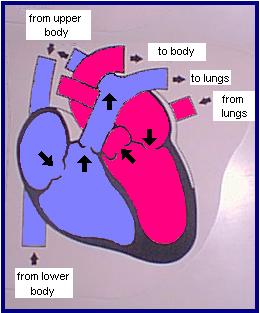
Blood
that is rich in oxygen appears red.
Blood
that is poor in oxygen appears blue.
The blood is the transport system by which oxygen and nutrients reach the body's cells, and waste materials are carried away. The heart, a muscular organ, positioned behind the ribcage and between the lungs, is the pump that keeps this transport system moving.
Blood
that is rich in oxygen appears red.
Blood
that is poor in oxygen appears blue.
Blood leaves the left side of the heart and travels through arteries which gradually divide into capillaries. In the capillaries, food and oxygen are released to the body cells, and carbon dioxide and other waste products are returned to the bloodstream. The blood then travels in veins back to the right side of the heart, where it is pumped directly to the lungs. In the lungs, carbon dioxide is exchanged for oxygen, and this renewed blood flows back to the left side of the heart, and the whole process begins again.
