1. Looking north from Blow-Me-Down Park

The quiet fishing community of Lark Harbour, a typical West Newfoundland outport, clusters round the shores of a small harbour. The first settlers built their homes where the modern homes still stand. This picture is taken from the Lookout Tower about 100m/300ft above sea level in Blow-Me-Down Provincial Park. In 1996 a fine wooden boardwalk was constructed to the Lookout Tower, facilitating the climb with 422 steps, which enables many more visitors to make this worthwhile climb. Once at the top, the more adventurous can then take the more challenging hike out to George's Lookoff on Lark Harbour Head, where a cairn was constructed by George Cake of York Harbour at a location offering a panoramic view of the entire Outer Bay and inland as far as Corner Brook.
2. The village of Lark Harbour

This is the original area of the community. Houses cluster along the waterfront and extend up the hill to where one of the first homes in the community was built over a hundred years ago. Traces of its foundation are still visible. In recent years the town, population about 750, has expanded along the roads to York Harbour and Littleport.
3. St James Anglican Church
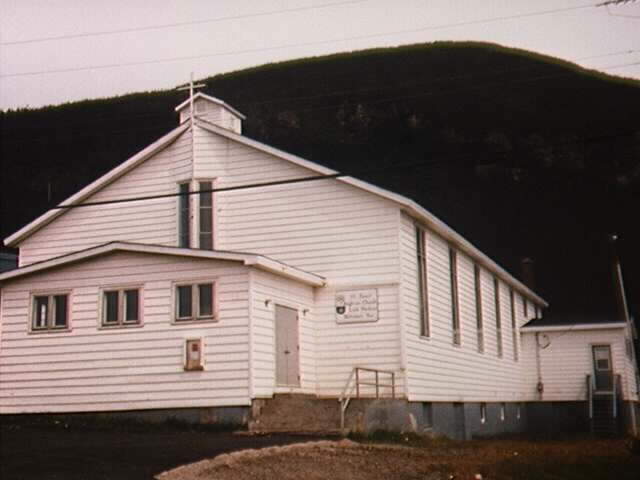
This church was consecrated in 1962, and replaced the original St James Church which had stood at the foot of the cemetery since 1898. It is a spacious building and contains an attractive east window and a bishop's chair made in the 1890s by a local craftsman. A cairn has been constructed in the present cemetery, marking the location of the original church of 1898.
4. Main Street looking east
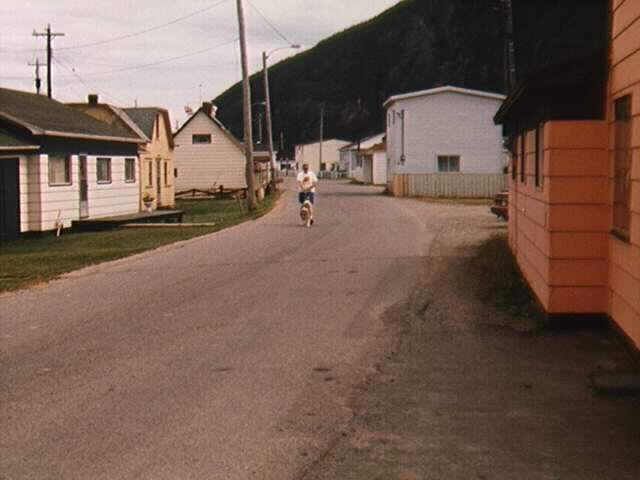
Traditional and modern homes line the Main Street of Lark Harbour, pictured on a warm and peaceful summer afternoon. To the right the square white house is of the "salt box" style, while to the left is a yellow house, more imaginatively constructed, before the turn of the century.
5. An outport cottage
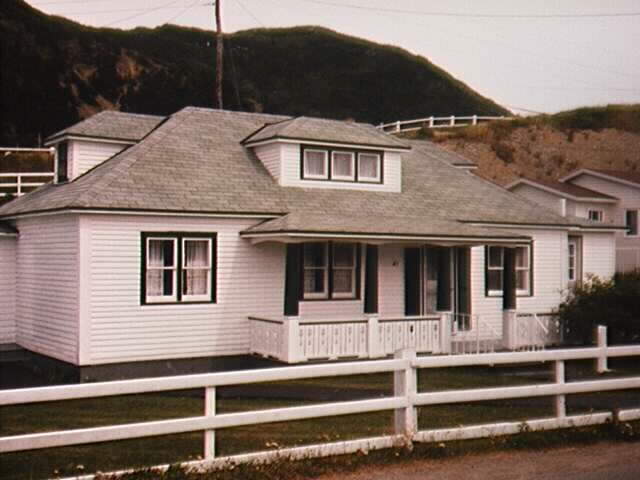
This attractive traditional home, dating from the early years of this century, is typical of the well-maintained houses to be seen in every fishing community in Newfoundland. It was built by the late Fred Sheppard, a local man who was customs officer in Lark Harbour for many years. Mr Sheppard died in his nineties a few years ago. The house is now occupied by his son Roland.
6. Bottle Cove and the Monster
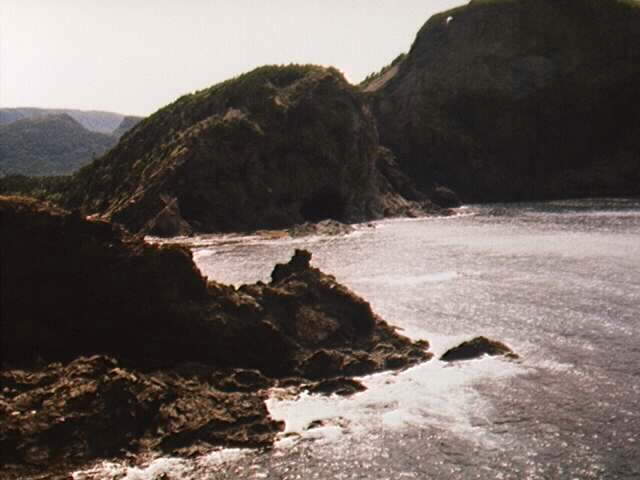
Don't be fooled by this idyllic scene. This is Bottle Cove (French bateau) on a calm summer day, but there are times during a northwesterly gale when the rocks in the centre of this picture are battered by breakers washing right over them. And there is the Bottle Cove Monster sitting on his favourite rock, jealously guarding the little cove and his seacave visible across the water. The storms have never seemed to bother him.
7. Looking west from Lark Harbour wharf

This is the main part of the community. Fishermen operate their boats from this section of shore, and from the wharf. Of course, in the summer of 1996 there was only limited activity much of the time, due to the problems experienced in the fishery in recent years. In years gone by, this would have been a scene of great energy, with boats leaving and arriving frequently. During the lobster season (April - June) this is still the case.
8. Bottle Cove
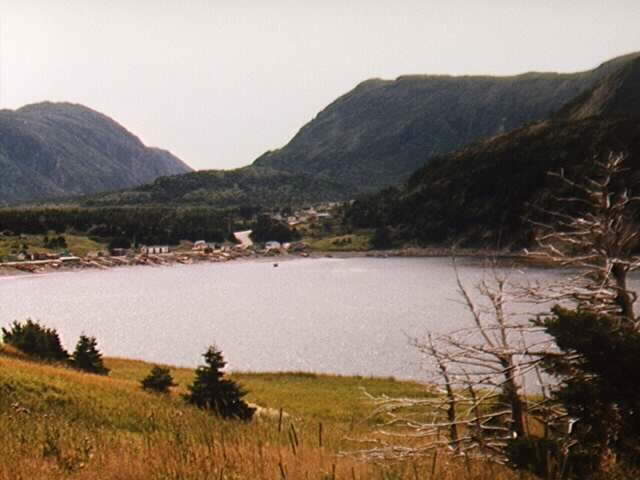
One of three fishing harbours within the community of Lark Harbour, Bottle Cove is small and sheltered from most winds. The buildings on the far side of the water are the sheds and slipways used by fishermen. This harbour and Littleport nearby were both occupied extensively, first by Basque and later by French fishermen, until the cancellation in 1904 of the treaty provisions which had given the French their historical fishing rights in Newfoundland waters for centuries.
9. Littleport Wharf

This small harbour was very popular among the French fishermen during the 1800s. Archdeacon Wix, an Anglican priest who visited here on 27 May 1835, reported to have seen in this small harbour "six French brigs moored, one a vessel of 350 tons". The harbour must have been quite full.
The boat in the foreground is a "dory", a flat-bottomed wooden boat of 16-20 feet, once used on the banking schooners and now the work boat of the Newfoundland inshore fishermen. Originally powered by oars, the modern dory has a stern adapted to accommodate an outboard motor. It is a stable boat and can skim over the water at quite high speed. The model seen here is widely known as a "Lark Harbour dory".
10. Keeping a boat "shipshape and in Bristol fashion"
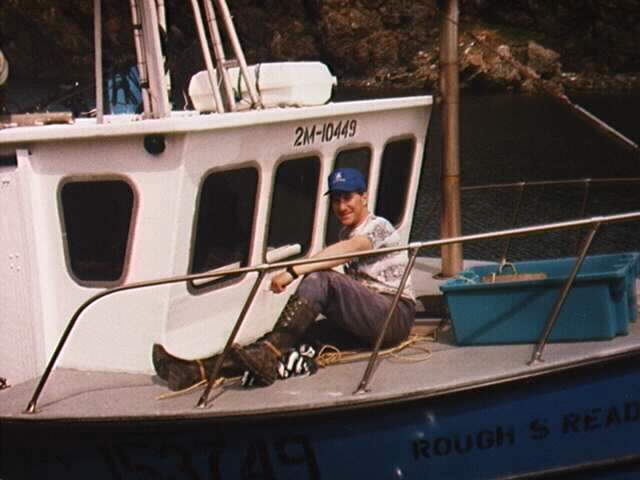
Even when boats are not in use, they must be kept in good order and protected from the elements. This one receives a coat of paint to brighten up her fibreglass exterior before she embarks on the halibut fishery.
11. Where are the Fish?

In early August, colourful dories drawn up on the slipway give the lie to a prosperous fishing community. Many of these boats may never again be used for commercial fishing as there has been a moratorium on the catching of codfish for the past four years and numbers of fishermen have surrendered their commercial fishing licences to look for alternative employment. This sad state of affairs results from a variety of factors whose exact relationships and effects are unknown to fishermen and scientists alike. Among these factors are overfishing, climatic and oceanic changes, pollution, and other environmental factors caused by human activity. When the fishery may resume, if ever, is also uncertain. In the meantime, rural Newfoundland communities like Lark Harbour are suffering economic hardships often resulting in poverty, social difficulties, and even depopulation, as those once employed in the industry leave the province to seek employment in mainland cities. As late as summer 1998, there appears to be little fresh hope for the fishery.
E-mail me with any comments or suggestions, and thanks for visiting.
Text and pictures © 1997, Stuart L Harvey, Lark Harbour, Newfoundland, Canada