 The "Matthew" visits Lark Harbour
The Matthew visits Lark Harbour, 23 July 1997
1. The Matthew in Lark Harbour
 There is no record that the Matthew ever visited the west coast of Newfoundland in 1497, but in 1997 this is the sight that met the eyes of those who went down to Lark Harbour wharf at 6am on Wednesday 23 July. The Matthew, skippered by Captain David Alan-Williams, had fired her cannon and aroused everyone. And there she stood in the grey light of early morning, this beautiful replica of Giovanni Caboto's medieval caravel, her sails hanging loose in the still air. One small boy remarked that she looked like a pirate ship!
2. A Closer Look at the Matthew

With an overall length of only 73 feet, a displacement of 50 tons, and a draft of 6 feet, Giovanni Caboto's little ship, with a crew of 19, crossed the Atlantic Ocean from Bristol to Newfoundland in 1497, taking just over seven weeks. The replica, also with a crew of 19, made her voyage in similar time. The ship was researched and designed by Colin Mudie, a British naval architect. Twenty-six oak trees provided the timber for the hull, and a 75-foot Douglas fir was the mainmast. The decks were of Douglas pine, while other wooden parts were made of larch. Some fittings of steel, and some of aluminum bronze, were used in place of the iron ones of the original in order to comply with modern safety standards. The caravel is also fitted very unobtrusively with two propellers driven hydraulically by a 200hp diesel engine, and to enable her to cope with today's busy seaways she carries a state-of-the-art navigational system.
3. Presentation of James Cook's Chart
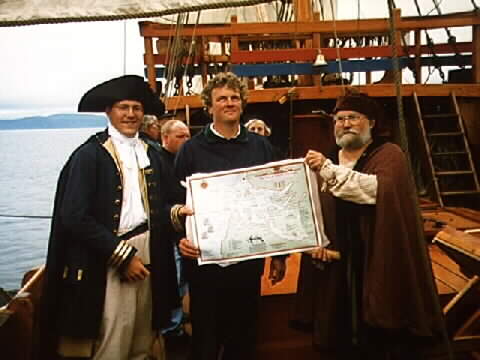
To welcome the Matthew and her crew into our Bay, the citizens of Lark Harbour and York Harbour presented Captain Alan-Williams with a copy of a chart of James Cook, who spent the summer of 1767 surveying the Bay of Islands for the British Admiralty. In this picture, left to right, are: Captain James Cook (Matthew Sheppard), Captain David Alan-Williams, and John Cabot (Clar Barnes) on the main deck of the Matthew.
4. At the Helm of the Matthew
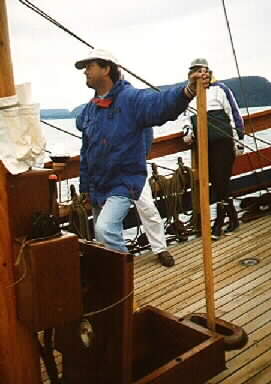
Every effort was made to ensure authenticity in the building of this replica, even though this frequently meant using marine technology that had long become obsolete. The steering mechanism is one such example. In the 1400s ships did not have a helmwheel such as we expect to see on modern vessels. Instead, steering was fully manual, without the gearing assistance that a helmwheel can provide. A pole passed down through the afterdeck and moved the tiller and large rudder by means of a block and tackle pulley arrangement. In heavy weather it took two or more men to steer the ship, even with the aid of ropes to dampen the movement of the mechanism, although the vessel was quite responsive to helm movements. The helmsman stood on the afterdeck, completely exposed to the elements at all times.
5. In the Galley of the Matthew
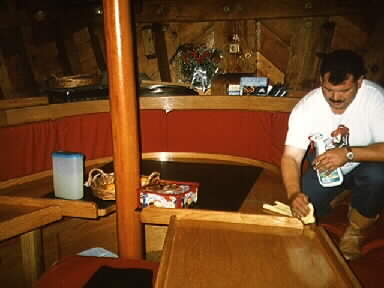
The ship's cook cleans up after breakfast. The galley of the Matthew is basically as it would have been in Caboto's day, except that modern equipment has been used to comply with safety requirements: in place of a wood or coal stove there is a propane cooking range. Space is rather limited, but in the replica conditions looked surprisingly comfortable.
6. "Ship-shape and Bristol fashion"

The Matthew is no exception to the idea that a good ship is a clean ship, and each day the decks, hatch tops, rails, and companionways were washed and scrubbed, even if they didn't seem to need it! The crew, mostly volunteers, turned to with willing hands and manned the brushes and buckets, down on their knees if necessary.
7. Ancient Rigging
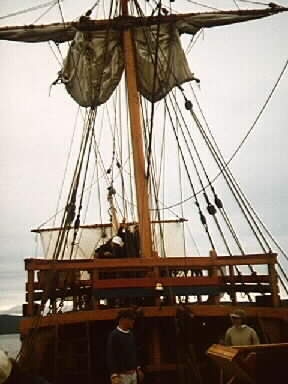
Unlike modern sailing ships which carry their sails furled downwards to the spar, in the heyday of the caravel the sails were furled to the top spar. This necessitated the lowering of the spar for furling, and then the laborious effort of raising it again, with the additional weight of the sail, back to its position near the top of the mast, as can be seen in this shot of the foremast of the Matthew. This ship has three masts, the fore and aft ones each carrying a single sail, while the mainmast has two, the big mainsail, and a small one set from the crow's nest; one more on the bowsprit makes the complement of five sails. She carries a total of 2,360 square feet of canvas.
8. Leaving Lark Harbour
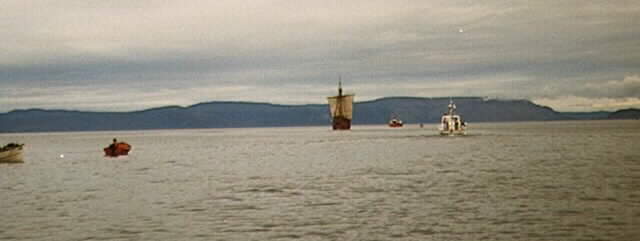
Just before 7am the Matthew slowly began to move and resumed her voyage to be at Corner Brook for noon. Escorted by a flotilla of small boats, she sailed out into the misty greyness of the Bay of Islands.
Information about the Matthew obtained from
Matthew, the replica of John Cabot's square-rigged caravel in which he discovered his 'New Founde Landes'
by Steve Martin & Colin Sanger, published by Godrevy Publications, 1996.Pictures and Text © 1997, Stuart L Harvey, Lark Harbour.
Please e-mail me with any comments about this webpage.