



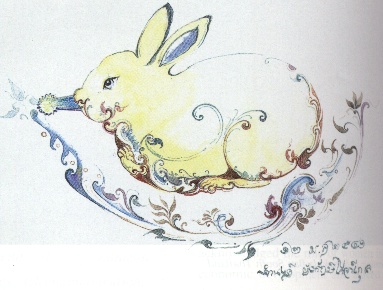
The rabbit grater or Kratai Kut or Lek-Kut ( Iron grater ) is an instrument used for grating coconut. Some folks call it Kratai-Kut . The rabbit grater may have gotten its name from the fact that the teeth of the grater has a long shape resembling rabbit's teeth. In addition, the grater is attached to a wood on which the person using the grater sits, and the wood is more often constructed in the shape of a rabbit. In the old days, coconut milk was extracted by using a spoon made from coconut shell that will grate the coconut into fine strips. In some places, bamboo sticks with teeth cut into them woukd be used to grate the coconut. It was not until metals were introduced into the household that a thin sheet of metal cut in a curvy shape with shape "teeth" called "rabbit's teeth" were attached to the wood carved of animal shape. Grating lightly will give finer coconut strips, they make it easier to extract the milks, as well as providing volume. It is never advisable to providing volume. It is never advisable to grate coconuts long before its use because when the moisture evaporates, less milk is extracted, but also, grated coconut left for a long time gives off a foul smell. nowadays, rabbits graters losing their popularity because mechanical tools have replaced them and villagers today have less time carving animal shapes. They now use metal sheets to make their graters. |
 |
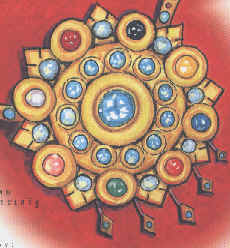
Nine Precious Gemstones In Thai, "Manee-Nopparattana" refers to the nine precious gemstones traditionally believed among Thai people to be most auspicious. In this case, the nine refers to the diamond, ruby, emerald, topaz, garnet, sapphire,pearl,zircon and green gem. These gemstones not only serve as beautiful accessories and indications of social status for the wearer ; it is believed they also have the power to augment the fortune of the owner in terms of wealth, safety and longevity. Precious gemstones remain popular among Thai contemporaries who choose them according to the date, month and year of birth to reinforce good fortune in their lives. They bring satisfaction to the owners and protection to the wearers and people close to them. It is also a popular practice among owners of precious gemstones to use the nine gemstones as decoration for a single ornament to give absolute assurance of good fortune ahead. |
|
Nam Op Thai , or Thai perfume came into existence during the Ayutthaya Period (1350-1767). In those days , it was a part of everyday Thai life , when it was popularly used to perfume oneself to relieve the heat , and keep oneself ingood odor all day. Nam OP Thai is light yellow in color , and translucent with the sweet odor in the Thai style. Gennerally , this kind of scented liquid has been produced by the people in the central region of Thailand for household use , or as a souvenir for close relative and friends. Bottles of Nam Op Thai are also available across the country. It is often made from the scents of such spices as benzoin , borneo camphor and sandalwood. Also , frequently used are sweet smelling flowers such as Lamduan or Melodorum , Chan Kapho , Kradangnga , and , in particular , Chommanat or valaris. The mixture of Nam Op Thai and perfurmed powder can be applied to both faces and bodies. It can relieve irritation on the skin , especially that of children. When mixed with powdered rice , it can be used to ease itches and inflammation resulting from allergies. Moreover , Nam Op Thai is used as an offering in various rites and rituals such as the ceremonies of Tham Khwan Khao and Tham Khwan Khao and Tham Khwan Mmae Phosop where its use is to give strength to the rice crop , and to worship the Rice Mother , respectively. Some drops of Nam Op Thai are popularly used to make scented water to sprinkle onto Buddha images , monks and older persons on various occasions. According to Thai traditions , Nam Op Thai is also mixed with perfumed powder to anoint a person , an animal or an object on certain auspicious occasions. |
|
|
Thick white smoke rises from the huge
joss-stick holder. The piercing sounds of traditional xylophones, gongs, and
cymbals keep pace with the dancers who sway in front of the divine
"Swayampu." In this milieu, the dancers are the mediators between man and
divinity. Offerings from the pitiful, in this confused world, go to "Pachabordee," who is particularly fond of the dance, despite its lack of cogerence. Those offering thanksgiving pay little heed to this incoherence; their main concern is to ensure the hired dancers perform, sing, and dance in the act of thanksgiving. At dawn, the dancers dress in dance costumes. Rest comes late at night after people retire. This dose not require formal training; just a will to memorize the poses and develop the skill that enables them to help relieve the suffering of mortal humans in the intercession for divine beneficence. |
|
Traditional
Thai New Year, or "Songkran," is observed each April 13 with celebrations
usually lasting for three days.
|
|
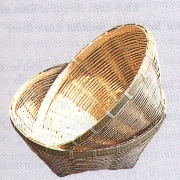
| Krachat is made of bamboo stalks and rattan stems. It is short and cylindrical in-shape with round mouth. The bottom is shallow in square shape. In the old days, Krachat was popularly made shallow but now, they are made deeper. Krachat is for storing dried items. It is bommanly carried on the hop oe on a pole. |
|
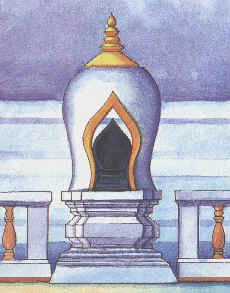
Stones marking the boundary of a Buddhist religious community, reserved for common religious activities, are found at temples or Buddhist-related ancient sites.Known as sema stones, and built around a temple, these boundary-stones come in different shapes depending on design preferences at different periods. They can be slabs or bars of such varying shapes, such as bell-shaped, square slabs and octagonal stone bars. The designs featured on the sema stones by the craftsmen vary from Thai designs to Buddha images, or the history of the Buddha, to the stories of the ten incarnations of the Buddha. While of them are simply slabs of boundary-stones, others are smooth bars with no specific motif. Contemporary sema stones are chiseled slabs of stone, with a broad and arched top that gradually tapers into a triangular shape. The sema narrows towards the center and expands again at the bottom. The Dhamma wheel motif is usually engraved on the top half of the stone slab.
|
|
A painting can be a pivture painted with pigments. or a drawing with pigments as the essential element to creat an illustration. In paintings, to used natural colors or creat new ones In the past, traditional Thai painter on their faith in Buddhism, intending to pass on the story of Buddhism and their own thought and feeling about regition. The makeup of traditional Thai paintings , as a resuit, were often related to buddhism, such as the stories of the past lives of the Lord Buddha. They may even involve stories from Thai literature ans folk tales reflecting traditional beliefs and lifestyle. The belief is that oldest traditional Thai painting came into existence in the early 13th century or middleof the 14th centurt. The form of Thai painting developsed continously and reached its peak in the early part of the 17th century during the Ayutthaya Period. The technique for traditional Thai painting spread to Phetchaburi City with the creation of more colorful paintings. Those recognized for their magnificence and delicateness include murals at What Koh Khew Suttharam, Wat Yai Suwannaram and Wat Mahathat Varavihan in Phetchaburi. Considered masterpieces oof Thai art are the mural paintings from the Ayutthaya Period at Wat Koh Keaw Suttharam and Wat Yai Suwannaram. |
|
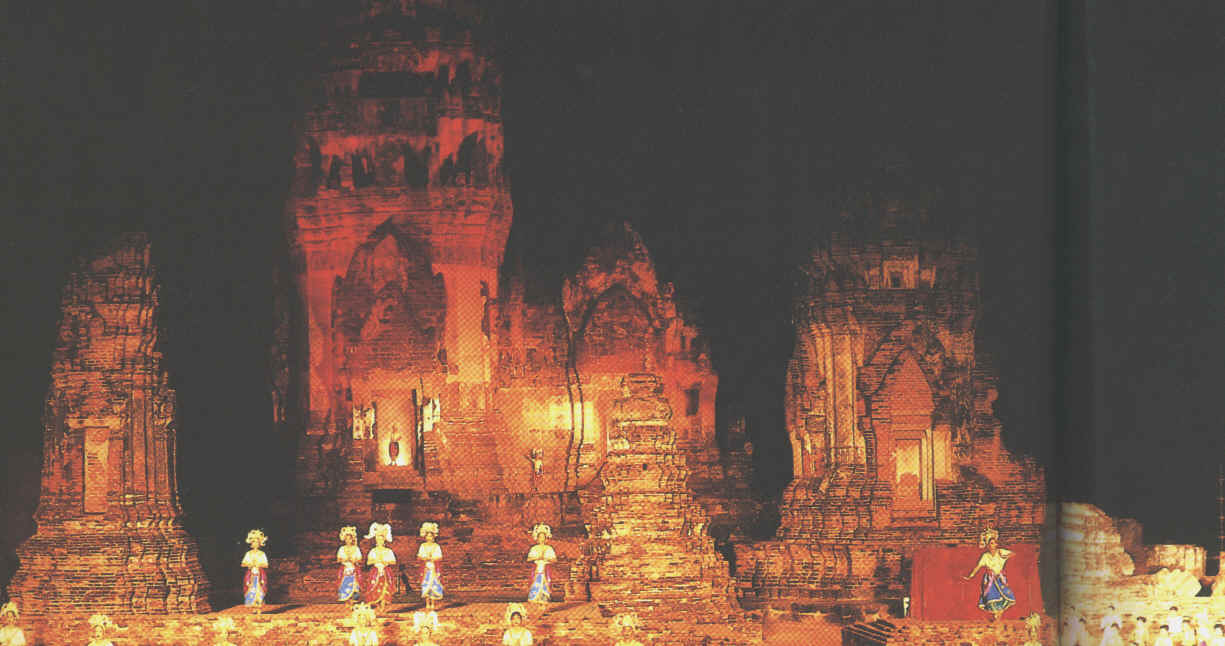
Lavoh, Sriburi, city of grandeur, is a ligh and sound presentation at the Age of King Narai the Great Fair, to commemorate the benevolence of King Narai the Great towards Lopburi and the rest of the country. In addition to a ceremony paying homage to the spirit of the late King Narai , Other plays are planned and a procession featuring dress of the Ayutthaya Period and lanterns that once adorned the palace of King Narai the great. The whole presentation is an account of the history of Lopburi displayed against the ornately decorated backdrop of Wat Phra Srirattana Mahadhat in Lopburi More importantly, resident adults and children add variety and flavor to the Fair by dressing in traditional costumes as a signof gratitude to the king who founded their city An anual event, the light and sound presentation is dividted to Lavoh culture and civilization inherited for millrnia The second act feature story oa Queen Chammadevi, deauther of the King of Lavabura who, at the invitation of hermit Wasudhep founed the city of Haripunchchai |
 |
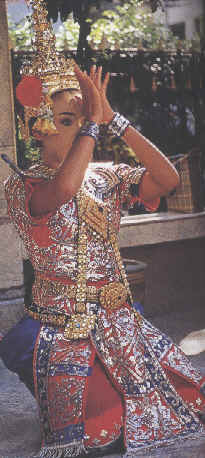
Ballads that are normally used in the accompaniment of traditional Thai dance as the prelude to stage performances normally direct their primary attention to the beautiful and delicate attire of the performers. This very cultural manifestation reveals much about the attitude of the Thai people towards the way they dress themselves. Traditionally, Thai people wove their own cloth, color-eyed it and decorated it with exquisite designs. Embroidery is another way they used to embellish their cloth. Because embroidery is a very fine craft, it requires a lot of time to create a piece of cloth with exquisite designs. For such a piece of embroidery, therefore, it implies that the cloth is designated for a very specific purpose, a special occasion, an important person or an exceptional case. Sometime, an embroidered design telling a story is used as a home decorative item : Nang Wanthong, is one of the Thai literatures, Khun Chang , Khun Phaen, also created such a piece of embroidery for the same purpose. The cloth used to wrap the Buddhist scriptures, and the ecclesiastic fan containing refined stitches of embroidery presented to monks at an auspicious merit-making occasion such as an anniversary merit-making ceremony are examples of embroidery created for specific purpose. Embroidered works for important people can be seen in those used by members of the Royal family, These embroidered cloths are normally rare pieces of work. especially the shawls used by court ladies, which are embroidered using gold and silver threads. And more than just a matter of aesthetics, they were occasionally gifts given to members of the Royal family as a sign of official ranking. These exquisite designs would be quickly reproduced as costumes for traditional Thai stage performances featuring stories of the royal court. Authors of these “plays” normally devote part of the narratives to the exquisite details of the costume almost every time the “star” appears with the costume in a main scene. As already described, the dancer will dance to the lyrics of the song or ballads such as “Chom Talad” (visiting the market” or “Song Thon.” Embroidery is purely a feminine thing. Court ladies, for instance, were taught the arts of cooking, floral arrangement and embroidery, a value similar to that of the contemporaries who send their children to ballet or piano classes. Except in cases where those doing the embroideries are capable of creating their own designs, designs for embroidery are normally handled specifically by designers. Materials used in embroidery vary. Some of the major materials such as silver and gold threads, sequins and beads were once so rare that they had to be imported from countries like Persia and India. However, some people, because of their artistic inclination, develop their own materials using things readily available from their surrounding like peek malang tab (bupestris wings ) and colorful gemstones. The process of embroidery starts with the design on a piece of paper. Once this is done, color chalk is used to trace the design before the chalked traces are transferred onto the cloth. The stitching then starts following the design on the cloth using, in combination of threads, materials such as sequins. Embroidered cloth is preciously guarded to protect its delicate materials, especially the threads, sequins or anything metallic. As a result, they are rarely washed. However, admirers of delicately embroidered cloth can feel its magic and the dedication behind it whenever it is taken out of the closet. The amazement and appreciation they engender is genuine. This author, for example, once came across an exquisitely embroidered pillowcase in an obscure corner of Chao Mae Larn pavilion. Moved by an unknown force, this author uncovered it and, having unfolded it realized the exquisiteness of the design. This pillowcase is today safely guarded, and has served as prototype to other adjusted designs for equally wonderful pieces of embroidery, such as is shown in this illustration.
|
|
The multi-purposed loincloth, called “pha-khao-ma”, has been closely associated with the Thai people since the olden days, and is representative of Thai folk wisdom. The pha-khao-ma is truly a multi-functional piece of material used by persons of all ages and either gender. In the olden days, this loincloth was the first piece of material to receive the newborn. Sometimes, it was wrapped around the baby as a blank of sorts. The pha-khao-ma can also substitute for bay’s cot; people tie its ends to two trees, creating a hammock that is ready to lull the little baby to sleep. While busy working, mothers keep their babies protected and nearby by holding the babies next to their chests with the pha-khao-ma. As the baby grows older, the loincloth becomes his/her play toy Depending on the imaginative power of the toddler, the pha-khao-ma can become a ball, can be used to cover the eyes in a game of hide- and-seek, or used in the “hitting-the-kerosene-can” game. Thai males use the pha-khao-ma to substitute for belts. Sometimes they also use is as another garment placed across the shoulder or around the neck when they leave home. To help protect them from the glaring sun, they will sometimes wrap the pha-khao-ma around their heads. Occasionally, it is used to carry personal effects or as a body towel. Thai females, too, find functional purposes for the pha-khao-ma. In Thai rural areas, it is still a practice for females to use the pha-khao-ma as a substitute for a brassiere or as a bathing sarong. Moreover, a pha-khao-ma can make a wonderful gift for our senior citizens on all occasions. It is an impressive Thai souvenir that is both useful and not too expensive. |
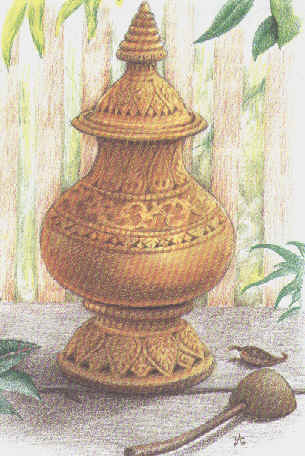
Thai people, in the old days, usually made their household utensils from readily available materials using simple designs. For example, Thai earthenware, ( historically clay-based), and the art of making household items, like the water-pot, has been handed down over each generation. Even today, the younger generation continues to make earthenware utensils, like water-pots, for modern-day usage. Traditionally a redbrick color, the water-pot was one-foot in height, and one-foot at the width of its girth. Used to store drinking water, because clay keeps water fresh and cool, many water-pots ( with coconut water ladles) appeared outside the front gates of Thai houses for generations. House owners encouraged passers-by to take a ladle of water as they passed by the house – a kindness reflecting the thougtulness and generosity of the Thai people. The shape of pots differed from district to district, but most pots usually had a wide girth with a narrow top and bottom, and a lid to keep the water cool and clean tasting. Although used for specific purposes, it was usual to find pots decorated with beautiful patterns with similar treatment to the handles of ladles.
|
|