
 |
The Position of the Sculptures | |
|
The Metopes 447-442 BC | |
|
||
|
||
|
||
|
||
|

The Position of the Sculptures
The Parthenon was unusual in the richness of its decoration. The amount of sculpture that adorned its exterior was unparalleled in the Greek world.
Pediments were often filled with sculptures. Since the Parthenon had eight columns at its ends, like an Ionian dipteral temple, the space for pedimental sculptures was abnormally wide and it contained very many extremely large figures. These were carved fully in the round as if they were freestanding statues.
Many Doric buildings had carved metopes. Only if the building was small, like the tiny treasury of the Athenians, built at Delphi after the battle of Marathon, was it likely that metopes on all four sides would be carved; most larger buildings had only a few metopes sculpted. On the Parthenon, however, all ninety-two metopes were decorated with sculptures carved in high relief.
Normally, a Doric temple would have no continuous frieze. Not so the Parthenon. The frieze, carved in low relief, not only decorated the area over the porches, but also ran along the top of the side walls of the naos. Like the eight columns in front and at the back, the frieze was an unexpected Ionic touch introduced into a mainly Doric building.
The sculptures were all placed high up on the temple, but they were made easier to understand at a distance by the addition of color which picked out hair, eyes and clothing, and helped the figures to stand out against a painted background. Pieces of bronze were attached to the stone to indicate the bridles and reins of horses and other such details.

The sculptures adorning the Parthenon were more than mere decoration. They all had a meaning. The carved metopes, for instance, portrayed mythical battles, a different one on each side. Those, on the south side showed the conflict of the Lapiths, legendary men who were supposed to have lived in northern Greece, with the centaurs, monsters who were part man and part horse.
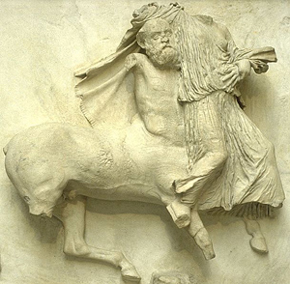 The
story was that the Lapiths were neighbors of the centaurs and when the Lapith
kink got married, he invited the centaurs to the wedding as a matter of common
courtesy. At first all went well, but after a while the centaurs got drunk and
misbehaved, attacking the women and breaking the place up. After a violent fight,
the Lapiths beat the centaurs and drove them from their country.
The
story was that the Lapiths were neighbors of the centaurs and when the Lapith
kink got married, he invited the centaurs to the wedding as a matter of common
courtesy. At first all went well, but after a while the centaurs got drunk and
misbehaved, attacking the women and breaking the place up. After a violent fight,
the Lapiths beat the centaurs and drove them from their country.
The Greeks often show myths as examples of human experience. The story of the Lapiths and centaurs would have suggested to them that the centaurs were ill-mannered brutes and the Lapiths who defeated them were civilized and brave. They would have wondered if this story could in some way apply to their own lives or recent history. “The centaurs”, they might have thought, “in their wild and barbaric actions behaved very much like the Persians who so rudely invaded us, their neighbors”. The Lapiths victory over the centaurs would then seem to them like a mythological parallel to the Greek’s recent victory over the Persians.
The other stories illustrated in the metopes, Amazons attacking Athenians, god fighting giants, and the Trojan was, could also, with a little though, be seen in this light, as mythical allegories of the Persian wars.
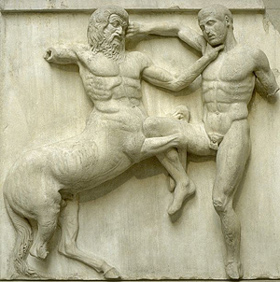 Once
the subjects had been selected, sculptors had to be found to carve the representations,
and this was a matter of some urgency. The metopes had to be ready to be slipped
into place once the peristyle had been erected, so that work could continue
above them. They seem to have been in position by 442 BC.
Once
the subjects had been selected, sculptors had to be found to carve the representations,
and this was a matter of some urgency. The metopes had to be ready to be slipped
into place once the peristyle had been erected, so that work could continue
above them. They seem to have been in position by 442 BC.
The carving of ninety-two metopes, each about 1.3 meters (4 feet 3 inches) square, in something under five years was no small undertaking, and sculptors were hurriedly collected from all over Greece. Some were better than others. There was no time to train them all to reach the same standards or the same artistic ideals.
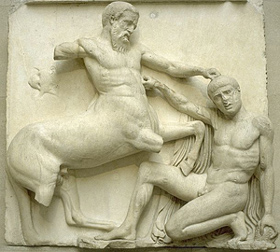 The
sculptors differed markedly from one another in their interpretations of the
story. One sculptor carved a centaur with a crude and barbaric face, almost
like a mask, while another portrayed a centaur with so kindly an expression
that he could be imagined as a loving grandfather.
The
sculptors differed markedly from one another in their interpretations of the
story. One sculptor carved a centaur with a crude and barbaric face, almost
like a mask, while another portrayed a centaur with so kindly an expression
that he could be imagined as a loving grandfather.
The sculptors also differed in their ability and the quality of their carvings. One of the best of them worked on the metope at the far western and of the south side of Parthenon. This metope is both beautifully designed and beautifully executed. Since it is still in place of the building, one can appreciate the wonderful animation that is given to the figures by the brilliant Athenian sunlight, and the vitality and humanity that these sculptures impart to the architecture.
The frieze was the next part of the architectural sculpture to be completed.
In is worthy remembering that the frieze could in fact be seen only through the screen of the columns of the peristyle, an important point for the designer.
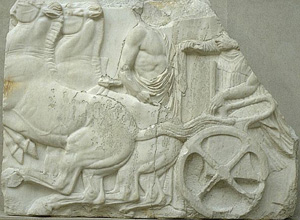
The design of the frieze was a great challenge. It was an immensely long ribbon a mere 1 meter (3 feet 3 inches) high and almost 160 meters (525 feet) long. The theme chosen for the frieze was a procession, forming up in the west porch and proceeding along both the north and south sides of the temple towards the east, where its two branches converged. This was the front of the temple.
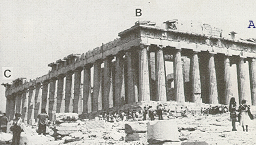 In
the plan, the direction of the procession seems to change rather abruity at
the southwest corner (A), which might be expected to give an awkward visual
effect, but in fact it was very carefully calculated in terms of how a visitor
would actually approach the Parthenon. The visitor first saw the Parthenon from
the northwest corner; (B)The whole west side could be taken in at a glance (A-B).
he would normally walk along the north side to the front of the temple (B-C),
keeping pace with the sculptured procession. There was little temptation to
walk along the south, since the space between the temple and the edge of the
acropolis, from which there was a sheer drop, was relatively narrow.
In
the plan, the direction of the procession seems to change rather abruity at
the southwest corner (A), which might be expected to give an awkward visual
effect, but in fact it was very carefully calculated in terms of how a visitor
would actually approach the Parthenon. The visitor first saw the Parthenon from
the northwest corner; (B)The whole west side could be taken in at a glance (A-B).
he would normally walk along the north side to the front of the temple (B-C),
keeping pace with the sculptured procession. There was little temptation to
walk along the south, since the space between the temple and the edge of the
acropolis, from which there was a sheer drop, was relatively narrow.
 Visual
logic rather than abstract theory dictated the design of the frieze.
Visual
logic rather than abstract theory dictated the design of the frieze.
The procession included a large number of horsemen, some men in chariots, and youths carrying trays or water jars or conducting animals to sacrifice. At the east, moving very slowly, girls with offering bowls converged on an assembly of gods and heroes. In the very center an official and his assistant are handling a large folded cloth, perhaps the peplos for the statue of Athena.
The procession must have reminded the Athenians of the Great Panathenaic procession in honor of Athena, which regularly moved side by side with the sculpted frieze. It is unlikely, however, that the decoration of a temple at this time would merely represent a common event in the lives of ordinary people.
No surviving ancient account so much as mentions the frieze, so it is up to modern scholars to ponder what it might have meant. The most appealing suggestion is that the frieze represents the last celebration of the Great Panathenaia in which the men who later died at Marathon participated. Within two months of the festival they gave their lives to preserve Athena’ city. An ingenious counting of the men portrayed, excluding the charioteers but including unmounted youths, arrives at the number 192, the very number of those who fell at Marathon. According to this theory the gods are assembled to receive the heroic dead into the realm of immortal fame. This could explain why they all turn their attention towards the approaching processions while seeming to ignore the central scene with the peplos.
The solemnity of the procession and the unique honors that were accorded to the men who died at Marathon support this interpretation. We remember that the Parthenon itself had a special connection with Marathon, for it stood on the site of a building that had been begun just after the battle to commemorate the victory.
The idea of a sculpted procession accompanying the route of a real one has no parallel in Greece, but it has in Persia. There, in the great palace at Persepolis built between 500 and 460 BC, processions were carved to line the stairways and passages traversed by the participants in the traditional annual tribute-bearing processions.
Since the time of the Persian wars Athenian ambassadors and many other famous Greeks had visited Persia. Furthermore the sculptors who worked at Persepolis, under Persian orders and in Persian style, were Greeks. Reports of the great friezes at Persepolis had certainly reached the Athenians. Could their own unprecedented frieze on the Parthenon have been an artistic and ideological reply to the creation of their old enemy?
The screen of columns behind which the frieze was seen was used on the north and the south sides, and to some extent on the west as a foil to the movement of the procession: the steady, even march of the columns contrasting with the spurts of activity and the solemn slowing down of horses, chariots, and men on foot. On the east, the front of the temple, the columns framed significant or striking groups. Thus between the central columns was seen the ritual with the peplos flanked by the most important gods: Zeus with his wife Hera on the left, and Athena herself with the craftsmen god Hephaistos, the two great patrons of Athenian prosperity, on the right.
Why the Sculptures are so Beautiful?
Phidias, the director of works and sculptor of the statue inside the temple, was probably also in charge of the sculptures decorating outside. By the time the frieze was carved he had succeeded in impressing his ideas on the many sculptors he had gathered together and who had worked on the metopes. The carving of the frieze is generally of higher quality and the style is more uniform than on the metopes. For all that, we may still be wondering why this sculptures, battered as they are, having lost all their colors and very often their heads and arms as well, are so admired. Two examples may suggest the reasons.
 First,
if we look at the seated gods that were carved around 525 BC for a small frieze
at Delphi. They are very charming, and represent some of the finest work done
by Greek sculptors in the century before the Parthenon was built. We can see
how the poses of the figures are repeated and how the raised arms of the two
at the left produce a repeated rhythm. Notice the delightful identical patterns
that are used over and over again in the clothing and the hair.
First,
if we look at the seated gods that were carved around 525 BC for a small frieze
at Delphi. They are very charming, and represent some of the finest work done
by Greek sculptors in the century before the Parthenon was built. We can see
how the poses of the figures are repeated and how the raised arms of the two
at the left produce a repeated rhythm. Notice the delightful identical patterns
that are used over and over again in the clothing and the hair.
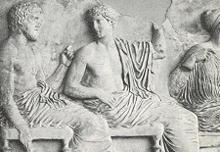 Now
if we look at the three gods sculpted on the Parthenon frieze, we can see how
natural and relaxed they appear. How casually they seem to sit, how varied are
the folds of their clothing and the locks of their hair. It all looks so simply
and easy, and yet it has been meticulously though out. Each figure’s pose is
carefully distinguished from that of its neighbor. The first sits sideways,
nearly in profile, with his head in profile; the next sits in a three-quarter
front view with his head in a three-quarter front view; the third sits in a
three-quarter front view, too, but with her head in profile. Though differentiated,
the figures are also united. Notice, for instance, the lower arms of the three
figures: the first drops, the second is lifted halfway up, the third is bent
right up, they are like film stills of one continuous movement.
Now
if we look at the three gods sculpted on the Parthenon frieze, we can see how
natural and relaxed they appear. How casually they seem to sit, how varied are
the folds of their clothing and the locks of their hair. It all looks so simply
and easy, and yet it has been meticulously though out. Each figure’s pose is
carefully distinguished from that of its neighbor. The first sits sideways,
nearly in profile, with his head in profile; the next sits in a three-quarter
front view with his head in a three-quarter front view; the third sits in a
three-quarter front view, too, but with her head in profile. Though differentiated,
the figures are also united. Notice, for instance, the lower arms of the three
figures: the first drops, the second is lifted halfway up, the third is bent
right up, they are like film stills of one continuous movement.
 On
the other hand, we can compare the almost contemporary carving of four men in
the frieze at Persopolis with the four water carriers from the Parthenon frieze.
The carving at Persepolis is very fine, but the figures are a bit dull and repetitive.
There is a sameness about them that even affects the shape of the spaces between
them. How different are the youths from the Parthenon frieze, each of whom is
slightly but perceptibly unlike the others.
On
the other hand, we can compare the almost contemporary carving of four men in
the frieze at Persopolis with the four water carriers from the Parthenon frieze.
The carving at Persepolis is very fine, but the figures are a bit dull and repetitive.
There is a sameness about them that even affects the shape of the spaces between
them. How different are the youths from the Parthenon frieze, each of whom is
slightly but perceptibly unlike the others.
As we have seen, the Parthenon frieze may have been the Athenians response to the Persepolis frieze of their former great enemy, Persia. While the Persians show the regimentation of subject peoples paying tribute to a powerful king, the Athenians show the easy self-imposed discipline of free citizens freely offering homage not to a man, but to their goddess.
The pediments were the last part of the sculptured decoration to be finished. They could be carved at leisure on the ground since tackles were used to lift them into place, and the roofing of the temple did not depend on their being in position. Final payment was made for them in 432 BC, so they must have been completed by them. Phidias seems to have left Athens after he finished making the great statue of Athena in 438 BC. It was just at this time that serious work began on the pediments, so that although Phidias may have designed them, their execution must have been largely independent of him.
The west pediment, though at the back of the temple, was the first one that we saw as we approached the Parthenon. It showed the contest of Athena and Poseidon for the patronage of Athens.
The east pediment, at the front, showed the astonishing birth of Athena. All the gods and goddesses were gathered for the occasion, just as they were gathered on the east side of the frieze within the porch to celebrate the anniversary of that occasion, Athena’s birthday.
Little is left of these two great compositions. A drawing made in the seventeenth century gives some hint of what the west pediment looked like then, but few of the statues shown have survived. Even by that time the whole center of the east pediment had already been lost, as we can see from another drawing by the same artist.
Modern scholars have tried to fill the gap and have made ingenious reconstructions of the center of the east pediment. Though some efforts look better than other, they are certainly all very far from what the original must have been like.
 Some
of the statues from near the corners are preserved in the British Museum. Three
goddesses, two seated and one lying down so that they will all fit confortably
under the slope of the pediment. The figures are huge, well over life-size.
Their bodies are clothed in loose drapery with many ridges that would catch
the light and make the forms beneath clear, even to a viewer standing far below.
Some
of the statues from near the corners are preserved in the British Museum. Three
goddesses, two seated and one lying down so that they will all fit confortably
under the slope of the pediment. The figures are huge, well over life-size.
Their bodies are clothed in loose drapery with many ridges that would catch
the light and make the forms beneath clear, even to a viewer standing far below.
The first woman sits facing front, the second turns a little to the side, a third reclines with her upper body turned a little to the side but her legs fully in profile. The progression from full front to full profile is accomplished in stages. The sculptor is working out in three dimensions something rather like the series of continuous movements we observed in the dropped, raised, and bent forearms of the gods on the frieze.
If we look at the back of these figures, we notice how differently the pliable cloth falls over the soft rounded bodies and over the hard angular seat. It is remarkable that such exquisite care was lavished on a part of the statues that was never supposed to be seen again once they were put in place.
The Celebrated Statue of Athena
 The
abundance and splendor of the sculptures that decorated the outside of the Parthenon
may well impress, but the art-lovers of antiquity seem hardly to have noticed
them. Neither the frieze nor the metopes are even mentioned by any Greek or
Roman writer whose works we have, and of the pediments no more is said that
what their subjects were. All enthusiasm was reserved for the wonderful statue
within.
The
abundance and splendor of the sculptures that decorated the outside of the Parthenon
may well impress, but the art-lovers of antiquity seem hardly to have noticed
them. Neither the frieze nor the metopes are even mentioned by any Greek or
Roman writer whose works we have, and of the pediments no more is said that
what their subjects were. All enthusiasm was reserved for the wonderful statue
within.
Phidias, who made it, was a great innovator in matters of interpretation, size and technique. His images of gods, lavishly covered in rich materials, were larger and more awe-inspiring than any that had been seen before.
The Athena in the Parthenon was about 10 meters (33 feet) tall; her face and arms and feet were veneered in ivory, her clothing thickly plated in gold, her eyes inset with precious stones. Statues made in this way, Phidias made another one for the temple of Zeus at Olympia, are called chryselephanteine. Of course the gold and ivory were only attached to the surface of the statue. The body, head and limbs were constructed on an armature, a sort if internal scaffolding, of wood, the hollow parts of which provided homes for families of mice.
Light in the naos came only from the door and the two windows flanking it at the east end. A visitor stepped out of the brilliant Greek sunshine into a darkened room. At the back of it stood the huge statue of Athena. The gold of her dress glimmered, the ivory of her skin glowed, the gems in her eyes flashed. There was a pool of water in front of the statue, to keep the humidity steady and so prevent the ivory from cracking, it must have caught the light and reflected the statue.
The peplos that was offered to Athena on the occasion of the great Panathenaia was not used to drape this statue. It was given to a much smaller, age-old image of the goddess made out of olivewood which was kept somewhere on the north side of the acropolis, in any case not in the Parthenon. The ancient, sacred olivewood statue was supposed to have fallen from heaven. It probably did not look very impressive; in fact it may have appeared rather crude. The Athena in the Parthenon was not that sortt of holy image of the goddess; it was, rather, rich thank-offering presented to her.
 The
statue was a gift to Athena, like an immense jewel; the Parthenon was built
to shelter and contain it. No altar for sacrifices was erected in front of the
Parthenon. The temple was apparently not thought of as a place of worship, but
as a sort of vast jewel box, a necessary part of the offering that was made
to the goddess. If that is understood, one can see why the ancient authors took
comparatively little notice of its external decoration and turned all their
attention to the costly and glorious dedication within.
The
statue was a gift to Athena, like an immense jewel; the Parthenon was built
to shelter and contain it. No altar for sacrifices was erected in front of the
Parthenon. The temple was apparently not thought of as a place of worship, but
as a sort of vast jewel box, a necessary part of the offering that was made
to the goddess. If that is understood, one can see why the ancient authors took
comparatively little notice of its external decoration and turned all their
attention to the costly and glorious dedication within.
The wooden core of the statue was easily damaged and we know of many repairs; a major reconstruction may have been necessary as early as the second century BC. By the end of the middle ages all traces of the statue had completely disappeared.
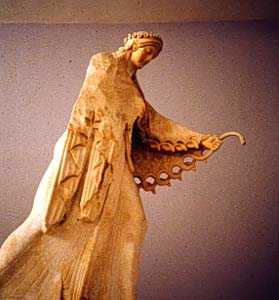
It is difficult to get any idea of what the Athena in the Parthenon actually looked like. We only have some rather long descriptions, they are mostly concerned with details of decoration, and some copies that were made, on a reduced scale, of stone. One of the earliest, largest, and handsomest of these is obviously a very free rendering. More literal copies were made later, some as souvenirs for the Romans, the tourists of antiquity. By and large they are depressingly ugly. They certainly do not convey an impression of what must have been the supreme glory of the Parthenon.
The Men who Made the Sculptures
Marble sculptors, like the stonemasons who were temple builders, had specialized skills that were only occasionally in demand. The lived itinerant lives, moving wherever work was to be found. Many of them even worked for the Persians at Persepolis.
The vast amount of sculpture needed for the decoration of the Parthenon, ninety-two figured metopes, nearly fifty over-life-size pedimental statues, and hundreds of men and animals carved on the frieze, drew sculptors to Athens like a magnet. The diversity of their backgrounds and training can be seen in the differences apparent in the carving of the metopes. The strong personality of Phidias had welded them together by the time they began working on the frieze. Differences in quality between one part of the frieze and another are not very marked.
The sculptors used iron tools similar to those employed by the stonemasons. Sometimes sculptors also worked as architects. It is easy to see why. We sometimes hear of families of sculptors. Obviously fathers were eager to pass their skill on to their sons.
A staff of specialists must have assisted Phidias with his work on the gold and ivory statue of Athena. Many of them probably accompanied Phidias when he left Athens to go and make another statue in the same technique at Olympia.
Once the pediments were finished, there was not so much work for marble sculptors to do in Athens. Some worked on the other temples that were being built, others kept busy carving gravestones. Most left, carrying their style and skill with them, diffusing the lessons learned from creating the sculpture of the Parthenon throughout the Greek-speaking world and even beyond.
Phidia’s strong personality, his genius as an artist, his friendship with Pericles and his ability as an organizer and director of work may have been very good for the Parthenon, but it did not make his own life easy. When political enemies wished to attack Pericles, they accused his friend Phidias of embezzling some of the gold intended for the statue. The charge was disproved, but it is significant that one of Phidias own workmen had been persuaded to level it at him. Jealously and discord must have often erupted among the sculptors who had been so hastily assembled. Yet in a mere fifteen years they were able to produce all the harmonious-seeming sculptures that decorated the Parthenon.
Top of the Page