|
|
| Title: |
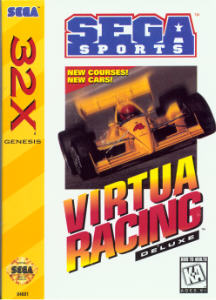
Virtua
Racing Deluxe |
| Released: |
1994 |
| Genre: |
Racing |
| Developer: |
Sega
Sports |
| Publisher: |
Sega
Sports |
| Regions: |
USA,
UK, Japan |
| Availability: |
Common |
|
The original Virtua
Racing was a revolutionary game in its day, the first completely
polygonal racer in a field of games that utilized scaling sprites to achieve
their pseudo-3d effects (Pole Position, Outrun.) Though it’s
very simplistic by modern standards, the gameplay is still as entertaining
as ever. Running off of Sega’s Model 1 arcade board, the arcade original
set a new standard in racing simulations with its incredibly tight control
and 3-D world. The 32x port is simply awesome and compares favorably with
the original, though the environments are made up of fewer polygons. This
is to be expected, as the Model 1 board is specifically geared towards
polygon calculations. Like all other Model 1 arcade games (Virtua
Fighter, Wing War), the original arcade Virtua Racing
was devoid of texture mapping (a process which adds a layer of bitmapped
"wallpaper" to a flat polygon to give it character and a more realistic
appearance.) The 32x was certainly capable of adding texture mapping to
the 3-D environment, leaving us to theorize that Sega wanted to keep the
game as close to the arcade as possible (the Saturn version didn't feature
texture mapping either.) The only thing missing is the arcade's analog
steering, a feature that was left out on the 32x since there were no analog
controllers available for the Genesis (the Saturn was the first Sega console
to utilize an analog controller.) The game generally compensates for the
loss of analog control with a progressive control scheme that works well
(the longer you press the control pad in one direction, the sharper the
turn.) Everything else is nearly arcade-perfect: the tracks, the multiple
views, the simple (yet funky) soundtrack and sound effects. There is a
bit of graphical pop-up, but it appears far in the distance and isn’t detrimental
to gameplay at all. The 32x version features 2 additional tracks not found
in the arcade parent, as well as two new cars (the stock car is great!)
Far and away the best racing game on the 32x, and one of the top games
overall.


|

|
|
|
Japanese Box
Art
|
European Box
Art
|
Promotional
Box Art
|
 |
The most expensive
Genesis game ever made, Virtua Racing
retailed for a whopping $90 when it was first released. It was the first
(and last) cartridge to feature the SVP (Special Virtual Processing) chip,
Sega's answer to the FX chip found in some Super Nintendo games such as
Doom and Star Fox. Closely related to the Hitachi
SH2 processors found in the 32x, the SVP chip boosted the processing power
of the Genesis, allowing it to display relatively complex polygonal models
that would have been impossible for the Genesis to process by itself. The
fuzzy graphics are a far cry from those of the original arcade parent,
but the game plays surprizingly well considering its humble origins. The
Genesis cart won't run on the 32x due to compatibility issues between the
SVP and SH2 processors. |
 |
|
 |
As expected, the Saturn
port of Virtua Racing is the
best of the three, boasting arcade-perfect visuals and optional analog
control. Sega added a host of new features, plus even more new tracks and
cars (give the go-cart a try!) Oddly enough, Sega once again decided not
to add any graphical enhancements for the Saturn version, nor did they
publish the game themselves. It was published in limited quantities by
Time-Warner. |
|
|
 |
Imitation may be the
sincerest form of flattery, but only if the imitator know what it's doing.
Atari had its heart in the right place when it tried to emulate
Daytona
with its own Checkered Flag
for the Atari Jaguar, and it almost worked. The polygonal graphics look
great, but the contol is absolutely atrocious. The game designers tried
something new with the control scheme and attempted to emulate analog control
with the digital pad. The longer you press down the directional pad, the
sharper the turn. Unfortunately, it simply doesn't work, rendering the
game virtually unplayable. |