 SODOM & GOMORRAH:
A Much Misunderstood Story

15 March 1998
Then the Lord said to Abraham, “There are terrible accusations against Sodom and Gomorrah, and their sin is very great. I must go down to find out whether or not the accusations which I have heard are true.” -- Genesis 18:20-21. “Terrible accusations?” By who? God traffics in rumors? “I must go down to find out” if they're true. Excuse me? God can't see that from where he is? “Their sin is very great.” But what is it? |
Was there really such a place?
Not counting Genesis, I find 16 Old Testament references to S & G. Most simply allude to the destruction while providing little if any detail about the actions that led up to it. In fact, as with this passage from Ezekiel, the books of Deuteronomy, Amos, Jeremiah, Lamentations and Zephania all say nothing about sex in regards to it:
Ezekiel portrays the sins of the two towns as inhospitality toward strangers -- contrary to important Hebrew law. He refers broadly to them committing "acts which God hates," but it certainly seems strange that he would list other such "acts" by name, yet leave out the homosexuality aspect if it were germane to the story.Ezekiel 16:48-50 "As surely as I am the living God," the Sovereign Lord says, "your sister Sodom and her villages never did the evil that you and your villages have done. She and her daughters were proud because they had plenty to eat and lived in peace and quiet, but they did not take care of the poor and the underprivileged. They were proud and stubborn and did the things that I hate, so I destroyed them, as you well know.
In the New Testament, Jude disagrees. In Jude 1:7, he suggests "sexual immorality and perversion," or in the King James translation, "giving themselves over to fornication," and "going after strange flesh" -- "strange flesh" being translated from the Greek "hetero sarkos," and very peculiar verbiage indeed. Much has been made of that and argued over, but for purposes of this discussion, I'll accept the contention of those who wish to infer from it an allusion to a sin of a sexual nature. It's important to note, however, that like the author of Genesis, Jude does not single out the men in that passage.
Peter is a trifle vague on the matter, referring to "immoral conduct of lawless people," (again important to note it's the generic "people," not just men) and "evil actions" in 2 Peter 2. Oddly, even Paul, who usually is the grand marshall of the anti-gay parade, contents himself with simply re-stating the words of Isaiah on the topic without additional comment in Romans 9:29.
So lo and behold -- this is one instance where we're going to have to read the story carefully and think for ourselves!
First of all, we need to understand that, as is so often the case with Biblical texts, the words "man," "men," and "mankind" can be used to represent both male and female. The book of Genesis is no exception. Genesis indicates the complement of citizens beleaguering the home of Lot was not comprised only of men, but rather, "all the people of the town:"
Genesis 19:4 But before they lay down, the men of the city, even the men of Sodom, compassed the house round, both old and young, all the people from every quarter.... [emphasis mine]
So everyone -- male and female -- is out there. That makes one wonder: Just how big do you suppose the population of that town (Sodom) was? Five thousand people, all storming around one house? Even if it were only a sparse five hundred people, it's still pretty far-fetched. But OK, we'll go with it nonetheless -- the entire town is out there.
The Hebrew verb "yada" (I have also seen it spelled "yadha") is at the core of this misunderstanding. It was translated as "to know" or "known," and depending on context, could indeed have connoted "known intimately," as in sex. But there are abundant other instances throughout the Bible where "yada" did not connote sex. Dr. Rembert Truluck, on his splendid and well-researched website www.truluck.com, claims to have found over 900 instances where "yada" was used in something other than a sexual context. Furthermore, there were the much more facile verbs "bo," meaning "to penetrate," and "yashav," "to lie with," which were used in other passages dealing with sex. Either of these words would certainly have been a much better one for the author of Genesis to employ if he wanted to be perfectly clear; as in "Bring these men out that we may 'bo' them."
What complicates this further is that in the late 16th/early 17th century, during the time of the King James Bible, the word "know" in the English language of that day had the same double meaning. But I emphasize double meaning. It certainly did not mean sex in every usage. The works of Shakespeare, also of that era, provide excellent examples of how the word was used both ways:
Much Ado About Nothing
Act 4, Scene 1
CLAUDIO: I know what you would say: if I have "known" her, You will say she did embrace me as a husband, And so extenuate the 'forehand sin....
In that instance, "known" was used to connote sex. But contrast it with:
Macbeth
Act 5, Scene 1
GENTLEWOMAN: It is an accustomed action with her, to seem thus washing her hands: I have "known" her continue in this a quarter of an hour.
To read a sexual connotation into that use of the word "know" would be lunacy!
You know the passage, I'm sure: “Bring these men out that we may [yada] know them.” And I'm sure you also know the passages detailing how Lot offers up his virgin daughters, explaining they have "never [yada] known men." Both words were indeed “yada” in the original Hebrew -- which is disappointing, but still not 100% conclusive. It certainly seems more sensible to take the first passage to mean, “bring these men out so we may know their identities!” But we'll stick with the sexual overtone for the sake of argument.
So let's run this scene:
Establishing shot: Camera pans back from small two bedroom bungalow in a middle class section, 123 Main Street, home of the ancient Ozzy and Harriet type, two-camel garage family named the Lots, in the anything-but-peaceful, buzzing metropolis of Sodom. On this dark and dreary night, XX-hundred people come storming up to the house, because they got wind of the fact there are two strange guys inside. Outside, the crowd pounds on the door, and the men (and only the men), in a loud voice, shout "send these men out that we may jump their bones!" Now mind you, the townsmen have never set eyes on these fellows, but sight-unseen all XX hundred of them want to have sex with the two of them? Which presupposes that every single man in Sodom is homosexual and desires sex with men? There's not one heterosexual guy in the whole town? And presumably the women will do what? Stand off to the side and passively watch this orgy? And just how many of these XX hundred Sodomite men will get a turn with one of these visitors? Don't you think they'd be good and dead after the first dozen or so forcible rapes? Anyhow... Next thing you know, Lot, the only "upright" man in this macabre spectacle, makes a startling and bizarre counter-offer: He'll turn over his virgin daughters to the evil band of rampaging homosexuals if they promise not to hurt his houseguests. Now I don't know about you, but I would lay down my own life for a "mere" neice or nephew in such a situation, let alone for my own daughters. What do some of you men who have children think of Lot's action?
But here, perhaps, is the most baffling piece of this entire puzzle -- a piece which just does not fit: If we are to accept the premise that this was a band of marauding homosexual men outside, of what possible use to them would Lot's FEMALE daughters be?
Nevertheless, let's keep going.
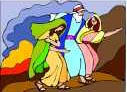 Next, the angels strike the crowd blind to facilitate a getaway for Lot's family. The town blows up (women and children included, even though they didn't partake of this orgy -- which never got any farther than the planning stage, by the way), Mrs. Lot turns into a pillar of salt (darn, I thought she was one of the good guys), and now it's Lot and the two daughters holed up in a cave on the outskirts of town. After what, maybe a day or two to assess their situation, the daughters leap to the ASTONISHING conclusion that all the men in the world are dead (which we know to be incorrect because Lot was Abraham's nephew, and we know at least Abraham was alive), so to perpetuate humanity they must have their father impregnate them. They get him drunk and he obliges.
Now hold on a cotton pickin' minute.
The getting drunk business makes it clear that incest was viewed as taboo then just as now, so Lot would not have done this with a clear head. (How scrambled the heads of the two daughters are is pretty clear -- after all, Ham only peeked at his dad Noah and look what happened to him!) So just how drunk are these gals going to have to get their father before he'll go along with this hare-brained scheme? Well, I would suggest Lot would have to be too standing-up-falling-down-crocked-to-the-eyeballs-plastered to even see straight. And you know what? I have serious trouble believing that somebody that drunk -- especially a man of Lot's age -- is going to be able to perform sexually in such a condition.
I have carefully pointed numerous times to the role of women in this story. Why, in historical terms, are only the men taking the rap here? In the entire Bible, only Paul in Romans 1:26 mentions lesbianism. (Assuming he in fact did. If so, he had to do it in a roundabout way, because no word for "lesbianism" existed in Koine Greek, the language used by the authors of the New Testament. This is illustrated in the cumbersome "women did change the natural use into that which is against nature" in the King James translation. Ask a lesbian woman, incidentally, if it is or isn't "natural" for her to desire women.) As stated in his book, "And Adam knew Eve," author Ron Ecker observes:
It is possible that same-sex lovemaking among women is not mentioned in the Old Testament because sex between women, unlike sex between males, does not involve a wasting of seed, indeed does not involve males, and was therefore of no particular concern in ancient Israel's male-centered society. [emphasis mine] ----Quoted from: And Adam Knew Eve.
My point is that human minds exerted an influence on the composition of at least portions of some Biblical texts, and thus it is not proper to call them the literal "Words of God." This must surely be one such instance.
To wrap this up, yes, Jesus makes mention of Sodom. That's Jesus, the master of parables. And Jesus didn't have a monopoly on parables, did He? Isn't it possible we're dealing with a parable here? At the very least, could it not be an historical episode with some embellishment? One moral that a person could derive from this weird and what I believe is at least a partially allegorical story is that forcible sex perpetrated by any person, male or female, is something God abhors, and I wouldn't quarrel the slightest with that.
In other words, part of God's indictment against Sodom & Gomorrah was for attempted gang rape -- and that is vastly different from a loving, consensual relationship between adults.
The Rev. Peter Gomes, University Minister at Harvard and professor of Christian Morals, stated in his bestseller, The Good Book, "To suggest that Sodom and Gomorrah is about homosexual sex is an analysis of about as much worth as suggesting that the story of Jonah and the whale is a treatise on fishing." I completely agree. Using the Sodom and Gomorrah tale to condemn consensual sex between two loving same-gender adults in private as wrong and immoral is without a doubt one of the wildest leaps of logic I can imagine.
On second thought, no....... it's the second-wildest thing I can imagine. Using the story to justify incest would go one better. And I've never heard anyone in his right mind even remotely try. Why then, do people try to use it to justify their anti-gay prejudice?
FINAL THOUGHTS....
The popular fundamentalist belief is that God destroyed the cities of Sodom and Gomorrah for the alleged “sin” of homosexuality. Careful reading shows that God made up His mind to destroy the cities before homosexuality was ever mentioned -- that mention being the planned attack on the angels by the mob. And I emphasize “planned” attack. As I mentioned earlier, it never came about. I have heard some people offer the argument that whether the planned gang rape against the angels took place or not, the townspeople were guilty of this “sin” all along. There's a minor problem with that argument, however: The text never says so.
Have you ever stopped to consider that this fundamentalist-literalist interpretation depicts God as destroying (we assume) thousands of men, women, and children? Have you further stopped to consider that the residents of these towns, even if (and it's a big if) they were guilty of this supposed “homosexual sin,” were not in possession of any known communication (such as Moses and the stone tablets) from God telling them what the rules were? In other words, without ever specifying the "dos and don'ts" to these people, God unleashed merciless wrath and killed every last one of them -- even the innocent children.
I don't know about you, but my God -- the Father of Jesus Christ and the Father of humanity and the author of all that is loving -- is NOT such a monster.
Last and not least, take a final look at the quote from Genesis 18 at the very top of this page, where it reads, “There are terrible accusations against Sodom and Gomorrah, and their sin is very great. I must go down to find out whether or not the accusations which I have heard are true.”
What's wrong with this picture?
Well, contrast Genesis 18 with Proverbs 15:3: “The Lord sees what happens everywhere....”
Or with Jeremiah 16:17: “I see everything they do. Nothing is hidden from me; their sins do not escape my sight.”
Or with Jeremiah 23:24: “I am a God who is everywhere and not in one place only. No one can hide where I cannot see them. Do you not know that I am everywhere in heaven and on earth?”
And finally with Hebrews 4:13: “There is nothing that can be hid from God; everything in all creation is exposed and lies open before his eyes.”
The entire Sodom & Gomorrah fable is predicated on God having to “go down to find out” if rumors he heard about the towns are true. Such nonsense! An omnipotent, all-knowing, all-seeing God does not traffic in rumors, and would not have to “go down to find out” anything -- He'd already know.
 CLICK HERE TO READ NEXT ESSAY |
 Return to menu of essays |
 Return to "V.E.'s" home page.
|
