
opening= I sat down to talk to Philip Blair about new disability insurance rider --- he said that my occupation had one of the lowest premiums to to lower risks (???) --- inwardly I smiled (What did they think the worst risks were? telephone elbow? toner burns?) I had a dangerous occupation --- shock, runaway trailer on I-44, hot TiO2 bag blew up all over me, lime burns, threatened with a crow bar, Union teamster at convention ---took dangers in stride, willing to put up with the dangerous occupation: long hours, burnout, hassles, mileage, air travel, loneliness, (for the money) but also for something even harder to put your finger on, the sense of identity found in promoting the growth of something larger than ourselves (the company)
Imagine yourself in the position of being unpaid, dirt poor, living on a subsistence diet, with everyone in high positions angry at you, delivering a message that you knew was going to get you killed, yet being content, finding joy, finding fulfillment in promoting someone else at great expense to yourself.
John the Baptist - a dangerous occupation
TEXT = John 3/22-30 (a portrait of John "midstream" in his ministry)
I feel a special affinity for John. It gives me hope because I see that God can call and use anyone from among the "HAIRY UNWASHED."
I see John in the role of "center" --- hard work, dirty, grimy, not much glory, QB gets the glory, center snaps the ball to the QB, then he clears the way. John as the "center" who snaps the ball to Jesus, and then clears the way for him.
What's John doing in Samaria? "at Aenon near Salim" What does this argument have to do with anything? 1) John continues to clear the way for Jesus 2) chronologically this story takes place AFTER Jesus' baptism John has already had the crowning, climactic moment of his ministry HE HAS MADE THE SNAP....yet he continues to go ahead and "prepare the way" out front clearing a hole or a path for Christ to run through
* v.25 an argument between John's disciples and an unidentified Jew sets up the question that his disciples ask and his response to them...
Who the Jew was is a question for discussion.... peripheral to the heart of this story suffice it to say that what is at stake here in this exchange between John and his disciples is a TURF ISSUE.
THE RISING STATUS OF CHRIST VERSUS THE DECLINE OF JOHN
from the other Gospel accounts, we learn about John: his VESTMENTS = made of camel's hair with a leather belt around his waist, which was intended to evoke images of the great prophets of the past such as Elijah)
his VITTLES = locusts and wild honey, which emphasizes his absolute dependency upon God. He received his nourishment and sustenance from the hand of God which might also evoke images of Elijah being fed by the ravens in the wilderness.
his VIRTUE = tremendous drawing power in the spiritual vacuum or desert of his day. People were coming down from the high places of the country that were supposed to be the beacons, to the streambeds and ravines of Judea (friends in low places). They came to be baptized in the same manner as common Gentiles would have been, not as the "pure" Jews would have been, which reveals the nerve that John touched off in the area of ceremonial washing in the passage that we are considering.
he VOCALIZED a VISION of the One more powerful than he was. One who would come after him and baptize not with water as he was doing but who would baptize with the Holy Spirit, which heightened the expectations in his country of Judea that at last the Messianic promises were coming to pass and they were entering an age of liberation from their oppressors.
Thrown into the incredibly complex situation was the growing tension of the politically and religiously powerful against John's ministry.
he VEXED those in high places because he was drawing people to the lowly places as though he were some kind of magnet man. His message vexed them because he proclaimed a new reign of power that was coming, a new King.
John's occupation was dangerous because: 1) he ventured into uncharted territory for ministry. 2) he unveiled "covered-up things" 3) he vetoed his right to run away 4) he valued Christ's fame above his own safety.
There is something freeing and liberating about living your life free from materialism, from affluence, from the bondage of money and of what other people think about you. It was liberating for John to live the lifestyle that he did. It gave John a clear mind and a keen insight into the world around him. It enabled him to live dangerously.
Why did they view John as dangerous? ***sword illustration*** "Handle" 2 aspects 1) God has a handle on us. He can wield us as a sharp and effective weapon. 2) We have a handle on truth and know how to wield it.

JOHN KNEW HOW TO WIELD THE TRUTH!
John may have been cosmetically challenged, he may not have been G.Q's Best Dressed Man, he may have been living on the Green Beret survival diet, but there was not a single thing in that man's heart that obstructed him from living freely and fully and wielding the truth.
****HUBBLE TELESCOPE**** transparent magnifier ----

When people came down to the water, there was power and a genuineness in John's message: REPENT FOR THE KINGDOM OF GOD IS AT HAND ---- because he lived his message. God had a handle on him, and John had a handle on the Truth. He was transparent enough to magnify the One more powerful that he proclaimed. He expended his life to magnify Christ.
***illustration**** How recognizable is the name Gutzon Borglum to you? For 40 years he labored at the tedious, pains-taking, exacting, expensive, unglorious work of carving a monument out of the side of a granite cliff located miles from nowhere --- in the hills of South Dakota. And though he faded into the background of history and his name is not exactly a household word --- the monument that he worked so long to produce with such passion and vision is still with us....MOUNT RUSHMORE. Gutzon Borglum did not get to see the end results of all his years of labor and struggle. . Others have reaped the benefits of his efforts.
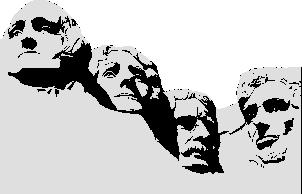
John did not get to see the results of this Samarian excursion --- In John 4/35-38, Jesus and his disciples reaped the benefits of John's sowing in Samaria.
"HE MUST INCREASE, I MUST DECREASE" This statement sounds ludicrous and unheard of in our day. This pathway to greatness is backwards to us ( I MUST INCREASE and HE,SHE, THEY MUST DECREASE). John understood that the pathway to greatness was not over someone else's cold, dead body.
Modern wisdom might say that John failed as a minister: He lost his ministry ( to another Person ), he lost his followers, he lost his freedom, he lost his confidence, he lost his life. We may have lost our former influence, our former identity, our former status, our respectability, our job, our friends (the perception of others --- that we're SOMEBODY). We may feel that we are at the bottom looking up at the rest of the world. When God asks us to be willing give our last shred of honor, respectability, identity, importance, that we think we have.
Here we see John in such a place. And even as low as John is on the social, economic, political, and religious ladder, he is still able to confess: HE MUST INCREASE, I MUST DECREASE.
I call this John's MANIFESTO OF MINISTRY ----
THE MAGNIFICATION OF THE MESSIAH ---- THE MINIMIZATION OF THE MESSENGER
THE SERVANT'S SELF-SACRIFICE FOR THE SAKE OF THE SAVIOR'S STATURE
What gave John the courage to fulfill his role was a proper understanding of his role:
The secret that John found that enabled him to live dangerously is found in verse 29: "The bride belongs only to the bridegroom. The friend who helps the bridegroom waits and listens for him. He is glad when he hears the bridegroom's voice. That is the same pleasure I have. And my time of joy is now here."
The groomsman had the important job of being the intermediary for the couple before the marriage. In Judea there were 2 groomsmen, one for the bridegroom, and one for the bride. It was the duty of the groomsman for the bridegroom to present him to his bride, and to defend the bride's good reputation. It was also the groomsman's job to guard the marriage chamber from pranksters. So when the bride and groom stole away from the festivities, the groomsman was over-joyed when he heard the groom coming for his bride, and he knew that he had done his job well.
John knew that THE BRIDE BELONGS TO THE BACHELOR, NOT TO THE BUTLER!
