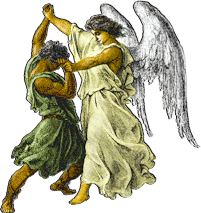
Genesis 32/22-30 “That night Jacob got up and took his two wives, his two maidservants and his eleven sons and crossed the ford of the Jabbok. After he had sent them across the stream, he sent over all his possessions. So Jacob was left alone, and a man wrestled with him till daybreak. When the man saw that he could not overpower him, he touched the socket of Jacob’s hip so that his hip was wrenched as he wrestled with the man. Then the man said, “Let me go, for it is daybreak.” But Jacob replied, “I will not let you go unless you bless me.” The man asked him, “What is your name?” “Jacob,” he answered. Then the man said, “Your name will no longer be Jacob, but Israel, because you have struggled with God and with men and have overcome.” Jacob said, “Please tell me your name.” But he replied, “Why do you ask my name?” Then he blessed him there. So Jacob called the place Peniel, saying, “It is because I saw God face to face, and yet my life was spared.”
**Have you ever wondered what it would be like to go a few rounds in the ring with God?
** Background: Jacob learns in the “school of Laban” departure, pursuit, bargain, journey on, and now facing the approaching wrath of his brother Esau. At the river Jabbok (the place of struggle) Jacob struggles alone in the darkness against an opponent who seems to embody everything that he has ever wrestled against.
More background: understand here the possibility that exists for Jacob to mis-interpret the nature of the struggle. There was a common superstition in that culture that a river had its own demon that came out at night and would depart at sunrise. Hence, the statement made by Jacob’s opponent “Let me go for it is daybreak.” v.26 Perhaps this relates to our time where we might say Jacob was “facing his demons,” with the exception that Jacob passes the test and correctly identifies his “assailant” as God.
***what Jacob feared was his worst nightmare was actually his greatest hope***
the touch on the hip v.25 = subduing, humiliation (a non-lethal blow, hip is a place for discipline, left a permanent reminder)
“What is your name?” v.27 ***the question hurt him worse than the touch***
**Jacob’s name, meaning = clutcher, cheater, deceiver Hosea 12/3-4 “In the womb he grasped his brother’s heel; as a man he struggled with God. He struggled with the angel and overcame him; he wept and begged him for his favor.”
“Jacob.” v.27 (the confession of surrender) ***we cannot accept the grace that God is willing to pour out in our lives until we put a name to that part of ourselves that does not belong to Him***
**play on words in the Hebrew: there are some amazing similarities in two pairs of words in this passage. (these are English transliterations)>
* Jabbok (Yabbok) (Ye’abeq) wrestle, struggle
* Jacob (Yakob) (Yakol) prevail
“to clutch for “to possess power as a prince,
power (not his by right)” with all authority bestowed."
**the conflict is inescapably the pathway from one side to the other
In his novel Toilers of the Sea, Victor Hugo tells the story of a man who struggled against impossible odds. The outcome of his struggle provides a sharp contrast to the struggle of Jacob.
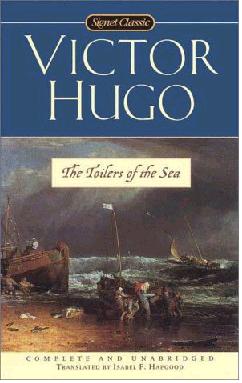
The plot of the story goes like this: There is a shipwreck in the English Channel of a steamboat, named the Durande. The ship is carried by the storm surge between two jagged rocks and left pinned there once the storm subsides. The owner of the Durande seeks someone to go out to the Durande, some 15 miles offshore, and salvage the engine. No one steps forward to do what everyone considers the impossible, except for one man. Gilliatt is the tragic hero of the story. He is an outcast, a reclusive fisherman that some consider to be touched in the head. Gilliatt agrees to go out to the Durande and bring back the engine, hoping that in the process he will win the affection and the hand of the owner’s niece, the lovely Deruchette. In his small boat, Gilliatt takes to sea and ties up at the scene of the wreckage. With only very simple tools, with little food and water or shelter, Gilliatt proceeds to rig up a hoist using block and tackle from the wrecked steamboat. He then carefully cuts the hull and flooring out from under the engine. All of this takes him some 3 weeks of hard labor. He drinks from rain pools in the rocks and eats shellfish plucked from the rocks. He almost loses his life in a frightening underwater encounter with an octopus (called a devilfish by the author). He rides out a terrific storm in his boat between the two protruding rocks and under the hull of the Durande. Finally, he manages to break the engine free of its mounting and lower it into his own boat, almost swamping it in the process. He returns home with the engine, and we think his battles are over. So much time has passed that most people have presumed him to be dead, having perished at sea. While he has been away, the competition has been busy courting the girl he hopes to win. After delivering the engine, Gilliatt goes to find Deruchette, hoping for the best. He comes upon Deruchette and her lover Caudray in a courtyard by night, and learns the awful truth that he is too late. They are engaged to be married. After the wedding,a despondent Gilliatt waits to see their ship off, sitting at the waterside on a cliff as the tide comes in.
(for saving space I have left out the paragraph breaks) read from pages 401-403: The “Cashmere” approached with the slowness of a phantom. Gilliatt watched it still. Suddenly a touch and a sensation of cold caused him to look down. The sea had touched his feet. He lowered his eyes, then raised them again. The “Cashmere” was quite near. The rock in which the rains had hollowed out the Gild-Holm-‘Ur seat was so completely vertical, and there was so much water at its base, that in calm weather vessels were able to pass without danger within a few cables’ lengths. The “Cashmere” was abreast of the rock. It rose straight upward as if it had grown out of the water; or like the lengthening out of a shadow. The rigging showed black against the heavens and in the magnificent expanse of the sea. The long sails, passing for a moment over the sun, became lighted up with a singular glory and transparence. The water murmured indistinctly; but no other noise marked the majestic gliding of that outline. The deck was as visible as if he had stood upon it. The steersman was at the helm; a cabin-boy was climbing the shrouds; a few passengers leaning on the bulwarks were contemplating the beauty of the scene. The captain was smoking; but nothing of all this was seen by Gilliatt. There was a spot on the deck on which the broad sunlight fell. It was on this corner that his eyes were fixed. In this sunlight were Deruchette and Caudray. They were sitting together side by side, like two birds, warming themselves in the noonday sun, upon one of those covered seats with a little awning which well-ordered packet-boats provided for passengers, and upon which was the inscription, when it happened to be an English vessel, “For ladies only.” Deruchette’s head was leaning upon Caudray’ shoulder; his arm was around her waist; they held each other’s hands with their fingers interwoven. A celestial light was discernible in those two faces fromed by innocence. Their chaste embrace was expressive of their earthly union and their purity of soul. The seat was a sort of alcove, almost a nest; it was at the same time a glory round them; the tender aureola of love passing into a cloud. The silence was like the calm of heaven. Caudray’s gaze was fixed in contemplation. Deruchette’s lips moved; and, amid that perfect silence, as the wind carried the vessel near shore, and it glided within a few fathoms of the Gild-Holm-‘Ur seat, Gilliatt heard the tender and musical voice of Deruchette exclaiming: “Look yonder. It seems as if there were a man upon the rock.” The vessel passed. Leaving the promontory of the Bu de la Rue behind, the “Cashmere” glided on upon the waters. In less than a quarter of an hour, her masts and sails formed only a white obelisk, gradually decreasing against the horizon. Gilliatt felt that the water had reached his knees. He contemplated the vessel speeding on her way. The breeze freshened out at sea. He could see the “Cashmere” run out her lower studding-sails and her staysails, to take advantage of the rising wind. She was already clear of the waters of Guernsey. Gilliatt followed the vessel with his eyes. The waves had reached his waist. The tide was rising; time was passing away. The sea-mews and cormorants flew about him restlessly, as if anxious to warn him of his danger. It seemed as if some of his old companions of the Douvres rocks flying there had recognized him. An hour had passed. The wind from the sea was scarcely felt in the roads; but the form of the “Cashmere” was rapidly growing less. The sloop, according to all appearance, was sailing fast. It was already nearly off the Casquets. There was no foam around the Gild-Holm-‘Ur; no wave beat against its granite sides. The water rose peacefully. It was nearly level with Gilliatt’s shoulders. Another hour had passed. The “Cashmere” was beyond the waters of Aurigny. The Ortach rock concealed it for a moment; it passed behind it, and came forth again as from an eclipse. The sloop was veering to the north upon the open sea. It was now only a point glittering in the sun. The birds were hovering about Gilliatt, uttering short cries. Only his head was now visible. The tide was nearly at the full. Evening was approaching. Behind him, in the roads, a few fishing-boats were making for the harbor. Gilliatt’s eyes continued fixed upon the vessel in the horizon. Their expression resembled nothing earthly. A strange lustre shone in their calm and tragic depths. There was in them the peace of vanished hopes, the calm but sorrowful acceptance of an end far different from his dreams. By degrees the dusk of heaven began to darken in them, though gazing still upon the point in space. At the same moment the wide waters round the Gild-Holm-‘Ur and the vast gathering twilight closed upon them. The “Cashmere,” now scarcely perceptible, had become a mere spot in the thin haze. Gradually, the spot, which was but a shape, grew paler. Then it dwindled, and finally disappeared. At the moment when the vessel vanished on the line of the horizon, the head of Gilliatt disappeared. Nothing was visible now but the sea. THE END
Gilliatt gave up….his dreams were shattered……and he surrendered to the sea that he had fought so hard to defeat.
Jacob never gave up….he was so desperate for the blessing that he hung on for dear life…….
We wrestle against circumstances that have gone before in our lives. We wrestle against the things that we are trying to accomplish in the right now. And we wrestle against the things that we are trying to become. This is our Jabbok, our place of struggle. This can be our Peniel, our “face to face” with God.
Principles for us:
1) the conflict is inescapably set before us as the pathway to the other side
2) painful reminders may linger of lessons learned
3) we can never know God’s fullest blessing for us until we confess that part of ourselves that does not fully belong to Him
4) a reminder of the value of holding out for God to come through no matter how bleak things may appear