THE
ROTARY CLUB
of
Lahore
Cantt.
Water
Tank Project

THE
ROTARY WATER TANK PROJECT FOR
THE
PEOPLE OF THE THAR DESERT
Basic
Tank design
Structure
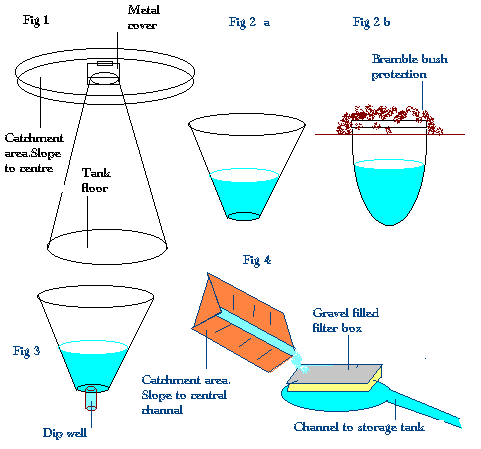
of the tank comprises the following components (Fig 1.):
The catchment area, which is a circular
“pucca” construction forty feet in diameter with a six inch slope towards
the center. Rainfall trapped in this catchment flows into the tank constructed
at the center of the area.
The storage tank: This is a conical
structure with a large circular base and a depth of about eight feet, and a
smaller circular opening at its apex. The side wall is firmed up from the inside
by pucca or semi-pucca masonry. The tank is built fully underground with its top
aligned with the surface of the catchment platform.
Tank cap: This is a fixed metal covering
over the tank’s upper opening. Along the bottom of the cap are a series of
small openings (holes) which allow water from the catchment platform to flow
into the tank for storage. The cap has an upper lid, which is opened for
lowering a suitable utensil or container to extract water from the tank.
Strengths
of the design
The structure is simple enough to construct
and has a cost economy of only about Rs. 3,000 per tank.
The tank is postulated to have a working
life of up to fifteen years.
Two tanks are reported to be sufficient for
one family, given two rainfall showers per year.
Apart from the masonry requirement, the
structure uses a minimum of other resources, limited mainly to fabrication and
installation of the simple metallic cover, which has no moving parts except the
lid.
The tanks installed by Rotary so far, or to
be installed in the present phase, involve estimated construction of 5,000 tanks
at a cost of Rs 1.5 million. This target will hopefully be met as required funds
have been mobilized. Beneficiaries of tanks already installed consider this to
be a heavenly facility. User satisfaction is therefore high, which already
represents high achievement on the part of Rotary donors.
The conical shape of the tank leads to a
smaller upper opening, which is more economical in terms of cost of the lid and
is presumably more convenient in handling.
Weaknesses
The conical shape of the tank would seem to
reduce the stability of the walls, which would have an increased propensity to
cave in and damage the functionality of the storage area. The life of the tank
will thereby be reduced. The weakness of the walls will be directly proportional
to the angle of the walls in relation to the base. The more acute the angle the
weaker will be the civil structure. This weakness will be further enhanced by
weights on the ground surface as may come about by men and or animals (e.g.
cows, buffaloes, camels) moving around the close vicinity of the lid.
The large bottom area created by virtue of
the conical shape of the tank will leave any remaining water at the bottom of
the tank spread out over the larger area in a thinner layer and will thus not be
accessible for drawing out. In a time of greater scarcity this would represent a
disadvantage.
During the prolonged dry seasons, the
catchment area will lie unused and could collect dust, grime, rubbish and refuse
of animals, humans and reptiles. If rains should occur in this state of
un-cleanliness, much harmful material, including soluble components, will enter
the storage tanks along with rainwater. Apart from that, such items as urine of
animals or children etc, resulting from carelessness of a tanks’ guardians,
will automatically flow into the storage tank, either during the dry season or
otherwise, at any time. This could happen unless an efficient cut off stopper
system is in place to obstruct
unwanted in-flows into the tank at times when rainwater is not under collection.
Because of the permanent slope of all
points of the catchment area towards the tank’s intake points, the catchment
area will not open to cleaning because any cleaning fluid used could also flow
into the tank along with the pollutants, again, as said above, unless a stopper
facility is provided. Even then, it will not be easy to throw or drain out the
washings, which will be trapped as a dirty pool towards the center of the
catchment area.
Stored water will be short of aeration,
which will lead to germination of anaerobic bacteria and mosses ( “kai” )
etc. inside the tank.
The lowering of unclean household utensils
into the tank, for water retrieval, may also lead to injection of additional
impurities and contaminations into the stored water
There are chances of social disorder if a
family short of water should sneak into the storage tank of another, at any time
of day or night, and steal stored water from a tank, which remains unguarded and
exposed in the open.
Tank
shape options
The
optimum tank shape would tend to be towards a straight-standing internal wall
orientation, whether circular, square or rectangular. The shape will increase in
stability the more obtuse is the angle of the wall in relation to the base, and
will decrease in stability to the extent of its being acute. We could usefully
consider a redesign of the tank’s interior wall at an angle of between 90 and
110 degrees. (Fig 2.)
For
purposes of enabling collection of even the last available amount of stored
water, a smaller central depression at the base could be built in, with the
entire base sloped towards it. (Fig 3.)
Tanks
could be pre-fabricated in fiberglass, along with cover, and installed very
quickly at destination. Manufacture of the first tank will be more costly, but
once the dies are made, manufacture of the rest should be cheaper.
Tank
placement and catchment area shape
Placement
of the tank at the center of the catchment area would seem to be a cause of some
weaknesses stated above, such as inability to cut off unwanted flows into the
tank and its increased exposure to possible pilferage of stored water, as well
as security of the storage tank. An alternative is to think of the tank and the
catchment area as two entirely independent structures, with no necessity of an
ordained mutual orientation. The cachment area can be of any shape or size
according to configuration of available space. It could be circular,
rectangular, square or triangular. Its total available catchment area is the
important consideration. The entire area would slope towards a point (Fig 4)
from where the water will be carried to a storage tank in the vicinity, even if
the tank is within the courtyard of the user. The channel for carriage could be
an open surface drain (more susceptible to pollution and damage) or an
underground PVC pipe, which could be the option of choice. The inlet (and
outlet) point of the pipe would be fitted with a tap to stop at will any
unwanted flows into the tank, a facility which can be of high practical value
for purposes of retaining the quality of water already stored.
Hillside
catchments
As a
corollary to the above, we can postulate that, in case of habitations alongside
of hills, the catchments may be created on a hillside, in which case storage
tanks will not even need to be placed underground, but would have taps towards
the base for drawing water.
Tank
inlets and water drawal
In using
the design regime as above, inlet points of a tank would be a single hole for
entry of a pipe or as reception point of a drain. A slide-down door will also
seal off the inlet when it is not in use, to prevent entry of insects or vermin.
The same opening may also double for insertion of plastic pump pipes to draw out
water. This latter option will eliminate the practice of lowering of household
utensils or other containers, with ropes or strings into the tank.
Water
quality
Water
standing stagnant over long periods is susceptible to contamination and growth
of bacteria. The following precautions are indicated.
Use
of the plastic pump pipes, pumped in reverse, daily to pump air into the
standing water for aeration.
Addition
of a chlorinating agent for disinfection, whose nature and dosage can be decided
in consultation with PCSIR or water board chemists. The possibility of adding
any other prophylactics, such as iodides, can also be
assessed.
Regular
cleaning of catchment areas will not be possible because of water scarcity.
However a regime can be established whereby users are trained to use the first
few minutes of a downpour for quickly cleaning the surface with hard stick
brooms.
It is also
necessary for civic minded organizations and individuals to chalk out a program
for repeated exhortation or education of users regarding the merits, i.e. the NECESSITY,
for boiling water for about 10 to 15 minutes before drinking it.
The
design proposed here still leaves one important element un-addressed. Before
entering the storage tank, water from the catchment platform preferably needs to
flow through a filtration box, through which water should percolate before
falling into a receptacle of the flow channel for carriage into the permanent
storage tank. The filtration tank could be a simple contraption comprising a
wooden frame with a wire gauze base, filled with fine gravel. This is to filter
out solid impurities including organic and inorganic matter, bird droppings,
bodies of dead insects etc. Fig. 4 shows placement of a filtration box at a
point just where the water leaves the catchment area. In actual practice the box
needs to be located not here but at a place just before the point where water
falls into the storage tank. This is to ensure that trash collected during the
water’s travel through the drain also is filtered out. A panel of persons
competent in this area needs to be constituted to propose
cheap and simple solutions, which could also include putting in a satchel
of bleaching powder into the filter box for chlorinating the water. Important
engineering considerations will also pertain to needed slopes in the arrangement
of each individual tank project, which may be somewhat specific for different
locations, depending on local topography.
An
important existing resource is ground water. This water is reported generally to
be brackish and unpalatable. It can, however, still be used for household
cleaning, washing of clothes, bathing and multiple other purposes, in this case
also for cleaning the catchment areas. Brackish water may collect because of
specific underground geological characteristics, which may or may not be
extensive. Hence wells over wider areas need to be drilled to prospect for sweet
water sources. Furthermore, the available brackish water resource needs to be
analyzed to arrive at chemical means for economically removing the main
impurities that cause offence, so as to soften the water and make it more usable
at least for non-drinking purposes.