History of the Classical Guitar
The first guitars are thought to have originated in Spain in the 15th century. These had four courses or pairs of strings tuned to the same note.

However the lute was consistently favoured over the guitar until the end of the 15th century. During the Baroque period, a fifth set of strings was added and several publications especially for guitarists were produced.
At the end of the Baroque period courses were replaced by single strings and a sixth string was added.
The early guitar was small, narrow and less resonant than today's instrument. Manual Torres changed the design and construction of the guitar through experimentation. He once built a guitar with a wooden top and paper mache back and sides to prove his theory that it was the top that produced most of the volume. He is considered the 'father' of the modern guitar by many.
During the classical period there were many composers and performers of classical guitar. Fernando Sor, Mauro Guilliani, Matteo Carcassi, Fernando Carulli and others wrote music, published methods and performed concerts to great public interest.
At the end of the 19th century the guitar lost popularity but was re-introduced to the world by Andres Segovia and by Francisco Tarrega, who began the tradition adopted by almost all classical guitarists today of picking strings with the fingernails.
By 1946 stronger nylon strings replaced gut strings on most instruments.
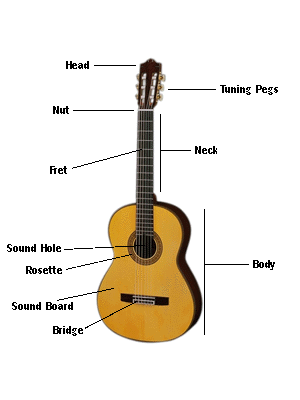
Parts of the Guitar
See some other members of the lute family
Timeline
Back to Index
The first guitars are thought to have originated in Spain in the 15th century. These had four courses or pairs of strings tuned to the same note.
However the lute was consistently favoured over the guitar until the end of the 15th century. During the Baroque period, a fifth set of strings was added and several publications especially for guitarists were produced.
At the end of the Baroque period courses were replaced by single strings and a sixth string was added.
The early guitar was small, narrow and less resonant than today's instrument. Manual Torres changed the design and construction of the guitar through experimentation. He once built a guitar with a wooden top and paper mache back and sides to prove his theory that it was the top that produced most of the volume. He is considered the 'father' of the modern guitar by many.
During the classical period there were many composers and performers of classical guitar. Fernando Sor, Mauro Guilliani, Matteo Carcassi, Fernando Carulli and others wrote music, published methods and performed concerts to great public interest.
At the end of the 19th century the guitar lost popularity but was re-introduced to the world by Andres Segovia and by Francisco Tarrega, who began the tradition adopted by almost all classical guitarists today of picking strings with the fingernails.
By 1946 stronger nylon strings replaced gut strings on most instruments.
Parts of the Guitar
See some other members of the lute family
Timeline
Back to Index