


The Spoon Theorem explained.
The purpose of this website is to explain the exiting new 'Spoon Theorem', so called because it involves spoons and 'theorem' sounds more intelligent than 'theory'. This theory is so new that it has not yet been accepted as mainstream science - it is quite possible that this is the first time you have ever heard of it. The Spoon Theorem is highly complicated, not to mention controversial, but fear not, it will be explained in layman's terms as far as possible.
Consider a spoon, a seemingly inert object, used by most of us every day. On a sub-atomic, biological and chemical level, however, the spoon is far more than a primitive musical instrument. Forget all pre-conceptions you may have about the Dish's fellow eloper.
The Spoon Theorem is an advanced version of Darwin's theory of evolution. While Darwin goes part of the way in describing the origin of life on Earth, he fails to explain where all the non-living entities of our world originate from. Darwin was right about genetic mutation being responsible for small changes, which, over time, resulted in the diversity we see today. However, when the acclaimed researchers Riley and Flindall tackled the issue, they made a major break through. Starting by tracing the evolution of the plain-handled table-fork using transfigurative techniques and a complex process of speculation, they found and proved unequivocally, at the 99% significance level, that the origin of all living and non-living entities, is in-fact the humble Spoon. .
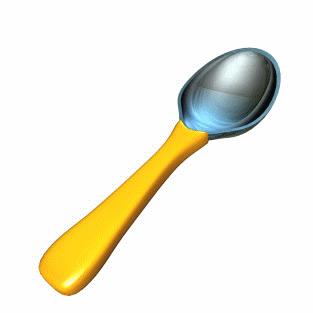
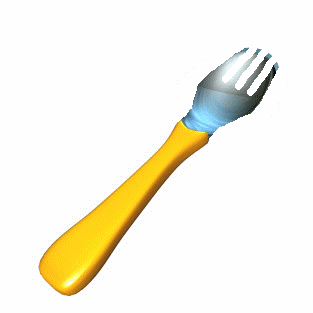
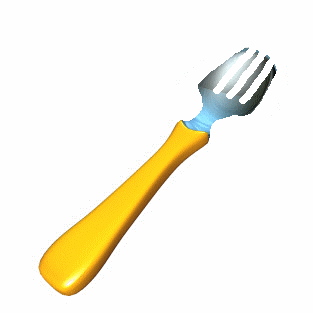
Spoon evolves into fork.
The fork example is very basic, however, even the most complex things evolved from spoons. The sketch below indicates in simple terms how a Homo-Sapian evolved from a spoon.

The science behind the Spoon Theorem is a complicated process known as Bio-Locking-Spectra-Spoonerism (BOLOCKS2). The process started soon after the Big Bang, as a result of a freak interaction between the first Spoon and the Primordial Soup. Although the interaction only took a few minutes, the spoon was then able to slowly evolve. Millennia of evolution and procreation have resulted in a largely diverse universe in which all the objects we know today are present.
That, my friends, is the spoon theorem in its simplest form.
NIMBY
Further Spoon Theory
Further analysis of the spoon theorem by leading scholars, who are willing to embrace the theory, has found a significance of spoons far beyond that first speculated by Riley & Flindall. It was discovered that "if one is to look beyond even the quantum level of matter, that is to say beyond quarks and bosons, then one will find that the smallest possible denomination of matter is the Spoon" (Earner, 2004). Three types of these Very Little Spoons (VeLiS), have, as of yet, been identified - Flat, Round and Telephone. Each of these Velis have a Spoon charge (explained later): 0, 1 and 2 respectively.
The Spoon Field
The Round and Telephone Velis both hold a spoon charge. Because of this, there is a Spoon Field around each Velis. The influence of this field only extends to around 1.5 x 10-97m from the core. The strength of this field depends upon the charge of the Velis and is measured in Ss-1 (spoons per second) or Calis, φ, for reasons that follow.

The Spoon Field
A spoon is the most stable entity in the universe, every other particle is slightly unstable, Close relations of the spoon, such as the fork and frying pan are more stable than the more distant, such as airliners and pet food. These items are perfectly stable in normal circumstances, however, if they are exposed to a spoon field, there is a likely-hood that they will decay, reverting to the most stable Spoon State, meaning that the disintegrate into the Velis they are made up from. To the human eye the object would appear to disappear. The field of one Velis is so small that it cannot cause any decays as no particle other than another Velis is small enough to fit in it. However, in a regular, human sized, basic spoon, the Velis are arranged in such a way as to extend a Spoon Field around it to 5.66x10⁻¹²m. Thus small particles such as electrons can be decayed. To explain the Calis unit; consider an infinite number of electrons at a single point in the spoon field, the Calis is a measurement of how many of these electrons are likely to decay per second, it is a measure of likely-hood since a decay happens by chance. The number of electrons likely to decay in a second increases as the electrons move closer to source of the field. A definition of the Calis can be given as follows:
"One Calis is that amount of Spoon potential which will probably induce one electron to decay per second, in an infinite supply of electrons at a single point in the spoon field."
The formula to calculate the strength of the spoon field upon other particles is still unpublished, however, a team of scientist from the Exeter University, claim to be close to completing it.
Scientists consider it possible to amplify the range of the field in order to decay larger objects - there is a large amount of anxiousness within the Spoon Theorem camp as to the moral implications of such technology, many fear it destructive powers.