 The
Windy City…
The
Windy City…
The
Windy City…
Getting here is a breeze…
You will be glad you came!
Chicago Today:
Chicago is a wealth of multicultural neighborhoods, and the downtown area has it all. The “Loop” as it is called, is home to the Hyatt Regency Chicago, home of the 2006 Summer NABC. It features an array of open-air sculptures and interesting architecture, as well as world-class shopping on Michigan Avenue.
The Art Institute, the Cultural Center which includes the Museum of Broadcast Communications, the Symphony, the Lyric Opera, several theaters, the financial district, the Field Museum of Natural History, the John G. Shedd Aquarium and the Adler Planetarium are just some the of major attractions close to the playing site.
Chicago’s River North neighborhood is home to the famous Chicago Merchandise Mart. Rehabbed loft buildings house art galleries, antique dealers and clothing boutiques. Many of Chicago’s great eating establishments and clubs are found on West Ontario and the nearby side streets.
North Michigan Avenue, which runs from the river to Oak Street, is called the Magnificent Mile. This is home to prestigious shopping and gourmet restaurants. The eight-level Water Tower Place reigns as the largest mall on Michigan Avenue. Anchored by Lord & Taylor and Marshall Fields, Water Tower includes more than 100 stores, and many dining options. Take the glass elevators to the upper floors to visit the frenetic Foodlife, an upscale food court with multiple stations that offer made-to-order items from a wide range of cuisines.
Navy Pier, at Grand Avenue and lakefront, features shops, restaurants, and an IMAX theater, in addition to the famous ‘ever-revolving’ Ferris wheel. Rush Street nightlife, the Terra Museum of American Art and the Museum of Contemporary Art are all close by. This sophisticated neighborhood is well worth a visit.
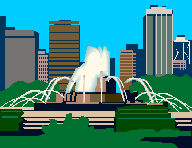
The Printer’s Row neighborhood is a must-see for architecture buffs. (The Chicago Architectural tour is a great choice if you take some time off from playing cards.) It features a wealth of restored buildings, jazz and blues clubs, shops, restaurants and galleries. If you have the chance, tour the landmark Auditorium Theatre, the Spertus Museum of Judaica, or Columbia College’s photography gallery, all located on South Michigan Avenue facing Grant Park. Within Grant Park, the glorious Buckingham Fountain features a color display nightly from May 1 through October 1, weather permitting.
First planned
in 1997 as a way to create new parkland in Grant Park and transform unsightly
railroad tracks and parking lots, Chicago’s newest attraction,
Millennium
Park has
evolved into the most significant millennium project in the world. If you were
here for the 1998 Chicago
NABC,
you were not able to see this because it was not yet started. And the reviews
are in: "Millennium
Park," says one prominent civic leader, "is a worthy creation for all time. It
defines Chicago to the entire world as
America’s
greatest city."
Located in downtown
Chicago
on
Michigan Avenue between Randolph and Monroe Streets, the 24.5-acre park is an
unprecedented center for world-class art, music, architecture and landscape
design, where you can experience everything from interactive public art and ice
skating to al fresco dining and free classical music presentations by the Grant
Park Orchestra and Chorus. Among the park’s prominent features is the dazzling
Jay Pritzker Pavilion, the most sophisticated outdoor concert venue of its kind
in the United States, designed by Frank Gehry, one of the world’s greatest
living architects.
The Lincoln Park area features live entertainment and nightclubs clustered along Clark Street ad Lincoln Avenue. It is also home to the beautiful Lincoln Park Zoo, the Conservatory and the Chicago Academy of Sciences.
For baseball fans, Chicago has two major league teams: the current World Champion Chicago White Sox and the Chicago Cubs. (Lucky for bridge players, the Sox will be in town for three days during the Nationals: July 21, 22, 23, to play the Texas Rangers… One of our planned excursions is a trip to the game on the evening of July 21st. The Sox play at U.S. Cellular Field on the city’s south side. Bus transportation will be included in the tour cost.) Whether you see the Sox at “the Cell” or the Cubs in Wrigley Field, you will have a great time eating hot dogs, drinking beer and cheering on the home team.
Attractions: Here are some suggestions for kibitzer activities while you are in our fair city:
Chicago Board
of Trade, 141 W
Jackson,
M-F free admission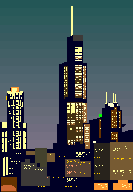
Chicago Cultural Center, 78 E Washington, daily free admission
Chicago Mercantile Exchange, 30 S Wacker, M-F free admission
Daley Center Plaza, Picasso Sculpture, Washington & Dearborn
Lincoln Park Conservatory, 2400 N. Stockton
Lincoln Park Zoo, daily, free admission
Merchandise Mart, Chicago River between Wells and Orleans
Navy Pier
Sears Tower Skydeck, Wacker Dr. at Jackson Blvd, daily 9-11 small fee
Adler Planetarium, 1300 S Lake Shore Dr., daily, admission charge
Art Institute, S. Michigan Ave. at Adams, donations
Chicago Children’s Museum, Navy Pier, 700 E Grand, Tu-Sun, admission charge
Field Museum, 1200 S Lake Shore Dr., daily, admission charge
The all new Millenium Park, Michigan Ave. between Randolph and Monroe
Museum of Broadcast communications, Michigan Ave. at Washington St, free
Museum of Contemporary Art, 220 E Chicago Ave, Tu – Sun admission charge
Museum of Science & Industry, 57th and Lake Shore Dr., daily, admission charge
John G. Shedd Aquarium, 1200 S. Lake Shore Dr., daily, admission charge
U.S. Cellular Field, home of the World Championship Chicago White Sox, 3500 S. Shields
Wrigley Field, home of the Chicago Cubs, 1060 W. Addison
(Call Ticketmaster for tickets to both ball teams’ home games.)
Special Events:
In honor of its 50th anniversary, the Chicago Contract Bridge Association is sponsoring two performances of Chicago’s famous Second City. You will not want to miss this. One performance will be on Saturday, July 15th … if you miss that, there will be a second performance on Friday, July 21st.
Getting Around the City:
The Hyatt Hotel is located on the edge of Chicago’s “Loop”, the central business district. An abundance of shopping, dining and sightseeing is located in walking distance (1 mile or less) of the hotel. In addition Chicago has a great public transportation system. CTA buses and the “L”, Chicago’s subway and elevated train system provide easy, economical transportation within the Loop and to other nearby areas. In addition Chicago’s taxicabs are numerous and reasonably economical for short jaunts. Parking in downtown Chicago is not cheap and we recommend the use of public transportation whenever possible. Generally, you should not use the subway and “L” system in the late evening hours, unless you are familiar with the system and are comfortable with the areas through and to which you will be traveling. Michigan Avenue and Loop area buses are quite safe in the evening hours. Transportation to the suburbs is provided by the RTA. The RTA trains are a safe, easy transportation mode, but service is sparse in the late night hours and you should check the schedules ahead of time.
Walking: Chicago streets are a simple grid with a few diagonal streets. The “Zero” point is at the corner of State and Madison Streets in downtown Chicago. A mile is comprised of eight full blocks (each block equals 100 in addresses). The Hyatt Hotel is located at 151 E. Wacker Drive. Wacker Drive is 3½ blocks north of Madison Street and the Hotel is 1½ blocks east of State Street.
Almost all walks from the Hyatt will begin by heading west to the corner of Michigan and Wacker Drive. There are only a few establishments east of the hotel. The Chicago River is immediately north of the hotel and can be crossed by bridge at Michigan Avenue and on each of the next several streets to the west of Michigan Avenue.
The Magnificent Mile begins on the north side of the river on Michigan Avenue. Many restaurants are located on Michigan Avenue and on the east/west streets that cross Michigan as well as on the streets paralleling Michigan within a block or two to the east or west. The area to the east of Michigan Avenue is known as Streeterville.
Wacker Drive which follows the Chicago River is the northern and western border of the Loop. The Loop extends approximately ¾ mi. to the west of Michigan Avenue and ¾ mi. to the south of Wacker Drive with the southern border being Congress Street.
Beware! Wacker Drive turns a corner approximately 4 blocks (1/2 mi.) west of the hotel and becomes a North-South Street. Remember the Hyatt is located on EAST Wacker Drive. Also note that Wacker Drive and Michigan Avenue have lower levels but these beneath grade streets are not conducive to walking.
Basically all points in the Loop, Streeterville and the Magnificent Mile are less than 1 ½ miles from the Hyatt and are walk-able in good weather.
The L and Subway: If you plan to take in a ballgame during your stay in Chicago, the “Red” line subway which runs beneath State Street, is the most economical and convenient mode of transportation. The nearest stop to the hotel is at State and Lake Streets (an easy 2 block walk). Take the Subway south to 35th Street for Cellular One Field, home of the World Champion White Sox. If you prefer “minor” league baseball, take the Red line north to Addison Street, where you can visit Wrigley Field, home of the Cellar Dwelling Cubs. Either trip takes about 15 minutes. Trains run frequently and extra trains are added at the end of the ballgames. You can also take the Red line to Chinatown. Go South from the Loop and exit at 22nd Street.
The L system is also a convenient mode of transportation to Chicago’s airports if you are traveling with limited baggage. Take the “Blue” line subway from the corner of Clark and Lake Streets to O’Hare airport (allow an hour for this trip). You can take the “Orange” line “L” from the corner of Randolph and Wabash Streets to Midway airport.
One-way fares on Chicago’s L and Subway system are $2.00. You must purchase a Transit-card prior to boarding the train. The Transit-cards can be loaded with any amount of fare dollars and are available from machines at most stations. These same Transit-cards can be used for bus transportation. Bus fares are also $2.00 per ride. The best deal for visitors, who are staying in downtown Chicago, is the CTA’s Visitor-Pass. The visitor-pass provides unlimited travel on the L, Subway and bus system ($18 for 5 days, $12 for 3 days) and can be purchase online at www.transitchicago.com or in person at several Loop locations. The closest location to the Hyatt is the Cultural Center on the corner of Michigan and Randolph Streets. Note: The Chicago Visitor’s Center is located in the Cultural Center and is a very useful source of information for both local and out-of –town guests.
Buses: Take a load off your feet and hop on a bus for short jaunts around the Loop and North Michigan Avenue locale. Many bus routes run past the corner of Michigan and Wacker. Check the bus stop signs for the route numbers that stop at a specific corner. Ask the driver, if you are unsure of your stop. Beware of Express buses which by pass many stops. Fares are $2.00. The same fare-cards are used for buses and subways. The buses also accept dollar bills, but no change is given.
Taxis: Chicago has an abundance of taxis (unless it’s raining!). All taxis are supposed to be metered. Do not use un-metered “Jitney” cabs. The fares are generally considered moderate for a large city. The initial fare is $2.80 plus $0.20 per 1/8 of a mile. Additional passengers are charged $0.50. From the Hyatt to areas in the loop or on North Michigan Avenue, the fare will be about $5.00. Fares to Chinatown, Little Italy and the near-north restaurant areas will be $10-$15. Fares to O’Hare and Midway airport are $30-40. Tip the driver by rounding the fare up to the next dollar.
Commuter Rail Transportation: The Metropolitan Transit Authority (“METRA”) runs an extensive rail system between downtown Chicago and the suburban areas. Trains run very frequently during the morning and evening rush hours. Mid-day service is about once an hour. Late-night service is less frequent. Schedules are available at www.metrarail.com. Trains arrive at one of five Loop stations. All of these stations are within walking distance of the Hyatt and connecting buses are available (Union Station, the Ogilvie Center and the LaSalle Street Station are a mile or so from the Hyatt). The METRA Electric line from the South Suburbs and the South Shore Line from Northern Indiana utilize the Randolph-South Water Station, which is adjacent to Illinois Center, where the Hyatt is located.
Chicago History:
In 1673, Louis Joliet and Father Jacques Marquette discovered the area known as Chicago. In 1862, Frenchman Robert Cavelier, sieur de la Salle, recorded the region’s name as “Checagou” – a Native American word translated as “wild onion” because of the wild onions that covered Illinois.
During the early 1700’s, Native Americans inhabited Illinois and were ruled by France. Illinois became subject to British rule in 1765 and was incorporated as part of the Northwest Territory in 1878. In 1779, entrepreneur Jean Baptiste Point Du Sable became the first non-Native American to settle in the region.
By the time Chicago officially became a city in 1837, its population had grown to more than 4000 people. Industrialization stimulated the city’s expansion. In 1848, the first railroad began operations in Chicago. A shipping canal connected the Chicago and Des Plaines Rivers that same year, giving Chicago direct access to the Mississippi River.
By 1856, hundreds of trains were arriving and departing the city each day, making Chicago the busiest rail center in the world. Chicago became the hub of activity for the wheat, lumber, cattle and hog industries after the Union Stock Yards were built in 1865. Chicago’s reputation drew tens of thousands of immigrants a year and city’s population grew to 300,000 by 1870.
The city’s development ceased abruptly in 1871 when the Great Chicago Fire swept through the area. The origin of the fire, which started in the West Side lumber district, has never been determined. Legend has it that a cow owned by Mrs. Patrick O’Leary started the blaze when it kicked over a kerosene lantern in the barn. The fire killed more than 300 people, destroyed more than 18,000 buildings and caused an estimated $200 million in property damage, obliterating most of the city’s North Side and downtown.
Chicagoans turned the tragedy to triumph by inviting the top architects to rebuild the city. Chicago’s rise from the ashes became a symbol of success when the city hosted the World Columbian Exposition of 1893.
Chicago has evolved from a trading post into a business center that is home to many Fortune 500 companies and serves as a base of operations for associations, banking, commerce, conventions, research and technology, retail and telecommunications. Its architecture and culture contribute to its cosmopolitan character and enrich the lives of visitors and residents alike. For more than 100 years, Chicago has remained an industrial and transportation center that draws millions of immigrants and tourists from around the globe.
Chicago facts and figures:
The 4 stars on the Chicago flag represent Fort Dearborn, the Chicago Fire, the World's Columbian Exposition, and the Century of Progress Exposition.
Among the Field Museum's most prized jewels is the 5,890-carat Chalmerz topaz, which weighed 10,200 carats in the rough.
Chicago has 29 miles of Lake Frontage and 15 miles of public beach.
Lake Michigan: more than 10,300 years old, 307 miles long, 118 across at its widest point, average depth is 279 feet, maximum depth is 923 feet, contains roughly 1,350 trillion gallons of water covers an area of 22,300 square miles
Chicago is home to the world's largest population of Poles outside of Warsaw.
The Chicago Public Library is the world's largest public library with a collection of more than 2 million books.
The world's largest cookie and cracker factory, where Nabisco made 16 billion Oreo cookies in 1995, is located in Chicago.
The central water filtration plant, located on the lakefront north of Navy Pier, is the largest in the world.
Chicago's Oceanarium is the world's largest indoor marine mammal pavilion and doubles the size of the John G. Shedd Aquarium, which is the largest indoor aquarium in the world.
The old Chicago Post Office at 433 West Van Buren is the only postal facility in the world you can drive a car through.
The official flower of the city of Chicago is the chrysanthemum.
The Art Institute of Chicago holds the largest collection of Impressionist paintings outside the Louvre in Paris.
The Chicago River is always dyed green on St. Patrick's Day.
Jesse Owens, Frazier Thomas, "Wheaties," and Muddy Waters all have a Chicago street named in their honor.
Stephen Douglas, who beat Abe Lincoln in debates by defending the rights of slave owners, lies buried beneath a monument to him off 35th Street at South Shore Drive in the heart of Chicago's South Side black community.