Discovery and Settlement
Although it cannot be proved, it is said that Faial, firstly called Ventura, was discovered together with all the others in 1427 by Diogo de Silves, pilot of the King of Portugal. In 1432 Prince Henry then ordered the Flemish nobleman Josse Van Huerter to take charge of the island and to proceed with its settlement, although there was already a small Portuguese community from Terceira in the Cedros. The Flemish firstly settled in Almofariz Beach, but did not find any water supply there, and so moved to the valley which still holds its name in their memory - Flamengos. The Prince renamed the island São Luís and the arriving Flemish and Portuguese settled in Porto Pim (from the Flemish "safe port") and in Conceição, near the Espalamaca headland (from the Flemish "needle tip"). The Orta Village was then formed (the name was probably taken after Huerter), and the island was given the name of Fayal, due to the large number of trees of that species existing there.
With the very profitable pastel plantations (dyeing plant), more Portuguese arrived and after some time the Flemish influence faded away.
 Difficult Times
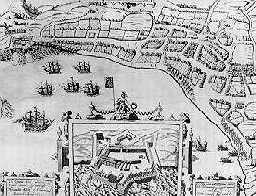
During the sixty years of Spanish occupation of Portugal, the archipelago became an easy prey for pirates and privateers that infested the Atlantic, searching for riches. In 1583 a Spanish fleet captured Faial and so the enemies of Spain became then also enemies of the occupied Portuguese. Among the British and French that attacked Faial were the squadrons of those of the Counts of Cumberland and of Essex that, in 1589 and 1597 respectively, pillaged defenseless populations, taking everything on their way, burning churches and convents and leaving traces of extreme violence, not only in the village but also in the rest of the island. To prevent such incidents from ever happening again, an impressive set of fortified walls was then built across the island, including the forts of Greta, São Sebastião, Stª Cruz, Boa Viagem, Bom Jesus, Alagoa, etc, totaling 21 in the XVIII century. Even though, the Cabeço do Fogo Volcano in 1672 made the island aware of its vulnerability, and although its economy remained stable, it suffered great damages and the loss of 400 people who immigrated to Brazil.
 The Golden Years
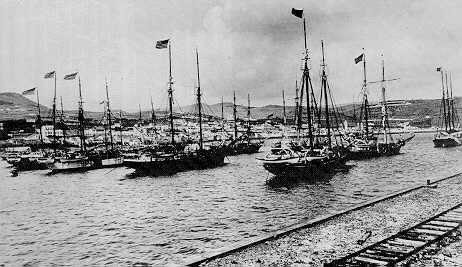
In the XVIII century the village grew with the help of its excellent harbour that, in addition to being a merchandise market also served as a refueling centre of the international shipping routes of the post-industrial era. In 1837 the wine and whale exportation industries reached its maximum and following a new source of employment and profits was born - the American whaling, initiated by its consul who greatly helped Faial’s development, Charles Dabney.
Afterwards started the civil war between Portuguese Liberals and Absolutists, being the first strongly helped by the people of Faial and promoting Horta to the category of town on July 4, 1833. Coal storage companies were installed to supply the new steam-engine ships but, in 1857 a severe cyclone lead a new immigration spree of 1523 people who had been left penniless to Brazil, USA, Britain and France. The number of steam-engine and wind ships did not stop increasing and in one of them arrived Prince Albert of Monaco, who spent some time in Faial promoting several scientific expeditions. At the start of this century submarine cables became essential to telecommunications between America and Europe and it was in Horta, owing to its excellent strategic position, that British and German cable companies decided to install their intermediate stations. The city develops and becomes urbanized, the harbour's dock is built, roads are surfaced and the public electric network is inaugurated.
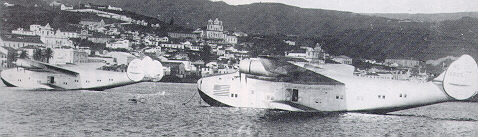 The invention of liquid fuel lead to a decrease in the number of visiting ships but a new chapter in Faial's history began - Sea aviation. The First seaplane to set down in Horta was owned by Captain Albert C. Read, in 1919 and many others followed his trail to the New World. Until the end of the Second World War, it was usual to see numerous Pan American's giant clippers or Lufthansa, Imperial Airways and Air France seaplanes anchored in the harbour.
 After the War
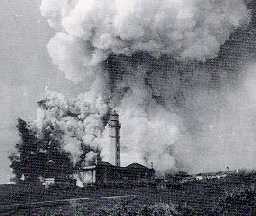
Once more modern technology determined the end of the need to stopover at Horta, but its people did resign easily. The population became poorer and became totally dependent on whale hunting and agriculture. On September 27, 1957 erupted the Capelinhos Volcano and lasted for over a year, destroying the surrounding agricultural fields due to the dense sand and ash covering and provoking serious damages. Then came as help measure from the Massachusetts Senator a permit allowing the immigration of 4500 people to that US state from the parishes of Capelo, Praia do Norte and Cedros. In the seventies the opening of the airport woke the tourism industry and the archipelago's autonomy favoured and stimulated the population. Joining the European Community brought development with it and the average lifestyle has greatly improved since then.