Transport system of Tokyo
Overview
- Related organisation
- JR (Japan Railway company)
Once runned by the national goverment (which called 'JNR' for Japanese National Railway).
After 1987, it separates 7 companies (JR Hokkaido, JR East, JR Tokai, JR West, JR Shikoku, JR Kyushu, JR Kamotsu<freight only>).
JR East runs the train on old JNR track in Tokyo area, so we call simply 'JR' for JR East in this site.
- Eidan (a public utility)
Eidan runs 8 subway lines in Tokyo city.
- Tokyo city
Tokyo city runs 4 subway lines, 1 street car line and Yurikamome train.
- Shitetsu (Private owned railway companies)
There are 8 major shitetsu railway companies around Tokyo.
They are 'Keikyu' (Tokyo-Yokohama express), 'Tokyu' (Tokyo express), 'Odakyu' (Odawara expess), 'Keio' (Tokyo-Hachioji railway), 'Sebu' (West Musashi railway), 'Tobu' (East Musashi railway) and 'Keisei' (Tokyo-Narita railway).
And 'Sotetsu' (Sagami railway) in Yokohama area.
Shitetsu companies also run department store at their terminal, develop regidential houses along their railway track.
- Other lines
There is 'Tokyo monorail line' between Hamamatsucho and Haneda Airport.
'Yokohama city subway' in Yokohama area.
And there also are some local Shitetsu lines.
- Topology
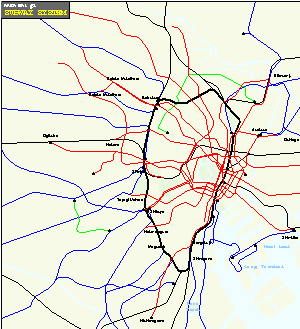 Black is JR line(Thicker black is Yamanote line), red is subway line, blue is shitetsu line, green is street car line.
|
Look the map the left, you may see that shitetsu trains never enter within the Yamanote line loop (with a few exception).
Each shitetsu line has its downtown-end terminal on the Yamanote line loop.
The city council decided that for the sake of avoiding an disorderly development of downtown area.
For the method of transportation within the Yamanote line loop, subway lines were constructed.
Train interchanging system
In Tokyo city, most of subway line serves train interchanging.
In those lines, subway track is physically connected to shitetsu line at one or both end.
The train runs on shitetsu line in suburb.
As they reach the downtown area, the train continues to runs on subway line.
At the boundary of shitetsu and subway, the train crue changes, and the train and its passenger continue their trip.
We must note that when they simply call 'subway', that usually means Eidan or Tokyo city subway lines, though some other lines are built as underground. (i.e. Tokyu Shin-tamagawa line)
|
History of transport method
Once upon a time, Tokyo was a land of streetcar.
The history of Tokyo's streetcar begins with horse car which opened in 1882.
The first electric car was introduced in 1903.
At the time of 1911, streetcar was runned by three companies.
But as the result of competition with each other, they have ran out their finacial ability.
They asked to buy them out to Tokyo city, and the street cars have been ran by Tokyo city from the year.
In 1940's, the streetcars have thier best time, their track length counts over 200 km.
On the other hand, Tokyo underground railway company opened the first subway line between Asakusa and Ueno station (which is the part of the today's Ginza line) in 1927.
At that time, the streetcar still took a leading role in downtown area.
In 1938, the subway had extended to Shimbashi, and Tokyo rapid transit company has opened another subway line from Shimbashi to Shibuya.
In 1941, Tokyu(railway company) had begun buying off the other shitetsu companies one after another, keikyu, odakyu, keio (today, ofcourse they exist as thier own companies, though still invested by Tokyu)
Tokyo underground railway and Tokyo rapid transit were also about to be took in by Tokyu.
To keep from the takeover, Eidan was founded by JR, Tokyo city and major shitetsu companies.
Eidan was expected to run the subway, taking the place of Tokyo underground railway and Tokyo rapid transit, and to build new subway lines.
By the way, the current subway construction plan is made in 1940's.
In the plan, 13 subway lines are proposed and each has # number (note: these numbers are not in order of their opening time).
For example, #1 line is planned as the line which connects Nishi-magome and Komuro,
but its license are shared with Tokyo city and Keisei (Tokyo city: Nishi-magome to Oshiage, Keisei: Oshiage to Takasago, Hokuso: Takasago to Usui)
where train operates as it is one line (see train interchanging system above).
So in this site, subway and shitetsu line will be categorized together as # number.

Street car map in 1910's.
Most of today's subway line were routed under the track of streetcar.
Because the subway lines were build as the replacement of streetcars.
Return to menu